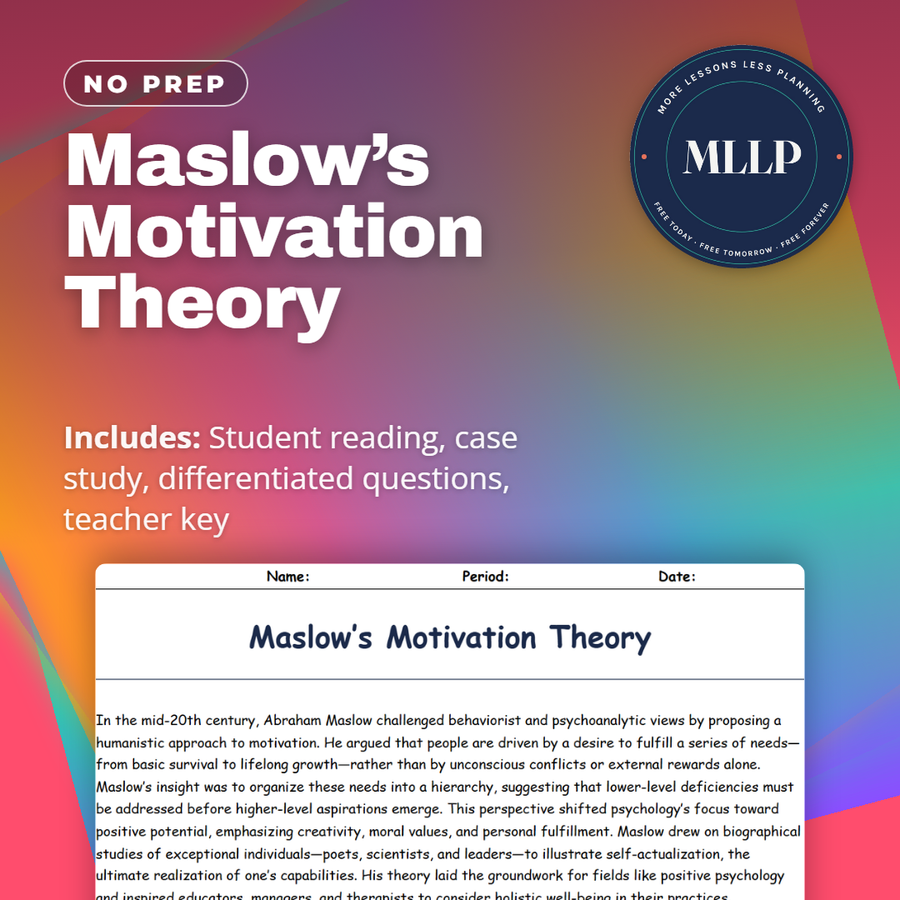
Maslow’s Motivation Theory
Quality reviewed September 2026
Facts verified September 10, 2026
- Subject
- Social Studies
- Grades
- Grades 9-12
- Length
- 6-page student worksheet
- Time
- About one 50-minute class period
- Great for
- Sub plans and independent work
- Includes
- Reading passage, comprehension questions + full answer key
- Format
- Print-and-go PDF
What students do
- Match terms like physiological needs, safety needs, belonging needs, esteem needs, and self-actualization to their definitions
- Fill in the blank sentences about D-motivation, cultural critiques of the hierarchy, and peak experiences
- Answer short answer questions on how unmet safety needs affect learning and how schools can build belonging
- Read a case study about a teenager at a youth shelter moving up the hierarchy of needs and answer questions about her progression
What it covers
- Maslow's five-level hierarchy of needs from physiological through self-actualization
- The shift from deficiency motivation to growth, or being, motivation
- Applications of the hierarchy in classrooms and workplaces, plus critiques of the model
Start reading this worksheet
In the mid-20th century, Abraham Maslow challenged behaviorist and psychoanalytic views by proposing a humanistic approach to motivation. He argued that people are driven by a desire to fulfill a series of needs, from basic survival to lifelong growth, rather than by unconscious conflicts or external rewards alone. Maslow’s insight was to organize these needs into a hierarchy, suggesting that lower-level deficiencies must be addressed before higher-level aspirations emerge. This perspective shifted psychology’s focus toward positive potential, emphasizing creativity, moral values, and personal fulfillment. Maslow drew on biographical studies of exceptional individuals (poets, scientists, and leaders) to illustrate self-actualization, the ultimate realization of one’s capabilities. His theory laid the groundwork for fields like positive psychology and inspired educators, managers, and therapists to consider holistic well-being in their practices.
The Hierarchy of Needs
Maslow arranged human needs into five levels, often depicted as a pyramid. At the base lie physiological requirements (food, water, shelter, and sleep), essential for survival. Once these are secure, individuals seek safety: physical security, health, and stable employment. The third tier, love/belonging, encompasses relationships, family, and community (fundamental for emotional well-being). Above this is esteem, involving self-respect, recognition, and achievement; without it, people may feel inferior or helpless. At the top sits self-actualization, characterized by creativity, authenticity, and the pursuit of personal growth. While Maslow originally saw these stages as sequential, later research indicates more fluid movement; people may pursue multiple needs simultaneously, and cultural factors can alter the ordering or expression of these needs.
Unmet Needs and Human Motivation
When lower-level needs go unsatisfied, motivation narrows to deficit-reduction: hunger drives food-seeking behavior; insecurity prompts risk avoidance. For example, an employee worried about job security may focus solely on meeting performance metrics rather than creative projects. Conversely, individuals free from deficiency worries can pursue growth needs: seeking challenges, learning new skills, and engaging in altruistic activities. Maslow described this shift as moving from “D-motivation” (deficiency motives) to “B-motivation” (being motives). Importantly, thwarted lower-level needs can produce stress, anxiety, and reduced well-being. Understanding this dynamic helps leaders and educators identify and address foundational barriers, such as ensuring safe learning environments, before expecting students or team members to excel in higher-order goals.
Like what you read? The full reading, the case study, and every question set are in the free download below, along with the answer key.
Why this matters
A teenager at a youth shelter in this reading doesn't start by worrying about self-actualization. Safety needs come first, and only once those are met does anything like belonging or esteem become possible. That order is the entire argument behind Maslow's hierarchy.
Students usually memorize the five levels as a checklist without grasping why the order matters. Walking through the shelter case study forces them to see that a student who is hungry or unsafe at home is not simply unmotivated in class, unmet safety needs are actively blocking the belonging and esteem levels a school is trying to reach.
From one teacher to another
I teach this alongside the hierarchy of needs pyramid so students have a full reading to reference, not the diagram alone. The case study follows a teenager at a youth shelter moving from basic needs up to self-actualization, which makes the levels concrete instead of abstract. Students match the five levels to their definitions and then answer short answer questions about how unmet needs show up in a classroom. It works well right before a quiz on motivation theories.
What you get
Download
Where should I send the next one?
Everything here is free and it stays that way. Leave your email and I'll send you the new lessons as they go up. You can unsubscribe from any one of them.
Related resources
Bandura’s Social Learning: Modeling Behavior and Self-Efficacy
Behaviorism Basics: How B.F. Skinner Shaped Learning Theory
Carl Jung’s Archetypes: Exploring the Collective Unconscious
Erikson’s Stages: Identity and Development Across the Lifespan
Milgram’s Obedience Study: Power, Authority, and Ethics
Pavlov and Classical Conditioning: The Salivating Dog Explained
Every lesson on this site is free to download and use. If one of them saved you a prep period, you can chip in a few bucks toward my three kids' daycare fund. That's genuinely where tips go.