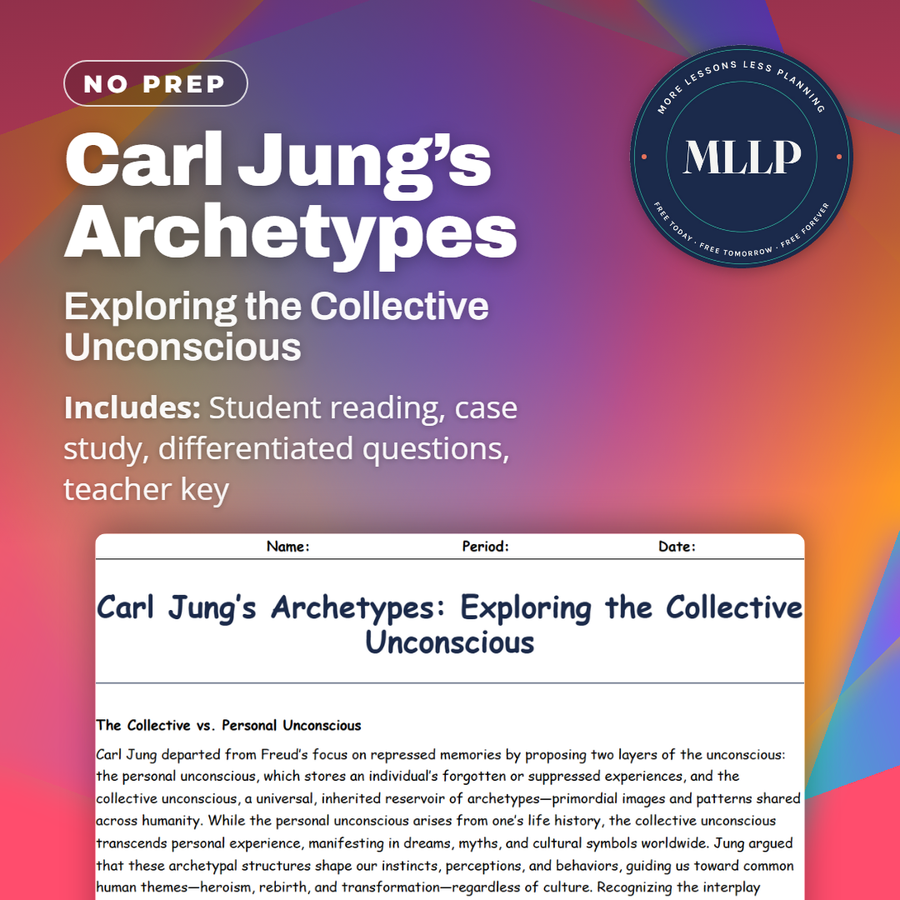
Carl Jung’s Archetypes: Exploring the Collective Unconscious
Quality reviewed September 2026
Facts verified September 10, 2026
- Subject
- Social Studies
- Grades
- Grades 9-12
- Length
- 6-page student worksheet
- Time
- About one 50-minute class period
- Great for
- Sub plans and independent work
- Includes
- Reading passage, comprehension questions + full answer key
- Format
- Print-and-go PDF
What students do
- Match terms like persona, shadow, anima/animus, self, and collective unconscious to their definitions
- Fill in the blank sentences about individuation, the collective unconscious, and active imagination
- Answer short answer questions on the persona and authenticity, and a modern application of Jungian archetypes in counseling
- Read a case study about a student confronting her shadow through active imagination and answer questions about that process
What it covers
- The difference between Jung's personal and collective unconscious
- The four major archetypes of persona, shadow, anima/animus, and self
- Archetypal imagery in dreams, myths, and therapy, including active imagination and the MBTI
Start reading this worksheet
The Collective vs. Personal Unconscious
Carl Jung departed from Freud’s focus on repressed memories by proposing two layers of the unconscious: the personal unconscious, which stores an individual’s forgotten or suppressed experiences, and the collective unconscious, a universal, inherited reservoir of archetypes (primordial images and patterns shared across humanity). While the personal unconscious arises from one’s life history, the collective unconscious transcends personal experience, manifesting in dreams, myths, and cultural symbols worldwide. Jung argued that these archetypal structures shape our instincts, perceptions, and behaviors, guiding us toward common human themes (heroism, rebirth, and transformation) regardless of culture. Recognizing the interplay between personal and collective depths enables therapists to address both individual conflicts and universal human motifs in fostering self‐understanding.
Major Archetypes: Persona, Shadow, Anima/Animus, and Self
Jung identified four central archetypes: the persona, shadow, anima/animus, and self. The persona is the social “mask” we present: the roles (student, friend, professional) we enact to navigate expectations. Overidentification with the persona, however, can lead to inauthenticity. The shadow holds repressed qualities: impulses, weaknesses, and desires deemed unacceptable. Confronting the shadow through “shadow work” fosters integration and wholeness. The anima (in men) and animus (in women) represent the contrasexual inner image, shaping relational dynamics and projections in love and creativity. Finally, the self archetype symbolizes the totality of the psyche, unifying conscious and unconscious into a balanced, individuated whole: a process Jung called individuation.
Archetypal Imagery in Dreams, Myths, and Therapy
Across cultures, dreams and myths teem with archetypal imagery: wise elders, tricksters, great floods, and heroic quests. These symbols arise from the collective unconscious, offering guidance and insight. In dream analysis, Jungian therapists help clients decode such imagery, interpreting a descent into darkness as a necessary confrontation with the shadow, for example. Jung also developed active imagination, encouraging clients to dialog with inner figures through art or writing, and to notice synchronicities (meaningful coincidences) as markers of archetypal influence. His approach laid the groundwork for tools like the Myers–Briggs Type Indicator (MBTI), which, though not a direct measure of archetypes, reflects Jungian ideas of psychological preferences and balances inner opposites (e.g., thinking vs. feeling). Through archetypal work, individuals gain access to deep wells of creativity, meaning, and self‐knowledge.
Like what you read? The full reading, the case study, and every question set are in the free download below, along with the answer key.
Why this matters
A student's version of themselves at school and the private version they hide already map onto Jung's persona and shadow before either word gets used. The reading builds that vocabulary through the collective unconscious and the four major archetypes, then asks students to apply it to a real case.
A girl confronts her shadow through active imagination in the case study, and my students split into two camps: some call that growth, others call it just discomfort. Defending a side in that argument teaches individuation more precisely than the definition alone does.
From one teacher to another
I use this one when we branch into Jung after covering Freud. Students match up the persona, shadow, anima/animus, and self, then work through a case study where a student processes her inner critic through active imagination. The dream and myth section gives us a jumping off point for talking about symbols kids already recognize. The short answer questions push them past memorizing the archetype names.
What you get
Download
Where should I send the next one?
Everything here is free and it stays that way. Leave your email and I'll send you the new lessons as they go up. You can unsubscribe from any one of them.
Related resources
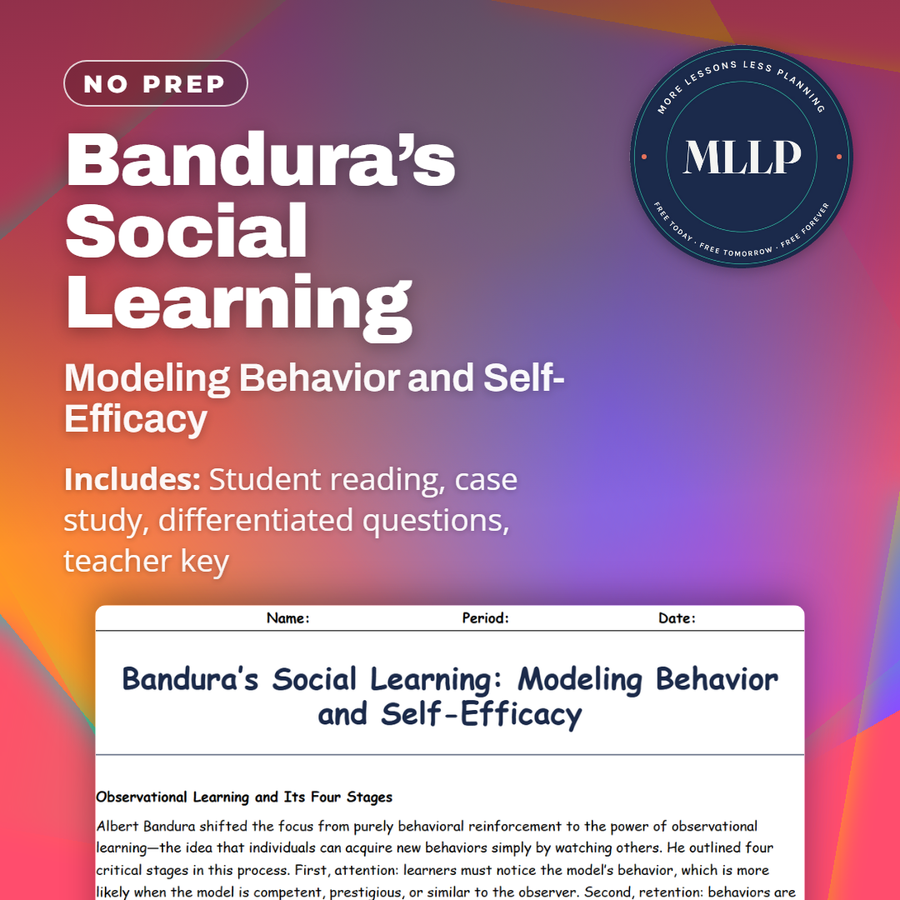
Bandura’s Social Learning: Modeling Behavior and Self-Efficacy
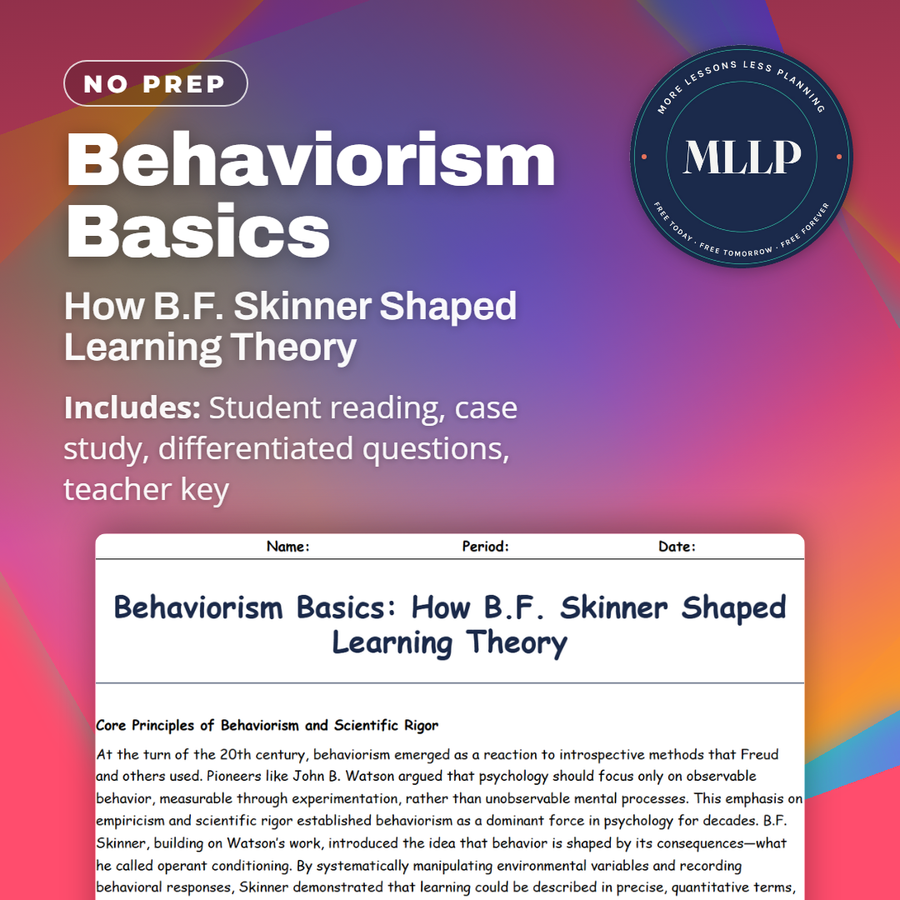
Behaviorism Basics: How B.F. Skinner Shaped Learning Theory
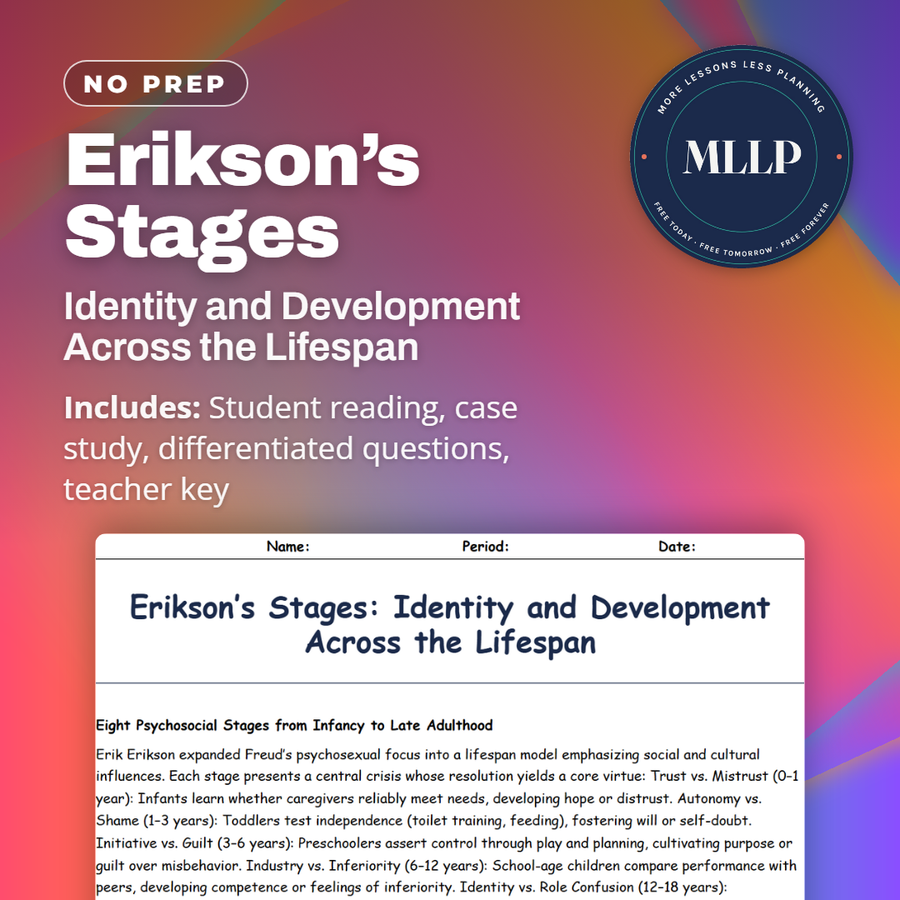
Erikson’s Stages: Identity and Development Across the Lifespan
Maslow’s Motivation Theory

Milgram’s Obedience Study: Power, Authority, and Ethics
Pavlov and Classical Conditioning: The Salivating Dog Explained
Every lesson on this site is free to download and use. If one of them saved you a prep period, you can chip in a few bucks toward my three kids' daycare fund. That's genuinely where tips go.