
Milgram’s Obedience Study: Power, Authority, and Ethics
Quality reviewed September 2026
Facts verified September 10, 2026
- Subject
- Social Studies
- Grades
- Grades 9-12
- Length
- 6-page student worksheet
- Time
- About one 50-minute class period
- Great for
- Sub plans and independent work
- Includes
- Reading passage, comprehension questions + full answer key
- Format
- Print-and-go PDF
What students do
- Match terms like authority proximity, institutional legitimacy, victim proximity, deception, and debrief to their definitions
- Fill in the blank sentences about authority overriding moral judgment, the right to withdraw, and institutional review boards
- Answer short answer questions on how institutional legitimacy affected obedience rates and how researchers now minimize harm from deception
- Read a case study about a classroom obedience demonstration and answer questions about why students complied and what the debrief revealed
What it covers
- Milgram's 1961 obedience experiments at Yale and the finding that 65 percent of participants reached the maximum shock level
- The situational factors that raised or lowered obedience, including authority proximity and victim proximity
- The ethical controversies the study raised and the research guidelines that followed, including informed consent and institutional review boards
Start reading this worksheet
Classic 1960s Experiments on Obedience
In 1961, social psychologist Stanley Milgram conducted landmark studies on obedience to authority at Yale University. Participants believed they were administering electric shocks to a “learner” (an actor) for incorrect answers. With each mistake, the “teacher” (participant) increased shock intensity up to lethal levels, if prompted by an authoritative experimenter. Despite visible distress (sweating, trembling, protests), 65% of participants continued to the maximum shock level when urged on. Milgram’s findings shattered assumptions about moral autonomy, revealing how ordinary people can inflict harm when instructed by an authority figure, a phenomenon with profound implications for understanding historical atrocities and everyday social pressures.
Key Findings on Compliance Under Distress
Milgram identified situational factors that modulate obedience: authority proximity, institutional legitimacy, and victim proximity. When the experimenter issued commands in person, obedience soared; when instructions came over the phone, compliance dropped significantly. Participants were more willing to obey in a prestigious university laboratory than in a nondescript office. Conversely, making the learner visible or physically closer (placing their hand on a shock plate) reduced obedience. These variables underscore that context often outweighs personal values in determining behavior.
Ethical Controversies and Guidelines
Milgram’s use of deception, the extreme stress inflicted, and the initial absence of fully informed consent provoked intense debate. Participants believed they were harming others, enduring significant emotional turmoil, even if debriefed afterward. In response, the American Psychological Association codified strict ethical guidelines: requiring clear informed consent, the right to withdraw at any time, thorough debriefing, and oversight by institutional review boards (IRBs) to ensure participant welfare.
Like what you read? The full reading, the case study, and every question set are in the free download below, along with the answer key.
Why this matters
Sixty-five percent of participants in Milgram's 1961 Yale experiments delivered what they believed was the maximum electric shock, simply because an authority figure told them to continue. The reading covers what changed that number up or down, including how close the authority figure stood and whether the learner was in the room.
Students assume obedience is about weak character, and Milgram's numbers say otherwise. The ethics passage on informed consent and institutional review boards gives them a real reason those safeguards exist now, not just a rule to memorize, and the classroom case study lets them practice explaining why people comply with authority.
From one teacher to another
I use this when we cover social psychology and obedience. Students read what actually happened in Milgram's experiments, including the percentage who went all the way to the maximum shock level, then work through the variables that changed obedience rates, like whether the learner was visible. The ethics passage leads to a real conversation about informed consent and why review boards exist now. The classroom case study gives them a low stakes way to talk about why people comply with authority.
What you get
Download
Where should I send the next one?
Everything here is free and it stays that way. Leave your email and I'll send you the new lessons as they go up. You can unsubscribe from any one of them.
Related resources
Bandura’s Social Learning: Modeling Behavior and Self-Efficacy
Behaviorism Basics: How B.F. Skinner Shaped Learning Theory
Carl Jung’s Archetypes: Exploring the Collective Unconscious

Erikson’s Stages: Identity and Development Across the Lifespan
Maslow’s Motivation Theory
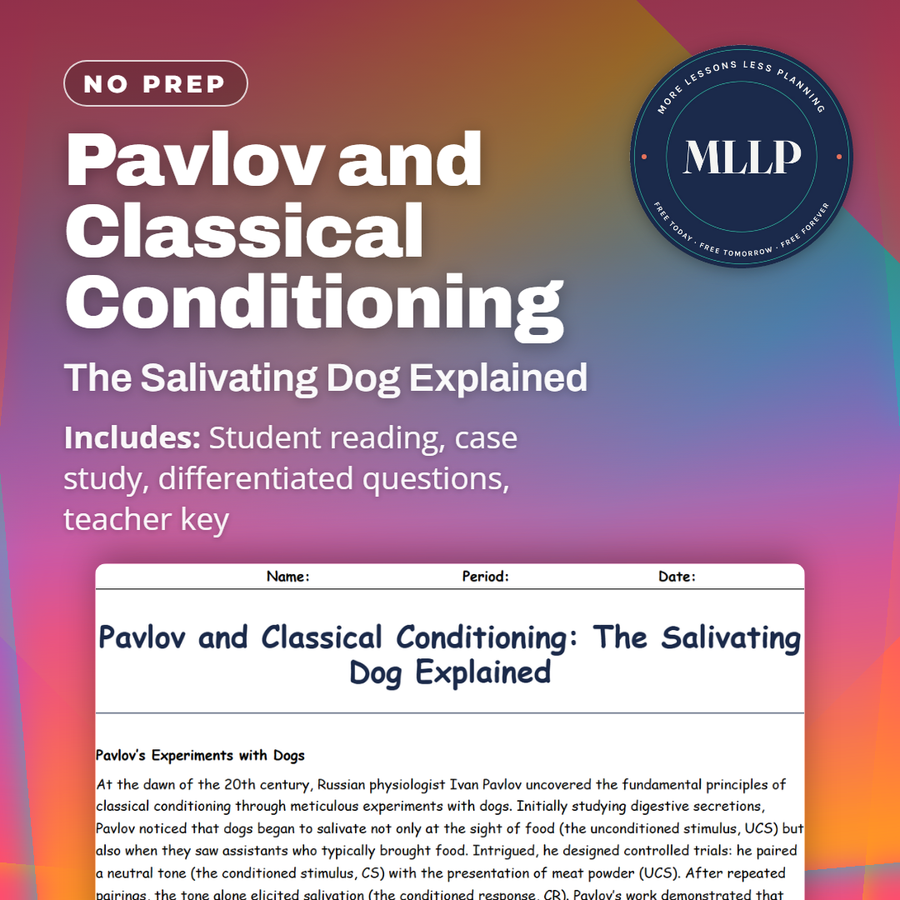
Pavlov and Classical Conditioning: The Salivating Dog Explained
Every lesson on this site is free to download and use. If one of them saved you a prep period, you can chip in a few bucks toward my three kids' daycare fund. That's genuinely where tips go.