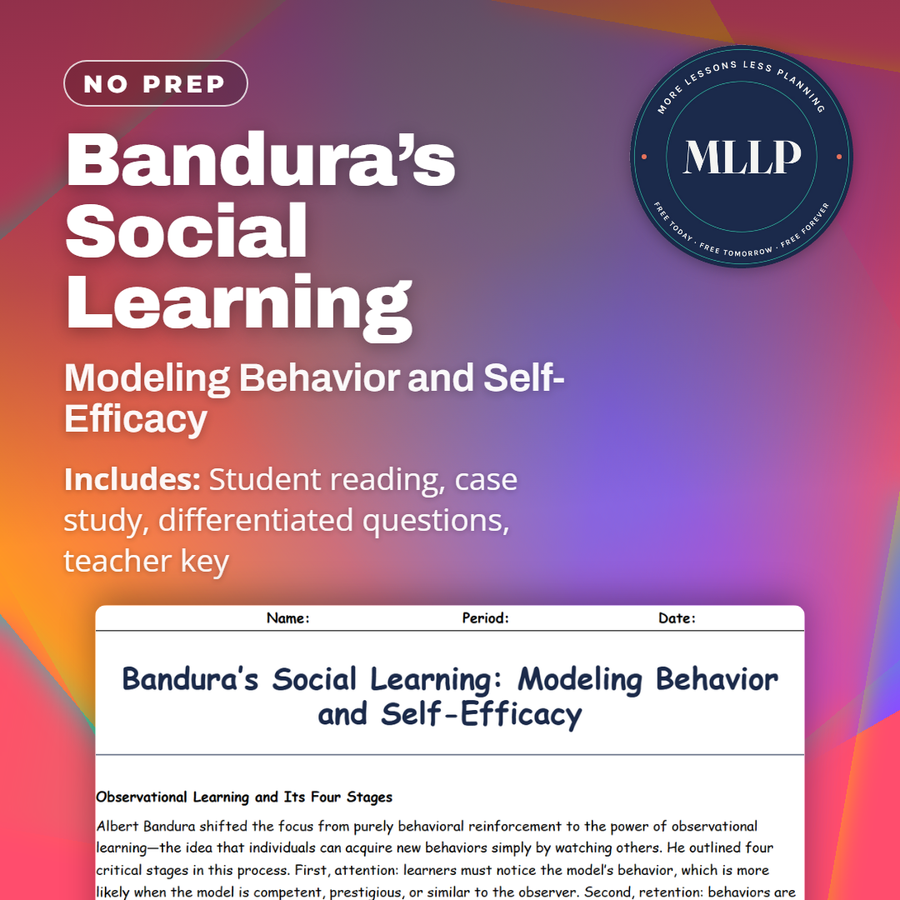
Bandura’s Social Learning: Modeling Behavior and Self-Efficacy
Quality reviewed September 2026
Facts verified September 10, 2026
- Subject
- Social Studies
- Grades
- Grades 9-12
- Length
- 8-page student worksheet
- Time
- About one 50-minute class period
- Great for
- Sub plans and independent work
- Includes
- Reading passage, comprehension questions + full answer key
- Format
- Print-and-go PDF
What students do
- Match key terms like attention, retention, reproduction, and motivation to their definitions in Bandura's four stages of observational learning
- Answer short answer questions explaining how peer tutoring uses all four stages and how self-efficacy affects response to academic challenges
- Fill in the blank sentences about vicarious reinforcement, cognitive modeling, and mastery experiences
- Read a case study on a peer modeling writing workshop and answer questions about self-efficacy sources and student motivation
What it covers
- Observational learning and its four stages of attention, retention, reproduction, and motivation
- The Bobo doll experiments and what they revealed about learned aggression
- Self-efficacy, its four sources, and how media and classroom modeling influence learning
Start reading this worksheet
Observational Learning and Its Four Stages
Albert Bandura shifted the focus from purely behavioral reinforcement to the power of observational learning: the idea that individuals can acquire new behaviors simply by watching others. He outlined four critical stages in this process. First, attention: learners must notice the model’s behavior, which is more likely when the model is competent, prestigious, or similar to the observer. Second, retention: behaviors are encoded into memory through mental imagery or verbal rehearsal. Third, reproduction: the observer must have the physical and cognitive capability to imitate the action accurately. Finally, motivation: having watched and remembered the behavior, the individual must desire to reproduce it, influenced by anticipated outcomes, such as rewards or punishments. In classrooms and peer groups, these stages guide how teachers and mentors demonstrate skills and provide opportunities for practice and encouragement.
The Bobo Doll Experiments
Bandura’s landmark Bobo doll studies in the 1960s demonstrated children’s capacity to learn aggression through modeling. In these experiments, preschoolers observed an adult behaving aggressively toward an inflatable clown doll: hitting it, shouting, and using toys as weapons. When later placed alone with the Bobo doll, children exposed to the aggressive model imitated the exact acts, even inventing novel aggressive behaviors. By contrast, children who observed a non-aggressive adult showed little hostility. These results challenged behaviorism’s emphasis on direct reinforcement, revealing that children could acquire and reproduce behaviors without experiencing tangible rewards or punishments themselves. Bandura’s findings underscored the potent influence of models in shaping social behavior.
Self-Efficacy: Belief in One’s Abilities
A central contribution of Bandura’s theory is the concept of self-efficacy: one’s belief in the capacity to execute actions necessary for desired outcomes. Unlike self-esteem, which reflects overall self-worth, self-efficacy pertains to confidence in specific tasks. Bandura identified four sources of self-efficacy: mastery experiences (success builds confidence), vicarious experiences (observing peers succeed), verbal persuasion (encouragement from others), and physiological states (managing stress and arousal). High self-efficacy fosters persistence, resilience, and willingness to tackle challenges, whereas low self-efficacy can lead to avoidance and quick discouragement. Educators can enhance students’ self-efficacy by setting achievable goals, modeling effective strategies, and providing constructive feedback.
Like what you read? The full reading, the case study, and every question set are in the free download below, along with the answer key.
Why this matters
Kids in Bandura's Bobo doll studies picked up aggression simply by watching a model do it first. Students trace that same process through the four stages of observational learning, attention, retention, reproduction, and motivation, before the reading turns to self-efficacy: the belief that you can actually pull off a task.
Self-efficacy matters most to students who already believe they are bad at a subject before they try it. Vicarious reinforcement, cognitive modeling, and mastery experiences name where that belief comes from, and picturing how peer tutoring builds it in someone else usually helps a student notice where their own confidence runs thin.
From one teacher to another
I use this reading when we cover Bandura in the social learning unit. Students work through the four stages of observational learning, then dig into the Bobo doll studies and what they show about kids picking up aggression just from watching a model. The self-efficacy section pairs well with a quick class discussion about what actually builds student confidence. The matching and fill in the blank sections make good review before a quiz.
What you get
Download
Where should I send the next one?
Everything here is free and it stays that way. Leave your email and I'll send you the new lessons as they go up. You can unsubscribe from any one of them.
Related resources
Behaviorism Basics: How B.F. Skinner Shaped Learning Theory

Carl Jung’s Archetypes: Exploring the Collective Unconscious

Erikson’s Stages: Identity and Development Across the Lifespan
Maslow’s Motivation Theory

Milgram’s Obedience Study: Power, Authority, and Ethics

Pavlov and Classical Conditioning: The Salivating Dog Explained
Every lesson on this site is free to download and use. If one of them saved you a prep period, you can chip in a few bucks toward my three kids' daycare fund. That's genuinely where tips go.