Voltaire, Rousseau, and the Enlightenment
Quality reviewed September 2026
- Grades
- Grades 9-12
- Time
- About two 50-minute class periods
- Includes
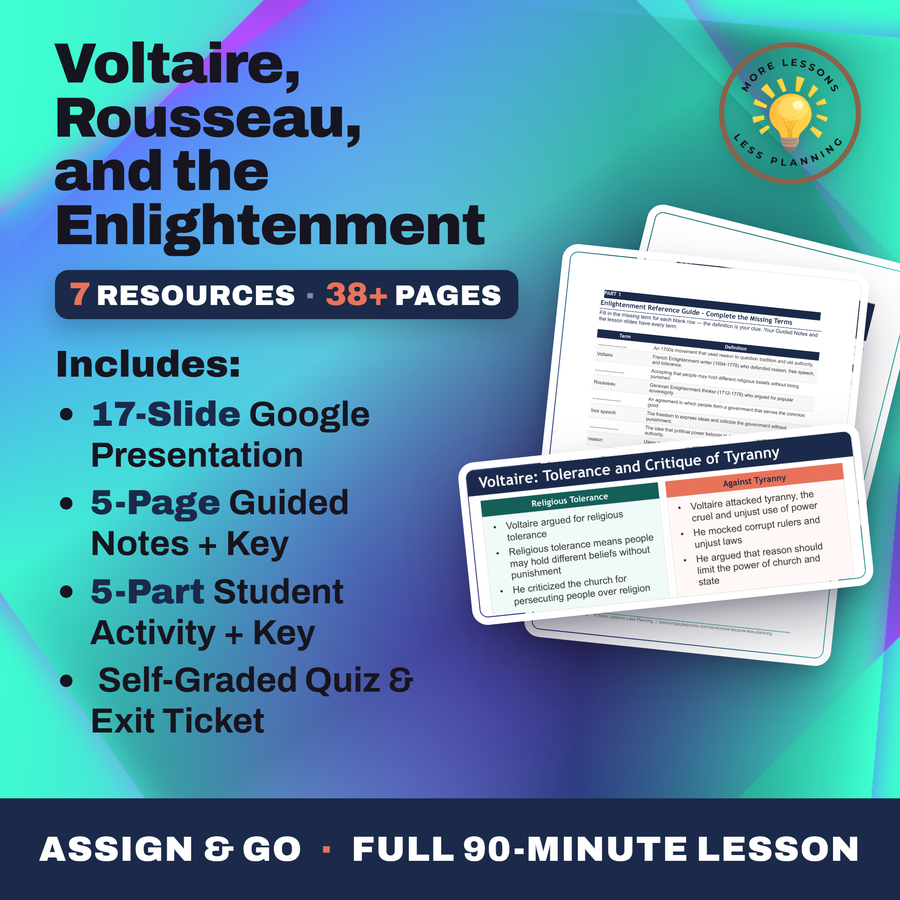
- 11 ready-to-teach files
- Format
- Word (.docx) · PowerPoint (.pptx)
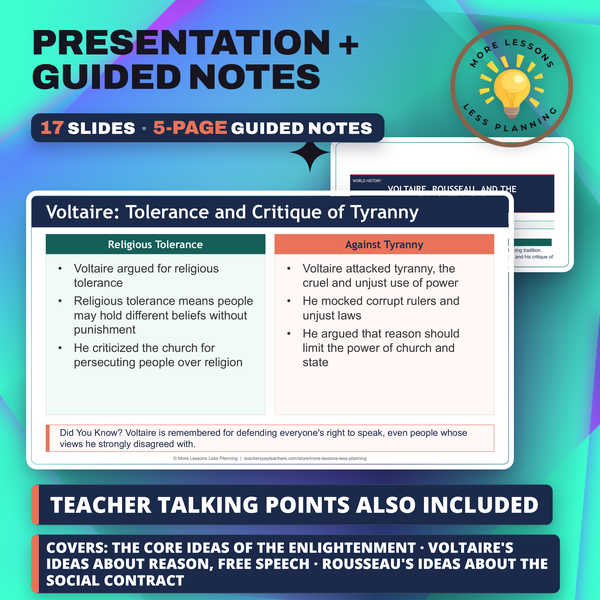
- Slide deck
- Guided notes
- Guided notes teacher key
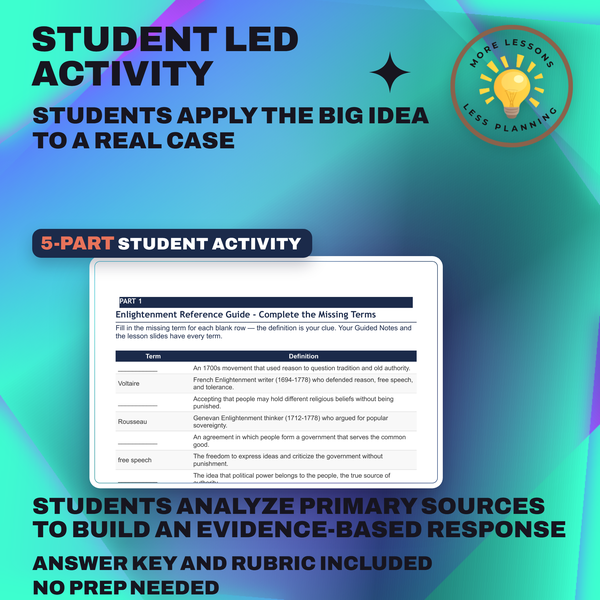
- Activity + answer key
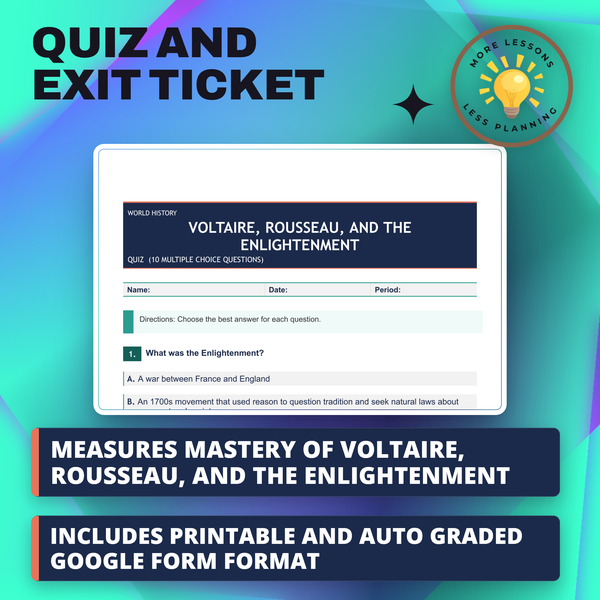
- Quiz + answer key
- Exit ticket + answer key
- Teacher guide
- Teacher presentation notes
What students do
- Define reason, free speech, and religious tolerance as Voltaire championed them against tyranny and the church
- Explain Rousseau's ideas of popular sovereignty, the general will, and the social contract
- Read an excerpt from The Social Contract and identify what Rousseau says force can and cannot create
- Use the reading and their notes to explain how a legitimate government gets its power under Rousseau's argument
What it covers
- Voltaire's defense of reason, free speech, and religious tolerance against tyranny and church authority
- Rousseau's ideas of the social contract, popular sovereignty, and the general will
- A primary source excerpt from the opening of Rousseau's The Social Contract (1762, G. D. H. Cole's 1913 translation) with sourcing, comprehension, and analysis questions
- How these Enlightenment ideas about freedom and government helped inspire the American and French Revolutions
Learning targets
- Explain the core ideas of the Enlightenment: reason, freedom, and questioning tradition.
- Explain Voltaire's ideas about reason, free speech, and religious tolerance, and his critique of tyranny and the church.
- Explain Rousseau's ideas about the social contract, popular sovereignty, and the general will.
- Explain the meaning of Rousseau's line, 'Man is born free, and everywhere he is in chains.'
- Explain how Enlightenment ideas about freedom and the social contract influenced the American and French Revolutions.
Peek inside
An Age of Reason
The was an 1700s movement that used reason to question tradition.
Enlightenment thinkers used instead of tradition or authority.
Enlightenment thinkers searched for natural about government and society.
Enlightenment ideas helped inspire later .
Why this matters
Two Enlightenment thinkers aimed at the same target, a government's real source of authority, and reached it by different roads. Voltaire fought for reason, free speech, and tolerance against church power, while Rousseau argued for popular sovereignty and the general will, and both fed directly into revolutions on two continents.
Studying two thinkers side by side teaches more than studying one alone, which is what makes this reading useful past the unit test. I'd rather students see that Enlightenment ideas were not a single fixed philosophy handed down from above, but an argument worked out between people who agreed on the target and disagreed on nearly everything about how to reach it.
From one teacher to another
This one is built around a single question I want students carrying out of the room: where does a legitimate government actually get its power. The guided notes set up Voltaire's fights for reason, free speech, and religious tolerance next to Rousseau's arguments for popular sovereignty and the general will, so students see two different Enlightenment thinkers aimed at the same target from different angles. The primary source is the real opening of Rousseau's The Social Contract - "Man is born free, and everywhere he is in chains" - and students have to pull his actual argument out of the text: that force alone creates no right, and that only agreement can. The activity closes with a verdict, using Rousseau's own words plus their notes, on where a government's authority really comes from. Guided notes, activity, quiz, and exit ticket all come with answer keys, along with a teacher guide.
Every file in this toolkit
Download
Where should I send the next one?
Everything here is free and it stays that way. Leave your email and I'll send you the new lessons as they go up. You can unsubscribe from any one of them.
Related resources
Causes of the French Revolution
John Locke and Natural Rights
Napoleon's Rise to Power
Simon Bolivar and Latin American Independence
The Bastille and the Rights of Man
The Declaration of Independence
Every lesson on this site is free to download and use. If one of them saved you a prep period, you can chip in a few bucks toward my three kids' daycare fund. That's genuinely where tips go.