Napoleon's Rise to Power
Quality reviewed September 2026
- Grades
- Grades 9-12
- Time
- About two 50-minute class periods
- Includes
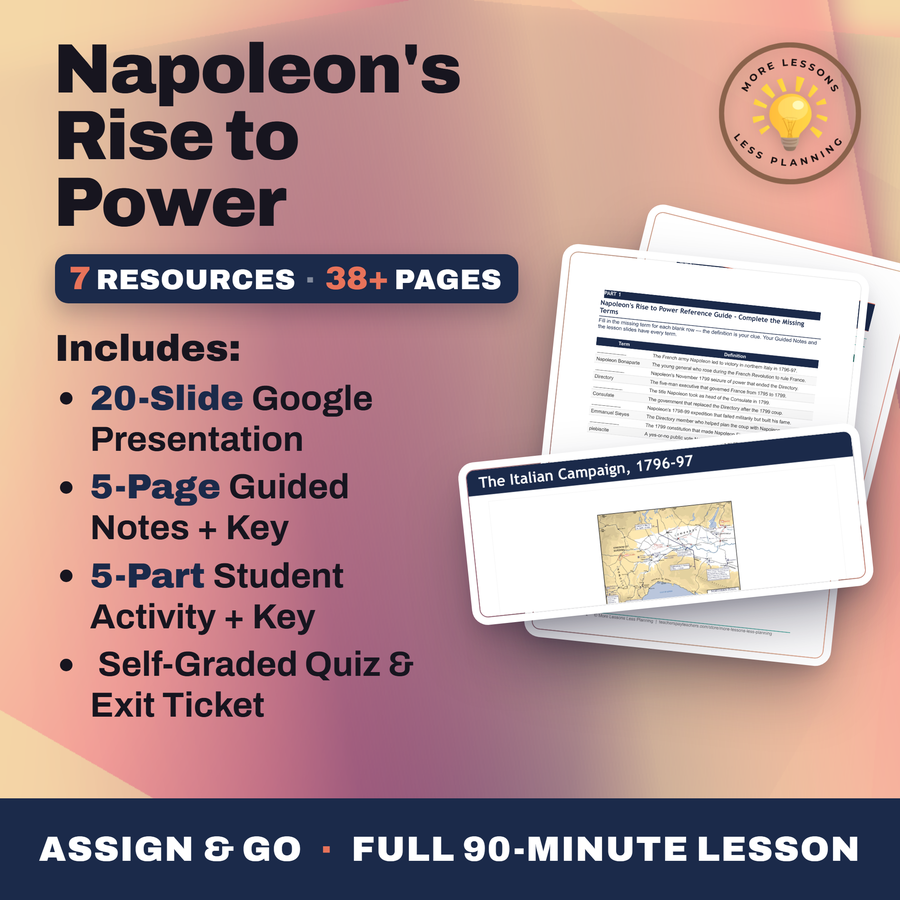
- 11 ready-to-teach files
- Format
- Word (.docx) · PowerPoint (.pptx)
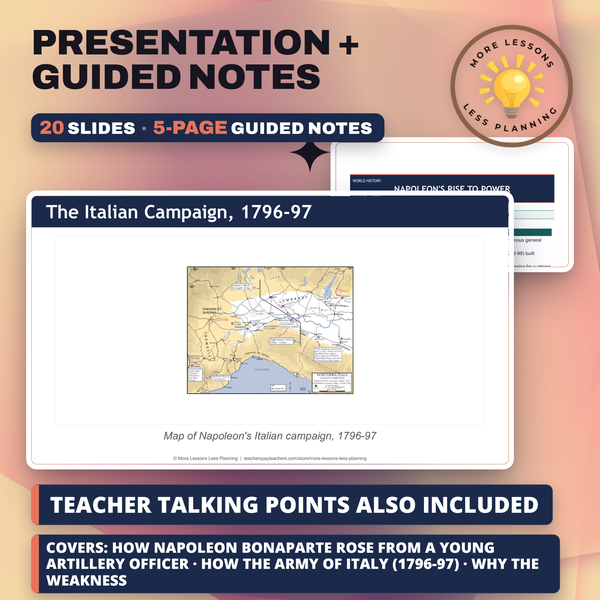
- Slide deck
- Guided notes
- Guided notes teacher key
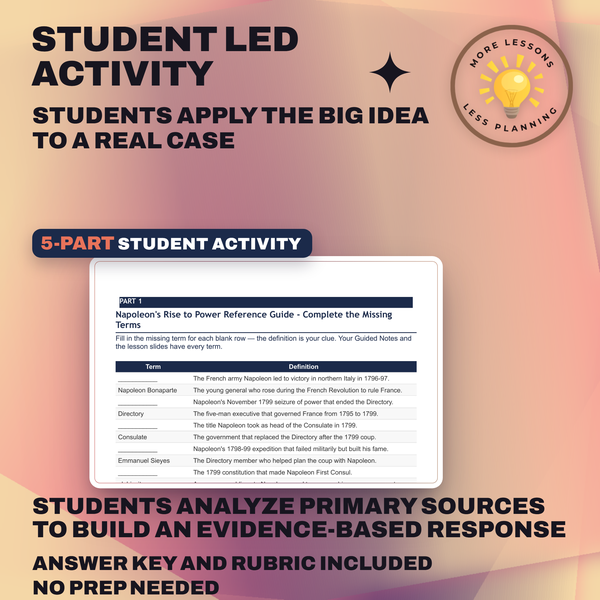
- Activity + answer key
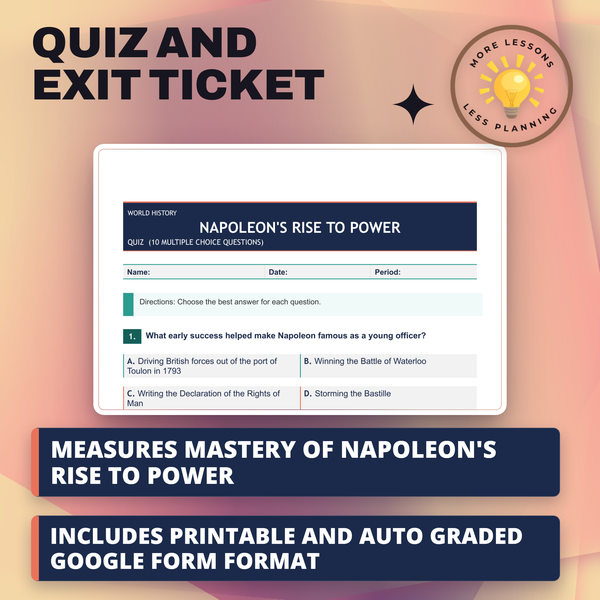
- Quiz + answer key
- Exit ticket + answer key
- Teacher guide
- Teacher presentation notes
What students do
- Trace Napoleon's rise from a young artillery officer to command of the Army of Italy in 1796
- Read an excerpt from Napoleon's 1796 proclamations to the Army of Italy and identify his appeal to his soldiers
- Explain why the weakness of the Directory created an opening for a strong leader
- Analyze the Coup of 18 Brumaire and explain why it made Napoleon First Consul, not yet emperor
What it covers
- Napoleon's early career and his rise to fame commanding the Army of Italy in 1796 to 1797
- Napoleon's 1796 proclamations to the Army of Italy as a primary source for his early appeal
- The Directory's weakness and unpopularity in the years before the coup
- The Coup of 18 Brumaire and Napoleon's rise to First Consul
Learning targets
- Explain how Napoleon Bonaparte rose from a young artillery officer to a famous general during the French Revolution.
- Describe how the Army of Italy (1796-97) and the Egyptian campaign (1798-99) built Napoleon's military reputation.
- Explain why the weakness and unpopularity of the Directory created an opening for a strong leader.
- Analyze the Coup of 18 Brumaire (November 1799) and how Napoleon became First Consul, not yet emperor.
- Evaluate how a revolution that overthrew a king ended with one-man rule under Napoleon.
Peek inside
Napoleon Bonaparte trained as an artillery officer in the French army.
In 1793, he drove British forces out of the port of Toulon and won fame.
In 1795, he crushed a royalist revolt in Paris with cannon fire.
The new Directory government rewarded him with higher command.
By his mid-twenties, Napoleon was one of France's most promising generals.
From Officer to Rising Star
Napoleon Bonaparte trained as an officer in the French army.
In 1793, he drove British forces out of the port of .
In 1795, he crushed a revolt in Paris with cannon fire.
The new government rewarded him with higher command.
1. In 1796, the Directory gave Napoleon command of a ragged, unpaid French force in northern Italy. This army was the .
Why this matters
Napoleon usually shows up already wearing a crown, which skips the young artillery officer commanding an Army of Italy that hadn't been paid in months. His own 1796 proclamation to those soldiers shows how he sold them on glory instead of wages, three years before the Coup of 18 Brumaire made him First Consul, not yet emperor.
Skipping straight to the emperor flattens the more useful lesson, how a weak, unpopular government like the Directory hands power to whoever looks strong enough to fix it. Watching Napoleon build his reputation battle by battle gives students a pattern they can recognize elsewhere instead of a coronation they can only admire or condemn.
From one teacher to another
Students usually meet Napoleon already as emperor, so I built this one to slow down and show the actual climb. It starts with a young artillery officer who wins fame commanding the ragged, unpaid Army of Italy in 1796 and includes an excerpt from his own proclamations to that army, where students can see how he pitched glory to soldiers who hadn't been paid in months. From there the lesson covers the Egyptian campaign, which failed militarily but didn't dent his reputation at home, and explains why the weak, unpopular Directory left an opening for exactly the kind of leader Napoleon had built himself into. It ends at the Coup of 18 Brumaire in November 1799, when Napoleon seized power and became First Consul, not yet emperor, so students see the actual sequence instead of jumping straight to the crown. Guided notes track the slides, the activity comes with a full answer key, and the quiz and exit ticket both include keys.
Every file in this toolkit
Download
Where should I send the next one?
Everything here is free and it stays that way. Leave your email and I'll send you the new lessons as they go up. You can unsubscribe from any one of them.
Related resources
Causes of the French Revolution
John Locke and Natural Rights
Simon Bolivar and Latin American Independence
The Bastille and the Rights of Man
The Declaration of Independence
The Haitian Revolution and Toussaint Louverture
Every lesson on this site is free to download and use. If one of them saved you a prep period, you can chip in a few bucks toward my three kids' daycare fund. That's genuinely where tips go.