The Bastille and the Rights of Man
Quality reviewed September 2026
- Grades
- Grades 9-12
- Time
- About two 50-minute class periods
- Includes
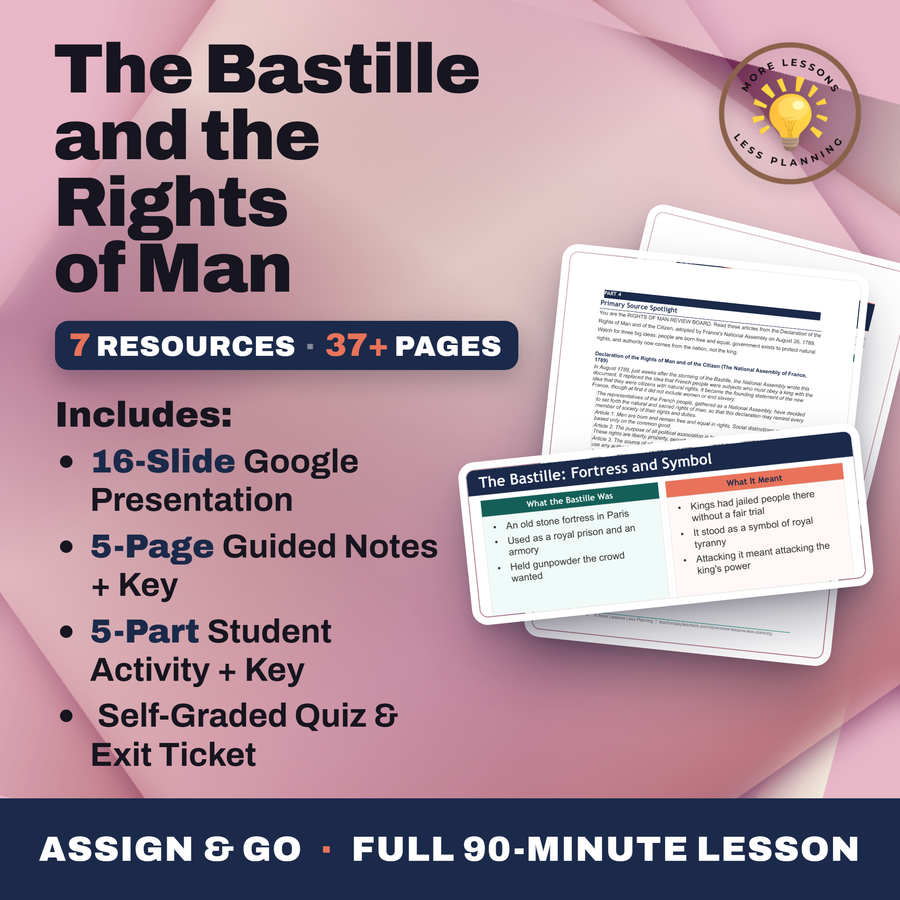
- 11 ready-to-teach files
- Format
- Word (.docx) · PowerPoint (.pptx)
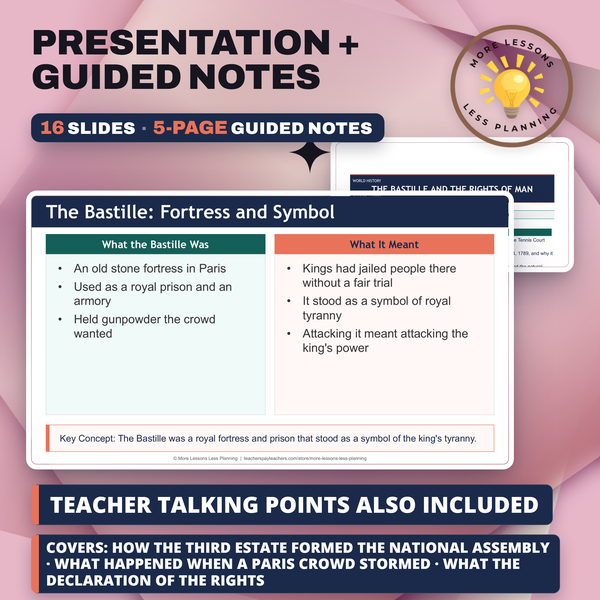
- Slide deck
- Guided notes
- Guided notes teacher key
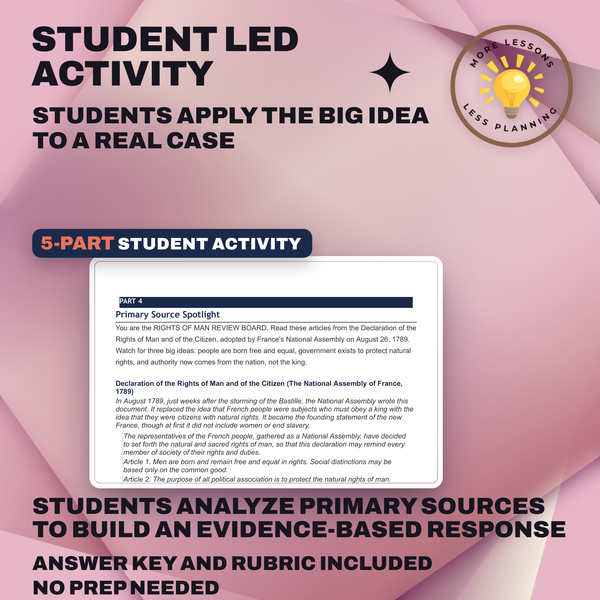
- Activity + answer key
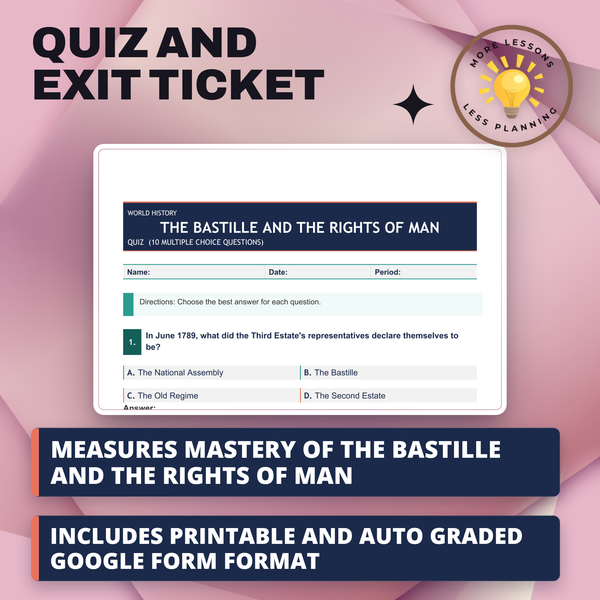
- Quiz + answer key
- Exit ticket + answer key
- Teacher guide
- Teacher presentation notes
What students do
- Trace the sequence from the Tennis Court Oath through the storming of the Bastille to the Declaration in August 1789
- Read articles from the Declaration of the Rights of Man and identify the natural rights it names
- Explain what popular sovereignty means and where the Declaration says all authority now comes from
- Argue how the Declaration turned French subjects into citizens, while noting its 1789 limits
What it covers
- The Tennis Court Oath, the July 14, 1789 storming of the Bastille, and the August 1789 Declaration in sequence
- Core vocabulary: National Assembly, natural rights, citizen, popular sovereignty, liberty, equality
- Real articles from the Declaration of the Rights of Man and of the Citizen, adopted August 26, 1789
- Why the Declaration's ideals did not yet extend to women or end slavery, even as it redefined subjects as citizens
Learning targets
- Describe how the Third Estate formed the National Assembly and swore the Tennis Court Oath in 1789.
- Explain what happened when a Paris crowd stormed the Bastille on July 14, 1789, and why it was the flashpoint of the Revolution.
- Explain what the Declaration of the Rights of Man and of the Citizen was and the natural rights it listed.
- Analyze the Declaration as the document that changed the French people from subjects of a king into citizens with rights.
- Explain how liberty, equality, natural rights, and popular sovereignty replaced privilege and subjecthood in 1789.
Peek inside
The Third Estate Takes Charge
In June , the Third Estate broke away from the Estates-General.
Its representatives declared themselves the Assembly.
They claimed to speak for the whole French .
Forming this assembly was a bold challenge to the 's power.
1. The new legislature formed by the Third Estate in June 1789, claiming to represent the whole French nation, was the .
Why this matters
A French subject in 1789 had no legal claim to liberty or equality until the National Assembly wrote those words into the Declaration of the Rights of Man that August, declaring that sovereignty rested in the nation, not the king. That same document still said nothing about women and did nothing to end slavery.
Enlightenment ideas feel abstract until students see them written into an actual law with a date attached, which is why this lesson follows the sequence from the Tennis Court Oath through the Bastille to the Declaration rather than summarizing it. Holding its achievement and its limits at once is harder than picking a side, and that's the point.
From one teacher to another
I built this one around the actual text the National Assembly adopted, not a paraphrase of "the French got rights." Students read real articles from the Declaration of the Rights of Man and of the Citizen - the ones stating that men are born free and equal, that government exists to protect natural rights, that all sovereignty rests in the nation rather than the king - and work through the sequence that got France there: the Third Estate forming the National Assembly, the Tennis Court Oath, then the storming of the Bastille itself on July 14, 1789. The lesson also asks students to hold two things at once: this document really did turn subjects into citizens with rights they hadn't had before, and it still left out women and did nothing to end slavery. That honesty is built into the questions, not left for a teacher to add afterward. It pairs naturally with any Enlightenment lesson since it shows those ideas actually being written into law.
Every file in this toolkit
Download
Where should I send the next one?
Everything here is free and it stays that way. Leave your email and I'll send you the new lessons as they go up. You can unsubscribe from any one of them.
Related resources
Causes of the French Revolution
John Locke and Natural Rights
Napoleon's Rise to Power
Simon Bolivar and Latin American Independence
The Declaration of Independence
The Haitian Revolution and Toussaint Louverture
Every lesson on this site is free to download and use. If one of them saved you a prep period, you can chip in a few bucks toward my three kids' daycare fund. That's genuinely where tips go.