Simon Bolivar and Latin American Independence
Quality reviewed September 2026
- Grades
- Grades 9-12
- Time
- About two 50-minute class periods
- Includes
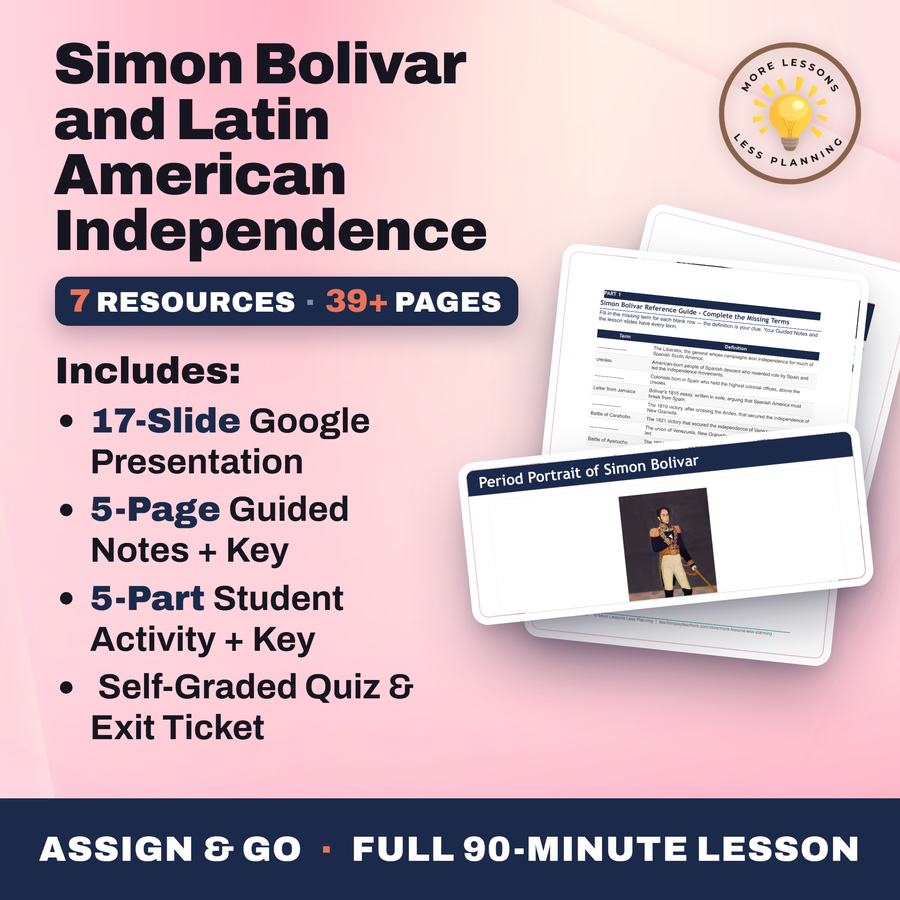
- 11 ready-to-teach files
- Format
- Word (.docx) · PowerPoint (.pptx)
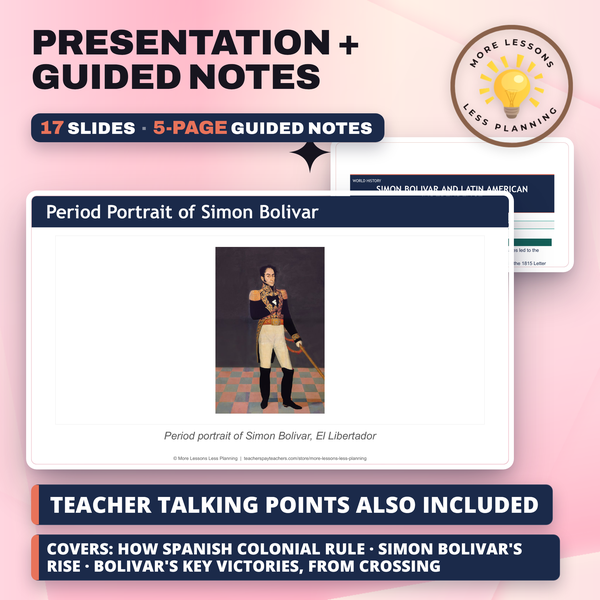
- Slide deck
- Guided notes
- Guided notes teacher key
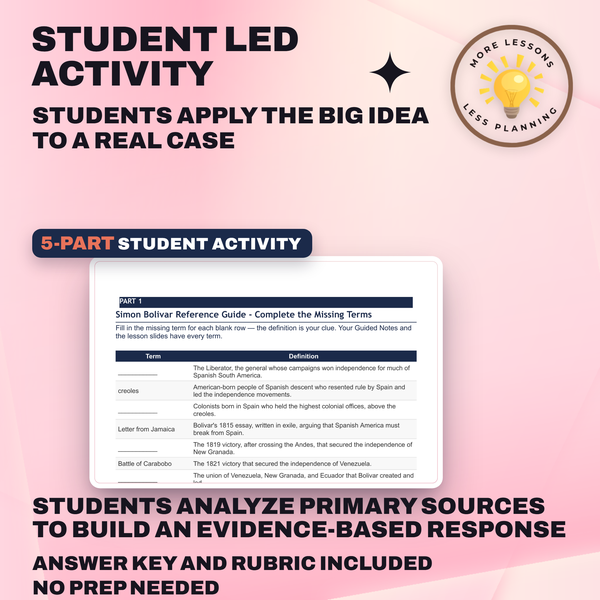
- Activity + answer key
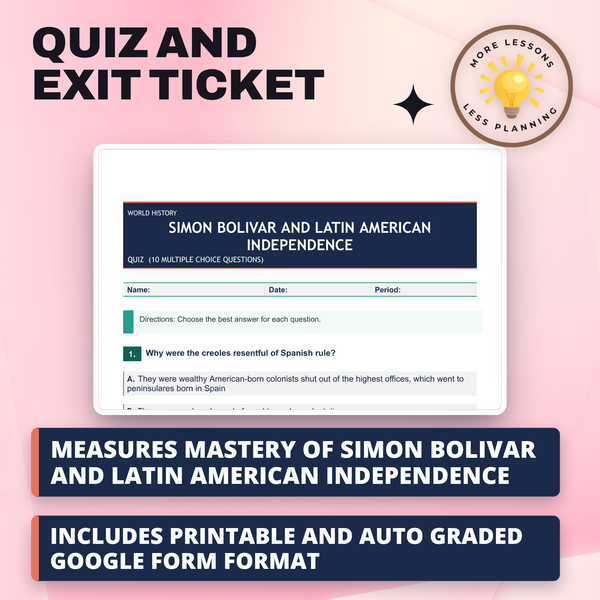
- Quiz + answer key
- Exit ticket + answer key
- Teacher guide
- Teacher presentation notes
What students do
- Read an excerpt from Bolivar's 1815 Letter from Jamaica and explain his vision for an independent Spanish America
- Trace Bolivar's key victories, from Boyaca in 1819 through Carabobo in 1821 to Ayacucho in 1824
- Explain how Spanish colonial rule and creole resentment of the peninsulares fueled the independence movements
- Evaluate why Bolivar's dream of a united Gran Colombia fractured even after independence was won
What it covers
- Spanish colonial rule and the creole grievances behind the independence movements of 1808 to 1826
- Bolivar's rise as the Liberator and the case he made in the 1815 Letter from Jamaica
- The military campaign from crossing the Andes and Boyaca through Carabobo to Ayacucho
- Gran Colombia's creation and why Bolivar's dream of a united Spanish America fell apart
Learning targets
- Explain how Spanish colonial rule and creole resentment of the peninsulares led to the independence movements of 1808-1826.
- Describe Simon Bolivar's rise as The Liberator and the vision he set out in the 1815 Letter from Jamaica.
- Explain Bolivar's key victories, from crossing the Andes and Boyaca (1819) through Carabobo (1821) to Ayacucho (1824), that freed South America from Spanish rule.
- Explain what Gran Colombia was and why Bolivar's dream of a united Spanish America ultimately fractured.
- Connect Bolivar's independence movements to the Enlightenment ideals of liberty and natural rights invoked by the American, French, and Haitian Revolutions.
Peek inside
For about 300 years Spain ruled a vast empire across South America.
Spain controlled colonial trade and reserved the highest offices for itself.
Peninsulares, colonists born in Spain, held the top government and church posts.
Creoles were American-born people of Spanish descent, shut out of power.
Creole resentment of Spanish control drove the independence movements.
Two Classes in the Colonies
For about years Spain ruled a vast empire across South America.
, colonists born in Spain, held the top government and church posts.
were American-born people of Spanish descent, wealthy but shut out of power.
Spain controlled colonial and reserved the highest offices for itself.
Creole of Spanish control became the engine of the independence movements.
1. The Liberator, whose campaigns won independence for much of Spanish South America, was .
Why this matters
A revolution can win every battle and still lose the peace, and Gran Colombia is the proof. Bolivar crossed the Andes and won at Boyaca, Carabobo, and Ayacucho, only to watch the united Spanish America he had argued for in his 1815 Letter from Jamaica fracture within a few years of independence.
Creole resentment and regional rivalry outlasted the fight against Spain, and forcing students to sit with that instead of a victory lap keeps the lesson honest about what independence actually delivered. It says something true about revolutions that a highlight reel of battles alone never would.
From one teacher to another
Most world history courses rush past Latin American independence to get back to Europe, so I built this one to give Bolivar the same source-based treatment I'd give any other revolution. Students read an excerpt from his 1815 Letter from Jamaica, written while he was in exile and the revolution looked lost, and use it to explain what kind of independent Spanish America he was arguing for. From there they trace the actual campaign: crossing the Andes, the victory at Boyaca in 1819, Carabobo in 1821, and Ayacucho in 1824, the battle that finally ended Spanish rule in South America. The last stretch is the part students never expect, that Bolivar's own dream of a united Gran Colombia fell apart within a few years of winning. Guided notes match the slides, the activity has a complete answer key, and the quiz and exit ticket both come with keys of their own.
Every file in this toolkit
Download
Where should I send the next one?
Everything here is free and it stays that way. Leave your email and I'll send you the new lessons as they go up. You can unsubscribe from any one of them.
Related resources
Causes of the French Revolution
John Locke and Natural Rights
Napoleon's Rise to Power
The Bastille and the Rights of Man
The Declaration of Independence
The Haitian Revolution and Toussaint Louverture
Every lesson on this site is free to download and use. If one of them saved you a prep period, you can chip in a few bucks toward my three kids' daycare fund. That's genuinely where tips go.