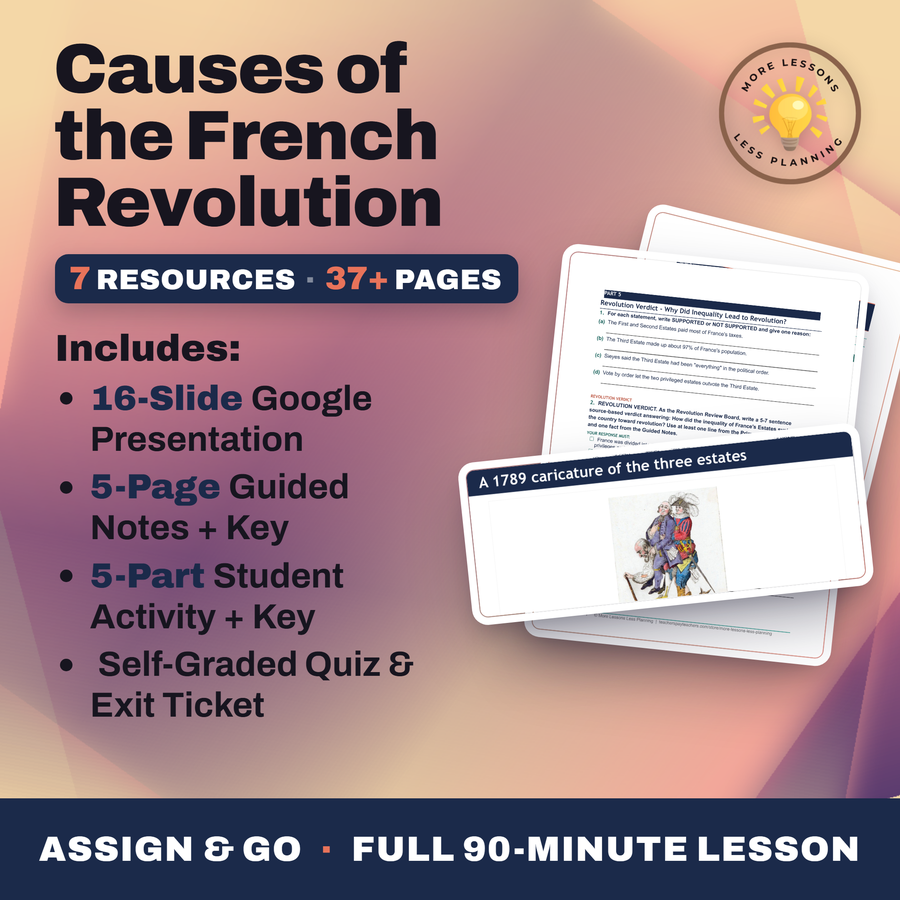

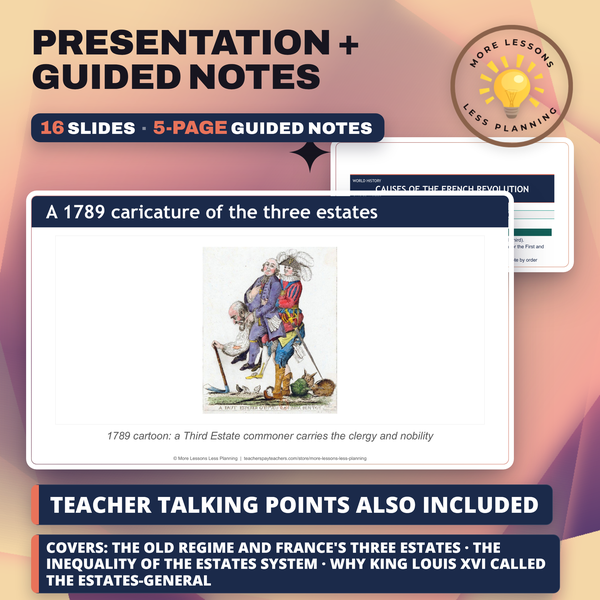
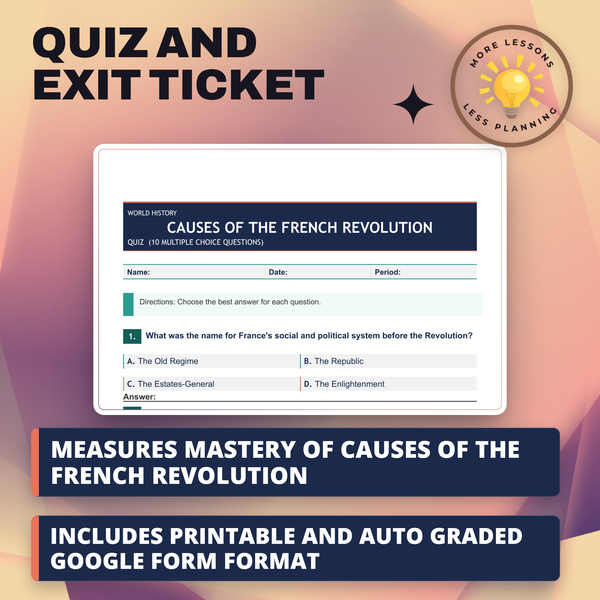
Causes of the French Revolution
Quality reviewed September 2026
- Grades
- Grades 9-12
- Time
- About two 50-minute class periods
- Includes
- 11 ready-to-teach files
- Format
- Word (.docx) · PowerPoint (.pptx)
- Slide deck
- Guided notes
- Guided notes teacher key
- Activity + answer key
- Quiz + answer key
- Exit ticket + answer key
- Teacher guide
- Teacher presentation notes
What students do
- Describe France's Old Regime and its three estates
- Explain why the tax burden fell on the Third Estate while the First and Second Estates stayed exempt
- Analyze Sieyes's 1789 pamphlet What Is the Third Estate as one side's persuasive case for equality and representation
- Explain why vote by order in the Estates-General angered the Third Estate
What it covers
- The inequality of France's Estates system, where privilege and tax exemption sat with the First and Second Estates
- Sieyes's argument that the Third Estate does nearly all the nation's work while treated as nothing
- Key vocabulary including Estates-General, Third Estate, Old Regime, privilege, and vote by order
Learning targets
- Describe the Old Regime and France's three estates (First, Second, and Third).
- Explain the inequality of the Estates system: privilege and tax exemption for the First and Second Estates versus the tax burden on the Third Estate.
- Explain why King Louis XVI called the Estates-General in 1789 and why vote by order angered the Third Estate.
- Analyze Sieyes's argument in What Is the Third Estate? as one side's persuasive case for equality and representation.
- Explain how financial crisis, inequality, and Enlightenment ideas combined to push France toward revolution.
Peek inside
1. The assembly of representatives from France's three estates, called by the king in 1789 for the first time since 1614, was the .
Why this matters
Two of France's three estates paid almost no tax under the Old Regime, yet in the Estates-General each estate cast one equal vote, so the First and Second could out-vote the Third on any change to that arrangement. Sieyes put the imbalance plainly: the Third Estate did the nation's work and still lost every vote that mattered.
Revolutions look inevitable once you already know the ending, so I start students at the vote itself, before any crowd reaches a prison. Reading Sieyes's actual case for equal representation keeps the argument about fairness rather than mob violence, and shows why reform through the system failed before anyone reached for force.
From one teacher to another
Why did a country where the Third Estate paid nearly all the taxes still lose every vote to the other two orders? I anchor the answer in Sieyes's actual 1789 pamphlet excerpt, since that's the case one side made for equal representation, live and unfiltered, not summarized after the fact. The lesson stops the moment the Estates-General actually votes, because that's when inequality on paper turns into a political crisis.
Every file in this toolkit
Download
Where should I send the next one?
Everything here is free and it stays that way. Leave your email and I'll send you the new lessons as they go up. You can unsubscribe from any one of them.
Related resources
John Locke and Natural Rights
Napoleon's Rise to Power
Simon Bolivar and Latin American Independence
The Bastille and the Rights of Man

The Declaration of Independence
The Haitian Revolution and Toussaint Louverture
Every lesson on this site is free to download and use. If one of them saved you a prep period, you can chip in a few bucks toward my three kids' daycare fund. That's genuinely where tips go.