John Locke and Natural Rights
Quality reviewed September 2026
- Grades
- Grades 9-12
- Time
- About two 50-minute class periods
- Includes
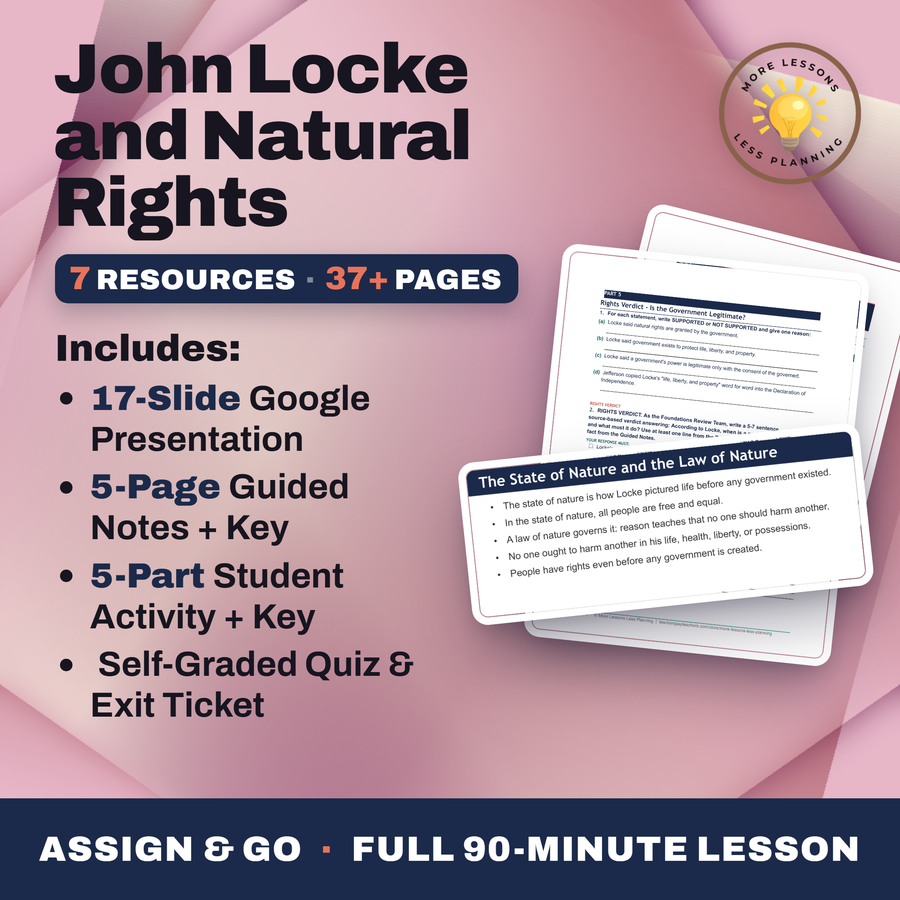
- 11 ready-to-teach files
- Format
- Word (.docx) · PowerPoint (.pptx)
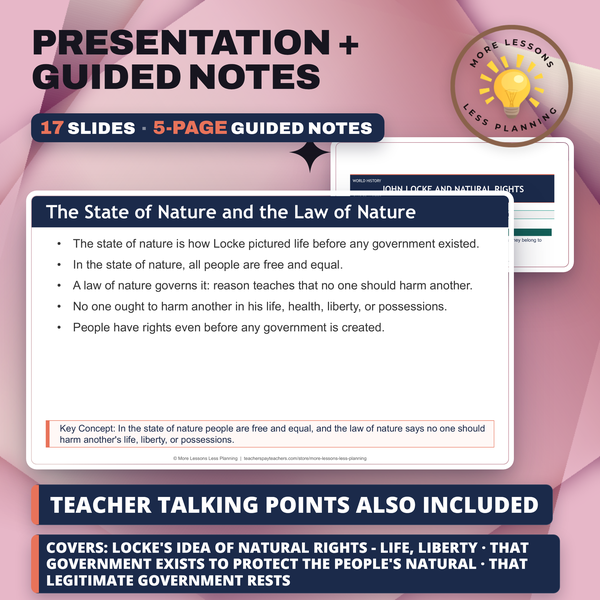
- Slide deck
- Guided notes
- Guided notes teacher key
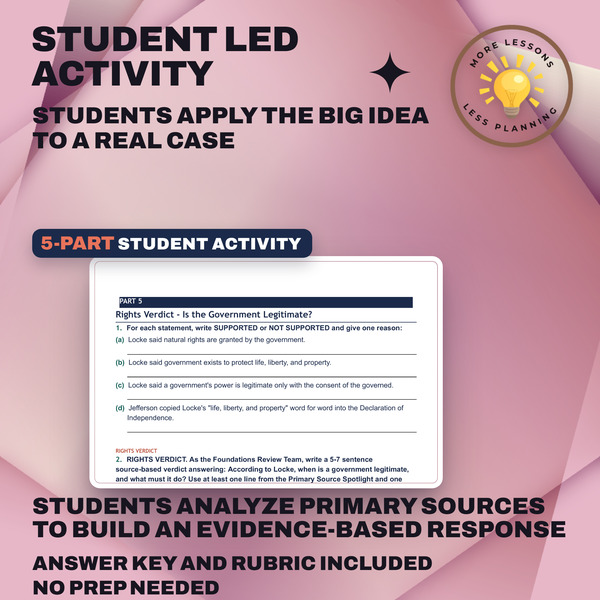
- Activity + answer key
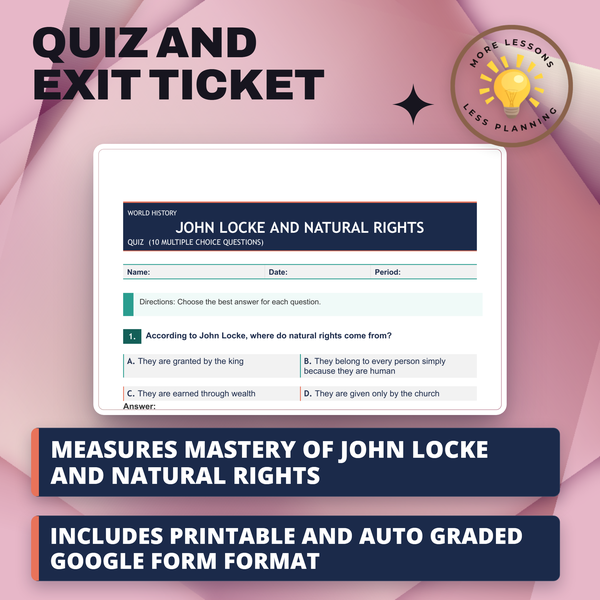
- Quiz + answer key
- Exit ticket + answer key
- Teacher guide
- Teacher presentation notes
What students do
- Read an excerpt from Locke's 1689 Second Treatise and explain his idea of natural rights to life, liberty, and property
- Explain why, in Locke's argument, government exists to protect people's natural rights
- Describe Locke's state of nature, law of nature, and social contract in their own words
- Trace how Jefferson later adapted Locke's language into the Declaration of Independence
What it covers
- Locke's natural rights to life, liberty, and property, and why they belong to people simply because they are human
- Locke's argument that government exists only to protect the people's natural rights
- The state of nature, the law of nature, and the social contract as Locke laid them out in 1689
- The direct line from Locke's language to Jefferson's Declaration of Independence
Learning targets
- Explain Locke's idea of natural rights - life, liberty, and property - and that they belong to people simply because they are human.
- Explain that government exists to protect the people's natural rights.
- Explain that legitimate government rests on the consent of the governed.
- Describe Locke's state of nature, law of nature, and social contract.
- Explain, accurately, how Locke's ideas influenced the American Declaration of Independence.
Peek inside
John Locke was an English philosopher who lived from 1632 to 1704.
He is often called the Father of Liberalism.
Locke argued that all people are born with natural rights.
He believed government should protect the people, not rule over them.
His ideas shaped modern democracy.
An English Philosopher of Rights
John Locke was an English who lived from 1632 to 1704.
Many people call Locke the Father of for his ideas about rights.
Locke argued that all people are born with , which no king grants.
Locke believed government should the people, not rule over them.
1. Rights that belong to every person simply because they are human are called .
Why this matters
A government that answers to divine right and a government that answers to the people it governs rest on entirely different reasons for existing at all. Locke's 1689 argument, that people are born with rights to life, liberty, and property and that government exists only to protect them, is the reason the second version outlasted the first.
Nobody questions where a government's authority comes from until someone hands them the argument that first challenged the divine right of kings. Tracing Locke's own words forward into Jefferson's Declaration shows that an old philosophical argument can still be doing quiet work inside a founding document students think they already know by heart.
From one teacher to another
Locke's a hard sell when nobody's thought about where government's authority comes from in the first place, so I built this one to start with the question instead of the philosopher's name. Students read an excerpt from Locke's 1689 Second Treatise of Government and use it to explain his idea of natural rights, that people are born with a right to life, liberty, and property simply because they're human, and that government exists only to protect those rights. They work through Locke's state of nature, his law of nature, and the social contract that turns individuals into a government by consent rather than by the divine right of kings. The lesson closes by tracing the line from Locke's own words to Jefferson's, since the Declaration of Independence borrows Locke's language and reshapes it into the pursuit of happiness. Guided notes track the slides, the activity has a full answer key, and the quiz and exit ticket both come with keys.
Every file in this toolkit
Download
Where should I send the next one?
Everything here is free and it stays that way. Leave your email and I'll send you the new lessons as they go up. You can unsubscribe from any one of them.
Related resources
Causes of the French Revolution
Napoleon's Rise to Power
Simon Bolivar and Latin American Independence
The Bastille and the Rights of Man
The Declaration of Independence
The Haitian Revolution and Toussaint Louverture
Every lesson on this site is free to download and use. If one of them saved you a prep period, you can chip in a few bucks toward my three kids' daycare fund. That's genuinely where tips go.