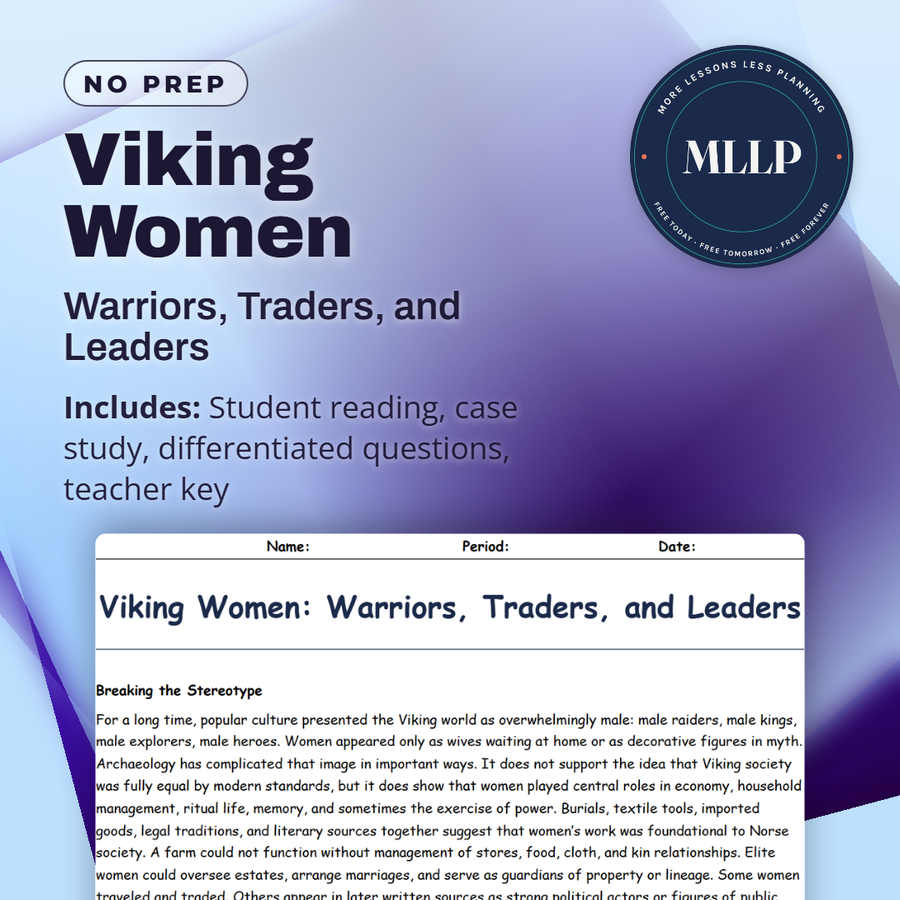
Viking Women: Warriors, Traders, and Leaders
Quality reviewed September 2026
Facts verified September 21, 2026
- Subject
- Social Studies
- Grades
- Grades 9-12
- Length
- 9-page student worksheet
- Time
- About one 50-minute class period
- Great for
- Sub plans and independent work
- Includes
- Reading passage, comprehension questions + full answer key
- Format
- Print-and-go PDF
What students do
- Match five terms, including Birka, BJ581, and textile, to their definitions
- Three multiple-choice questions test why textile production mattered economically and why the Birka BJ581 grave caused such debate
- Fill in three blanks naming the famous Birka burial, cloth production, and the family ties DNA can help identify
- A case study follows a museum team reconsidering grave BJ581 once DNA results identified the skeleton as female
What it covers
- Women's household and textile labor in the Viking economy
- The Birka BJ581 grave and what it reveals about assumptions in archaeology
- How sagas portray Viking women as landholders and family leaders
Start reading this worksheet
Breaking the Stereotype
For a long time, popular culture presented the Viking world as overwhelmingly male: male raiders, male kings, male explorers, male heroes. Women appeared only as wives waiting at home or as decorative figures in myth. Archaeology has complicated that image in important ways. It does not support the idea that Viking society was fully equal by modern standards, but it does show that women played central roles in economy, household management, ritual life, memory, and sometimes the exercise of power. Burials, textile tools, imported goods, legal traditions, and literary sources together suggest that women’s work was foundational to Norse society. A farm could not function without management of stores, food, cloth, and kin relationships. Elite women could oversee estates, arrange marriages, and serve as guardians of property or lineage. Some women traveled and traded. Others appear in later written sources as strong political actors or figures of public influence. What archaeology has done, above all, is force historians to stop treating women as invisible by default. When grave goods, isotopes, and DNA are studied carefully, long-standing assumptions begin to crack. A set of keys or weaving tools does not mean a woman’s life was unimportant; it may point to control over household wealth and production. A richly furnished burial can reveal rank and authority. The result is not a simple replacement myth in which every Viking woman was a warrior queen. Instead, we get a more realistic and more interesting picture of a society in which women occupied multiple roles that mattered deeply to the survival and identity of Norse communities.
Women in Households, Farms, and Trade
In everyday life, women were essential to the operation of farms and households, which formed the basic economic units of the Viking world. Textile production is one of the clearest examples. Spinning wool and weaving cloth were labor-intensive tasks, and sails for ships required enormous quantities of woven material. This means that long-distance travel, raiding, and trade all depended indirectly on women’s work. Archaeologists recover spindle whorls, loom weights, shears, and textile fragments from settlements and graves, making this labor visible in ways written chronicles often do not. Women also managed food storage, dairy production, and household organization. In a world without modern banking, control over goods, stores, and access mattered. Keys found in women’s graves have often been interpreted as symbols of household authority, though scholars debate how literal that symbolism should be. Elite women could act as landholders or temporary managers when husbands were absent abroad. There is also evidence that women participated in trade networks, especially in towns and ports where household production connected to wider exchange. The idea that home and economy were separate makes little sense in the Viking world. A household was productive, political, and social all at once. Women’s authority could therefore be local but still highly significant. Archaeology helps us recover these forms of power because it looks at tools, buildings, animal remains, and craft waste, not just kings and battles. In doing so, it reveals that Viking society rested on far more than male violence.
The Birka Grave and the Warrior Debate
The most famous debate about women in Viking archaeology centers on grave BJ581 at Birka in Sweden. When the burial was first excavated in the nineteenth century, its weapons, horses, and gaming pieces led scholars to classify it as the grave of a male warrior. For decades that assumption went largely unchallenged because the grave fit expectations: weapons meant man, strategy pieces meant commander, and therefore the occupant must have been male. More recent osteological work and DNA analysis, however, indicated that the buried individual was biologically female. The result sparked enormous public interest because it seemed to confirm the idea of a Viking woman warrior. Yet the debate did not end there. Some scholars argued that the grave goods might be symbolic, that the body and objects could represent different social meanings, or that warrior identity itself was more flexible than modern categories suggest. Others emphasized that the evidence for a martial role is strong because the burial contains a full set of weapons and items associated with command. The Birka grave matters not because it proves every saga about shield-maidens, but because it exposes how interpretation can be shaped by bias. The same burial was treated one way when people assumed the body was male and another way when scientific evidence showed otherwise. Archaeology here becomes a lesson in method: evidence does not speak without interpretation, and interpretation is influenced by expectations. Birka forces historians to ask harder questions about gender, warfare, and status in the Viking world.
Like what you read? The full reading, the case study, and every question set are in the free download below, along with the answer key.
Why this matters
The Birka debate is a rare case where students can watch historians change their minds in response to new evidence, which makes it a strong example of how science and history correct each other over time. Before the DNA results, the same weapons and gaming pieces were confidently read as proof of a male commander, and afterward, some researchers still debated whether those objects were symbolic rather than accepting the simplest explanation, which is a useful lesson in noticing bias even in careful scholarship. The reading also matters because it corrects a habit of treating Viking women as background figures, showing instead that household management, textile production, and even burial with weapons reflect a much wider range of female roles than the raiding-and-kings version of Viking history usually allows room for.
From one teacher to another
Viking women managed farms, stores, and household wealth in ways that written chronicles rarely mention, and this reading uses archaeology to bring that labor back into view. Spinning and weaving get particular attention because Viking ships needed enormous amounts of sail cloth, which means the textile work recovered from spindle whorls and loom weights helped power the same voyages usually credited to men alone. The reading's central case is the Birka BJ581 grave in Sweden, a weapon-rich burial assumed for over a century to belong to a male warrior until DNA analysis identified the skeleton as biologically female, forcing scholars to reexamine what the same evidence meant once their assumptions changed. Saga evidence adds another layer, showing women acting as landholders, negotiators, and memory keepers, even though those texts were shaped by later literary style. A case study follows a museum team arguing over grave BJ581, realizing that the burial itself never changed, only their assumptions about it did.
What you get
Download
Where should I send the next one?
Everything here is free and it stays that way. Leave your email and I'll send you the new lessons as they go up. You can unsubscribe from any one of them.
Related resources
 A Viking City Revealed_COVER.png)
Jorvik (York): A Viking City Revealed
L'Anse aux Meadows: Vikings in North America
Lindisfarne to Constantinople: The Viking Expansion
Runes and Sagas: Viking Writing and Oral History
The Norse in Greenland and Iceland: Climate and Collapse
The Viking & Norse World: An Overview
Every lesson on this site is free to download and use. If one of them saved you a prep period, you can chip in a few bucks toward my three kids' daycare fund. That's genuinely where tips go.