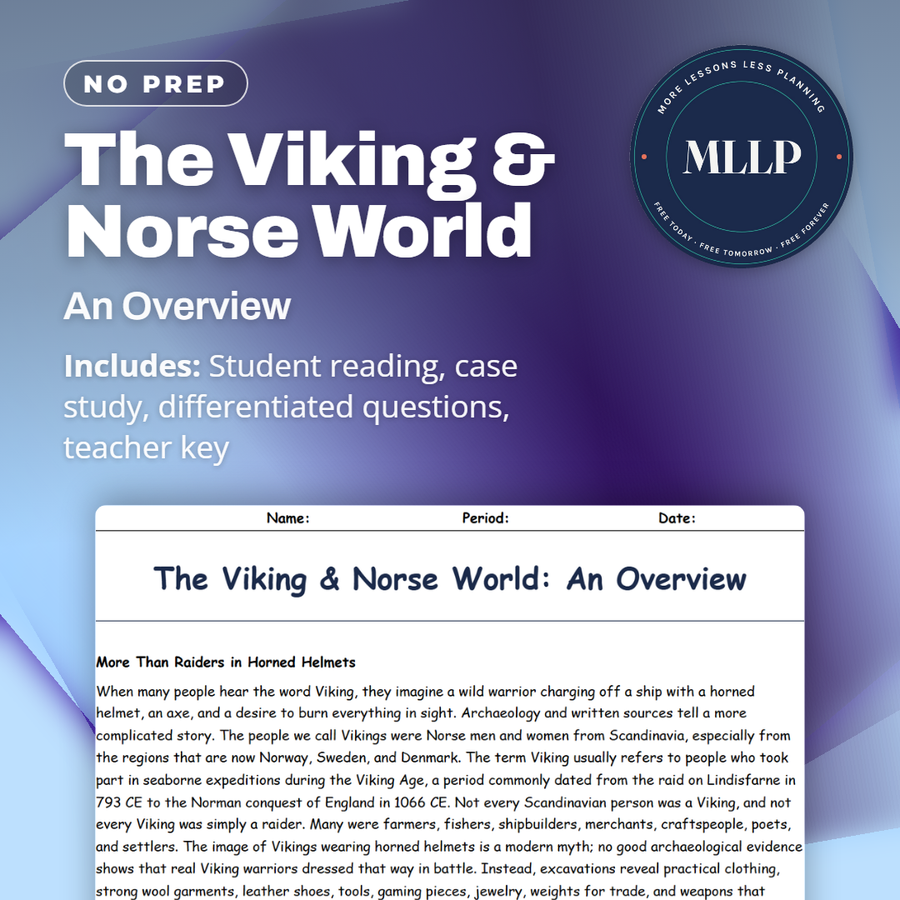
The Viking & Norse World: An Overview
Quality reviewed September 2026
Facts verified September 21, 2026
- Subject
- Social Studies
- Grades
- Grades 9-12
- Length
- 9-page student worksheet
- Time
- About one 50-minute class period
- Great for
- Sub plans and independent work
- Includes
- Reading passage, comprehension questions + full answer key
- Format
- Print-and-go PDF
What students do
- Match five terms, including Viking, longship, and saga, to their definitions
- Three multiple-choice questions test what the word Viking actually meant and why Scandinavian geography favored sea travel
- Explain in three blanks the terms for a Viking-age ship, a historical period ending in 1066, and Iceland's written narratives
- A case study follows Sofia deciding what to do after her metal detector finds a hoard of Viking silver
What it covers
- Why the horned helmet image of Vikings is a modern myth
- Farming, trade, textile work, and belief in everyday Norse life
- Trade networks reaching from the British Isles to Byzantium
Start reading this worksheet
More Than Raiders in Horned Helmets
When many people hear the word Viking, they imagine a wild warrior charging off a ship with a horned helmet, an axe, and a desire to burn everything in sight. Archaeology and written sources tell a more complicated story. The people we call Vikings were Norse men and women from Scandinavia, especially from the regions that are now Norway, Sweden, and Denmark. The term Viking usually refers to people who took part in seaborne expeditions during the Viking Age, a period commonly dated from the raid on Lindisfarne in 793 CE to the Norman conquest of England in 1066 CE. Not every Scandinavian person was a Viking, and not every Viking was simply a raider. Many were farmers, fishers, shipbuilders, merchants, craftspeople, poets, and settlers. The image of Vikings wearing horned helmets is a modern myth; no good archaeological evidence shows that real Viking warriors dressed that way in battle. Instead, excavations reveal practical clothing, strong wool garments, leather shoes, tools, gaming pieces, jewelry, weights for trade, and weapons that varied by wealth and status. Some people joined raids for profit or prestige, but others sailed to exchange goods, establish seasonal camps, or found new communities. Their society was not frozen in one role. A man might farm in spring, trade in summer, fight in a feud, and then attend an assembly where legal disputes were settled. A woman might manage a household, oversee stores of food and cloth, arrange marriage alliances, and preserve family memory through stories and ritual. Understanding the Viking world begins with dropping the cartoon version and seeing a mobile, skilled, and adaptable society.
A Sea Road Out of Scandinavia
Scandinavia helped shape that society. The region contains mountains, forests, rocky coasts, narrow fjords, and long winters, but it also offers thousands of miles of shoreline and waterways. For Norse communities, the sea was not a barrier; it was a road. A village that looked isolated on land could be tightly connected by water to distant markets and neighboring chiefdoms. Boats mattered because traveling overland through rough terrain was often slower than sailing along the coast or rowing up rivers. This geography encouraged shipbuilding, navigation, fishing, and maritime trade. It also made local resources uneven. Some areas had better farmland than others, and inheritance customs could leave younger family members looking for opportunities elsewhere. Scandinavian elites competed for followers and wealth, so leaders needed gifts, silver, and fame. Ships allowed them to pursue all three. A longship could land on a beach, cross open water, and move through river systems deep into Europe. Merchant ships, often broader than warships, moved furs, walrus ivory, slaves, iron, whetstones, honey, and timber outward while bringing in silver, silk, glass, spices, and luxury goods. Archaeological finds show that the Norse world was tied into trade routes reaching the British Isles, the Frankish kingdoms, the Baltic, the Byzantine Empire, and even the Islamic world. Hoards of Arabic silver coins found in Scandinavia prove that Viking networks were not small or local. Geography therefore did not trap the Norse in the north. It trained them to think outward, to master movement, and to see distant shores as reachable.
Farmers, Traders, and Storytellers
Daily life in the Viking world was built on work, belief, and relationships. Most people lived on farms and depended on animals, grain, fishing, and storage to survive difficult winters. Houses were often longhouses made from timber, turf, and thatch, with both people and animals using connected spaces in cold weather. Households were productive units where spinning, weaving, metalworking, woodworking, and food preparation all mattered. Textile production was especially important; making sails for ships required large amounts of cloth and labor, which means women’s work helped power overseas expansion. Religion before Christianization centered on Norse gods such as Odin, Thor, and Freyja, but belief was not just about famous deities. It also involved local ritual, burial practice, household luck, and ideas about fate and honor. At the same time, the Norse world valued memory. Runes could be carved on wood, bone, metal, or stone, usually for short messages, names, ownership marks, or memorials. Longer stories were preserved orally and later written down in texts such as the Icelandic sagas and the Eddas. These stories mixed history, family pride, law, and legend. Because the Viking world did not produce huge archives like some Mediterranean states, archaeology is especially important. A comb dropped in a workshop, a spindle whorl in a house, a buried ship, or a silver hoard hidden in a crisis can tell us as much as a king’s chronicle. The Norse left behind not one simple identity, but a rich material culture that records ordinary labor as clearly as heroic adventure.
Like what you read? The full reading, the case study, and every question set are in the free download below, along with the answer key.
Why this matters
Students arrive at this reading already carrying a costume-shop image of Vikings, and correcting that image is worth doing carefully, because it changes what counts as evidence for an entire society. Once students see that most Norse people were farmers and traders rather than raiders, they can ask better questions about how any culture gets reduced to its most violent moment in popular memory. Sofia's choice to report her silver find rather than sell it also gives students a real, current stake in the reading. Archaeological context, meaning where an object was found and what sat around it, is often more valuable than the object itself, and that argument applies just as much to a modern metal detectorist as it does to a professional excavation.
From one teacher to another
The horned-helmeted warrior charging off a longship is the image almost every student arrives with, but the reading opens by pointing out that no real archaeological evidence supports the horned helmet at all. Instead, it describes Norse men and women as farmers, traders, craftspeople, and settlers who happened to live in a region where fjords and coastlines made the sea easier to travel than the land. Students read about textile production feeding ship sails, trade networks reaching Arabic silver into Scandinavian hoards, and belief systems built from both famous gods and everyday ritual. The reading closes by showing how archaeology, not sagas or royal chronicles alone, recovers the ordinary labor behind this expansion. A case study follows Sofia, a teenager whose legal metal detector turns up a hoard of Viking silver in a Swedish field.
What you get
Download
Where should I send the next one?
Everything here is free and it stays that way. Leave your email and I'll send you the new lessons as they go up. You can unsubscribe from any one of them.
Related resources
 A Viking City Revealed_COVER.png)
Jorvik (York): A Viking City Revealed
L'Anse aux Meadows: Vikings in North America
Lindisfarne to Constantinople: The Viking Expansion
Runes and Sagas: Viking Writing and Oral History
The Norse in Greenland and Iceland: Climate and Collapse
Viking Burials: Ships, Sacrifice, and the Afterlife
Every lesson on this site is free to download and use. If one of them saved you a prep period, you can chip in a few bucks toward my three kids' daycare fund. That's genuinely where tips go.