 A Viking City Revealed_COVER.png)
Jorvik (York): A Viking City Revealed
Quality reviewed September 2026
Facts verified September 21, 2026
- Subject
- Social Studies
- Grades
- Grades 9-12
- Length
- 9-page student worksheet
- Time
- About one 50-minute class period
- Great for
- Sub plans and independent work
- Includes
- Reading passage, comprehension questions + full answer key
- Format
- Print-and-go PDF
What students do
- Match five terms, including Jorvik, Coppergate, and waterlogged, to their definitions
- Three multiple-choice questions ask why the Coppergate dig became so famous and what its wet soil preserved
- Fill in three blanks naming Jorvik itself, the preservation it is known for, and the crafts found in its workshops
- A case study follows leatherworker Astrid as the scraps she swept away become proof of a Viking city's daily work
What it covers
- Coppergate's waterlogged evidence for daily Viking life in York
- Craft economy of leatherworking, metalworking, and textiles in a Viking town
- The Jorvik Viking Centre and hygiene evidence from combs to parasites
Start reading this worksheet
From Roman York to Viking Jorvik
The Viking city known as Jorvik was the Norse version of York, one of the most important urban centers in early medieval England. York had already been a major place in the Roman and Anglo-Saxon periods, so the Vikings did not create a city out of empty land. Instead, they took over a strategic location with roads, rivers, political importance, and trade potential. After Viking forces seized York in the ninth century, the city became a key center in the Danelaw and later the kingdom of York. This matters because it challenges a common stereotype that Vikings only lived in isolated farmsteads or temporary raiding camps. Jorvik was urban. It contained craft districts, markets, houses, streets, and long-distance commercial links. The Norse presence in York was part of a much larger pattern in which Viking groups settled, governed, and adapted existing places. Written sources mention kings and battles, but archaeology lets us see ordinary life inside the city. That is where Jorvik becomes extraordinary. The site known as Coppergate, excavated in the 1970s and 1980s, produced one of the richest bodies of evidence for daily Viking Age urban life anywhere in Europe. Instead of just revealing walls and foundations, it preserved fragile materials that usually rot away, allowing archaeologists to reconstruct not only who lived there but also what they made, wore, ate, threw away, repaired, and stepped in. Jorvik matters because it turns the Viking city from an abstract idea into a place full of human detail.
The Miracle of Waterlogged Preservation
The most famous feature of the Coppergate excavation was waterlogging. In many archaeological sites, organic materials such as wood, leather, textile, and plant remains decay quickly once buried. At Coppergate, however, wet and low-oxygen conditions helped preserve these materials for centuries. That kind of preservation is a gift to archaeologists because it keeps the ordinary parts of life that elite written sources usually ignore. Instead of only finding durable objects such as metal tools or pottery, excavators recovered leather shoes, wooden bowls, weaving equipment, combs, animal bones, seeds, insect remains, and even traces of feces. Each of these categories tells a different story. Leather and wood show craft production and household equipment. Seeds and pollen reveal diet and plant use. Insects can indicate waste disposal, living conditions, and the presence of animals. Environmental evidence makes the city feel real in a way that weapon finds alone never could. Waterlogging also preserved structural evidence. Timber buildings, fence lines, floor layers, and pathways helped archaeologists map workshops and backyards. Because so many fragile materials survived, Jorvik became a model for how urban archaeology can recover entire ways of life. It taught scholars that Viking towns were not crude outposts. They were dense, busy, and economically specialized environments where craft, trade, and domestic life intertwined. Preservation did not just give archaeologists more objects. It gave them the texture of a city.
Workshops, Streets, and Everyday Business
The Coppergate finds reveal a place of intense work. Archaeologists identified evidence for leatherworking, metalworking, woodworking, antler carving, textile production, and trade. Waste from these activities mattered just as much as finished objects. Offcuts of leather, wood shavings, broken antler pieces, slag, and discarded tools show what kinds of crafts were practiced and where. This is why the case of a leatherworker’s trash is so important: rubbish in archaeology is often evidence of industry. A workshop floor layered with scraps can tell us how goods were made, repaired, and sold. Jorvik was connected to trade networks that reached far beyond northern England. Finds included imported goods and materials that point to movement across the Irish Sea, the North Sea, and the Viking world more broadly. The city’s location on the River Ouse gave access to inland routes as well as maritime connections. Houses were not separated cleanly from workspaces. In many cases, people lived, stored goods, and produced items in adjoining areas. Urban life was noisy, crowded, and economically mixed. The image of Vikings as only warriors dissolves quickly at Jorvik because the evidence is full of craftspeople and merchants. We can picture apprentices cutting leather, women spinning thread, traders weighing silver, and customers walking muddy lanes between stalls and workshops. Archaeology at Jorvik recovers a city economy built on skilled labor as much as on military conquest. The city was a marketplace of hands-on skill, and its archaeological layers preserve the rhythm of repeated workday after workday.
Like what you read? The full reading, the case study, and every question set are in the free download below, along with the answer key.
Why this matters
Jorvik is a useful corrective for students who picture Vikings only as raiders, because the evidence from Coppergate is overwhelmingly about ordinary work, cutting leather, spinning thread, weighing silver, and repairing tools inside a crowded, working city. That distinction matters outside the classroom too, since so much of what students know about the past comes from a handful of dramatic events rather than the daily labor that actually built most societies. The reading also gives students a concrete case for why archaeologists fight to protect waterlogged sites before construction destroys them. Without careful excavation at Coppergate, the shoes, combs, and workshop floors that now define Viking-age York would have been lost forever, and historians would still be guessing at what city life in this period actually looked like.
From one teacher to another
Jorvik was not a Viking camp thrown up on empty ground. It was the Norse name for York, a city the Vikings took over rather than built from nothing, and the reading traces what archaeologists found when they excavated Coppergate in the 1970s and 1980s. Wet, low-oxygen soil there preserved leather, wood, combs, seeds, and even insect remains that usually rot away within a few decades. Students read about workshops full of leatherworking and metalworking waste, streets packed with houses and stalls, and grooming tools sitting in the same layers as parasites and cess. A case study follows a leatherworker named Astrid, whose discarded scraps become, a thousand years later, evidence of an entire craft economy.
What you get
Download
Where should I send the next one?
Everything here is free and it stays that way. Leave your email and I'll send you the new lessons as they go up. You can unsubscribe from any one of them.
Related resources
L'Anse aux Meadows: Vikings in North America
Lindisfarne to Constantinople: The Viking Expansion
Runes and Sagas: Viking Writing and Oral History
The Norse in Greenland and Iceland: Climate and Collapse
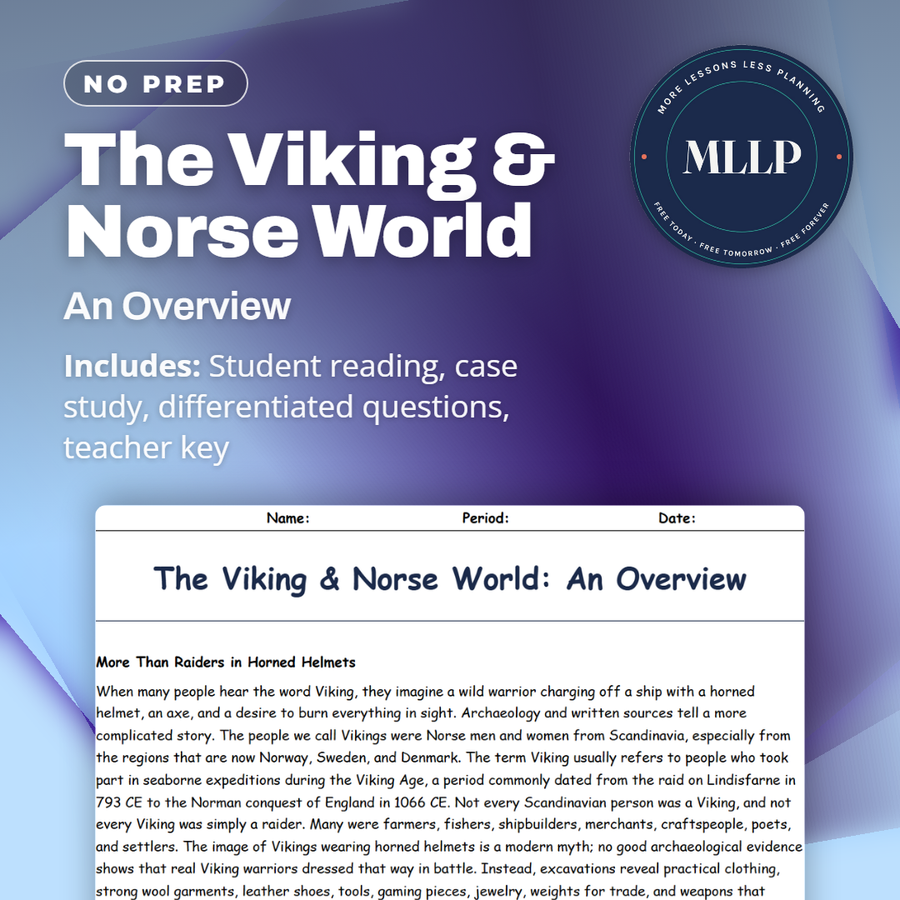
The Viking & Norse World: An Overview
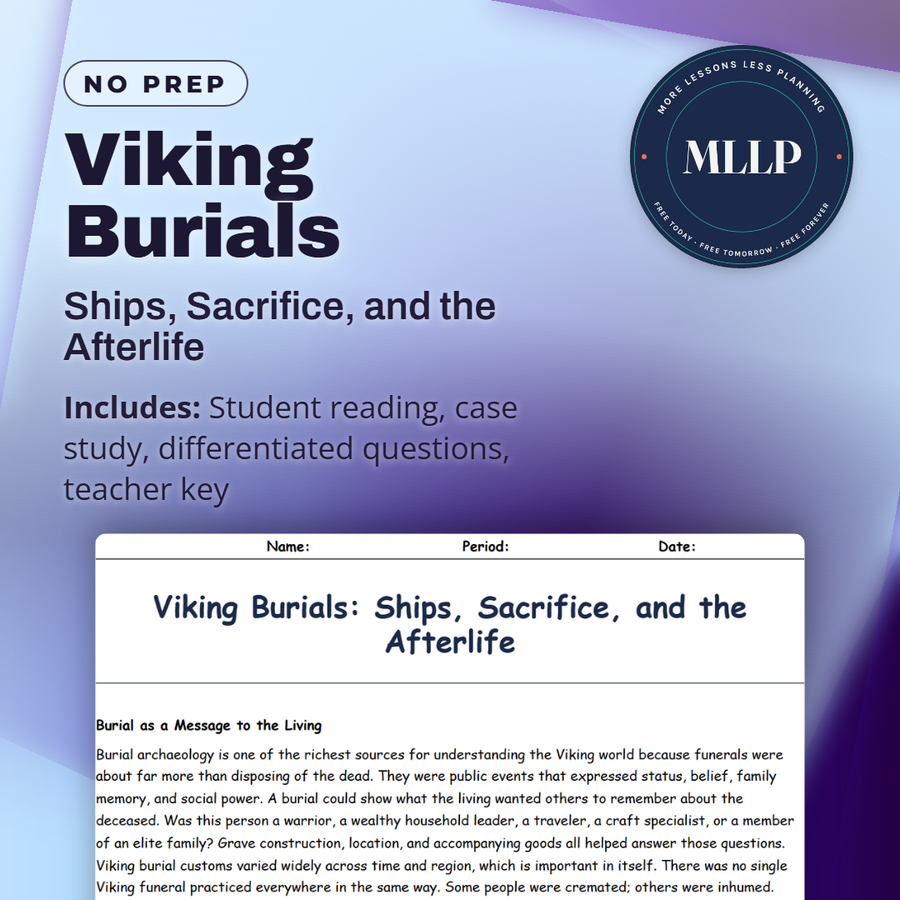
Viking Burials: Ships, Sacrifice, and the Afterlife
Every lesson on this site is free to download and use. If one of them saved you a prep period, you can chip in a few bucks toward my three kids' daycare fund. That's genuinely where tips go.