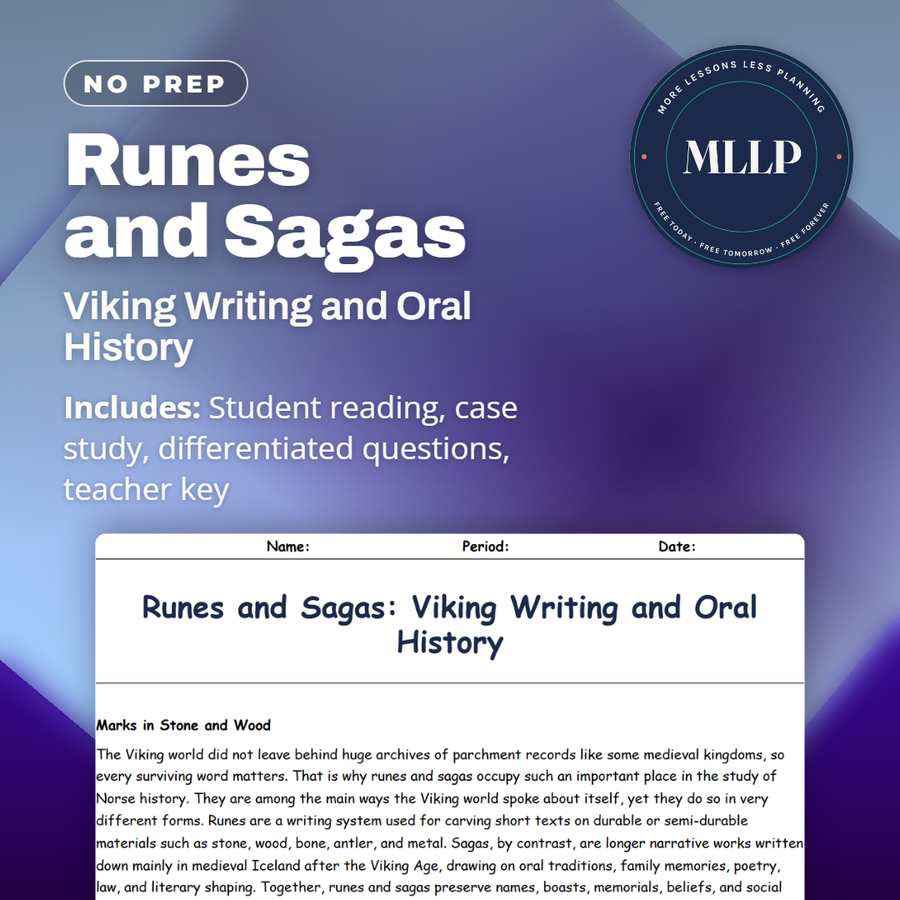
Runes and Sagas: Viking Writing and Oral History
Quality reviewed September 2026
Facts verified September 21, 2026
- Subject
- Social Studies
- Grades
- Grades 9-12
- Length
- 9-page student worksheet
- Time
- About one 50-minute class period
- Great for
- Sub plans and independent work
- Includes
- Reading passage, comprehension questions + full answer key
- Format
- Print-and-go PDF
What students do
- Match five terms, including rune, futhark, and runestone, to their definitions
- Three multiple-choice questions test what the Younger Futhark was and why sagas require careful reading
- Write in three blanks the words for the runic alphabet, a public memorial stone, and Iceland's later prose narratives
- A case study follows Sigrid negotiating what a runestone for her husband Hallvard should say
What it covers
- The Younger Futhark runic alphabet and how runes were carved
- Runestones as both family memorials and political statements
- Icelandic sagas and the Eddas as later, shaped historical sources
Start reading this worksheet
Marks in Stone and Wood
The Viking world did not leave behind huge archives of parchment records like some medieval kingdoms, so every surviving word matters. That is why runes and sagas occupy such an important place in the study of Norse history. They are among the main ways the Viking world spoke about itself, yet they do so in very different forms. Runes are a writing system used for carving short texts on durable or semi-durable materials such as stone, wood, bone, antler, and metal. Sagas, by contrast, are longer narrative works written down mainly in medieval Iceland after the Viking Age, drawing on oral traditions, family memories, poetry, law, and literary shaping. Together, runes and sagas preserve names, boasts, memorials, beliefs, and social values. But they do not function like a modern archive. They are selective, purposeful, and sometimes deeply political. A carved stone announcing who raised it and for whom is not neutral evidence; it is a public statement about identity and memory. A saga describing a feud or a voyage may preserve old traditions, but it may also dramatize events or reshape them for later audiences. This means historians must read Viking writing carefully, not reject it. The goal is not to ask whether a source is simply true or false. The better question is what kind of truth it is trying to present. Is a runestone preserving grief, family legitimacy, and public reputation at the same time? Is a saga telling us what happened exactly, or what later Icelanders believed was honorable, possible, or memorable? Those questions make Viking writing both difficult and fascinating.
The Futhark and the Uses of Runes
The runic alphabet most associated with the Viking Age is the Younger Futhark, a reduced system developed from an older runic tradition. Unlike the Roman alphabet, runes were particularly suited for carving, with straight lines that could be incised into hard materials. That practical design matters because writing in the Norse world often appeared on objects rather than in bound books. A knife handle, a wooden stick, a bone comb, or a memorial stone might all carry runes. Many inscriptions were brief: a name, an ownership mark, a prayer, a dedication, or a statement that a monument had been raised. Some texts were playful or personal. Others were solemn. Runes therefore show that literacy in the Viking world was not limited to kings writing long chronicles. It could be object-based, situational, and public. At the same time, rune use had social limits. Not everyone could carve well, and not every message needed writing. Oral memory remained powerful. This is why runes should not be imagined as a direct equivalent to modern mass literacy. They were part of a mixed communication system in which speech, memory, and inscription worked together. Even so, runes are invaluable because they preserve contemporary names and claims from the Viking Age itself. A runic inscription carved in the tenth century is often closer to the events it mentions than a saga written two or three hundred years later. That immediacy gives runes special weight, even when the text is short.
Runestones as Memory and Propaganda
Runestones are among the most dramatic surviving written monuments of the Viking world. Many were erected by family members to honor the dead, especially fathers, sons, husbands, or brothers. A typical inscription might state who raised the stone, in memory of whom, and sometimes where that person died or what status he held. Yet these stones were not just private memorials. They stood in public landscapes near roads, bridges, assembly places, or churches, where many people could see them. As a result, they also functioned as claims about inheritance, loyalty, achievement, and political legitimacy. The famous Jelling stones in Denmark illustrate this perfectly. One stone commemorates family ties, while another, associated with King Harald Bluetooth, proclaims major royal achievements and the conversion of the Danes to Christianity. That is not simply memory; it is state messaging carved in stone. Other runestones mention travel to England, Greece, or the east, reminding us that Viking mobility entered family history and local prestige. To say that a relative died abroad could elevate the status of the household that commemorated him. Runestones therefore blur the line between grief and propaganda. They tell us who mattered, how communities wanted the dead to be remembered, and what kinds of accomplishments were worth displaying. Archaeologically, they also reveal shifting religious worlds, because some include crosses or Christian prayers while still using older runic forms. A single stone can carry evidence of family memory, political ambition, conversion, and regional identity all at once.
Like what you read? The full reading, the case study, and every question set are in the free download below, along with the answer key.
Why this matters
This reading asks students to treat every historical source, not only Viking ones, as something written for a purpose rather than a neutral record. A runestone was a public statement about a family's status as much as a memorial, and a saga written two centuries after the fact reflects what later Icelanders valued as much as what actually happened. That is a skill students will use far beyond this unit, whenever they read a monument, a speech, or an old family story and have to ask who benefited from telling it that way. The reading's closing point, that archaeology can test what runes and sagas claim, also shows students why historians rarely trust a single kind of evidence on its own.
From one teacher to another
Every surviving rune and every written saga matters more than it might in a better-documented society, because the Viking world left behind no huge archive of parchment records. The reading explains how the Younger Futhark, a runic alphabet designed for carving rather than writing on paper, let ordinary people leave short, contemporary messages on stone, wood, bone, and metal. It also looks closely at runestones such as the Jelling stones in Denmark, showing how a monument raised to honor the dead could double as a political statement about kingship and conversion. Sagas get a different kind of scrutiny: written down centuries after the events they describe, they preserve real memory but also dramatize it for later Icelandic audiences. A case study follows Sigrid arguing with her husband's brothers over what a memorial stone for Hallvard should actually say.
What you get
Download
Where should I send the next one?
Everything here is free and it stays that way. Leave your email and I'll send you the new lessons as they go up. You can unsubscribe from any one of them.
Related resources
 A Viking City Revealed_COVER.png)
Jorvik (York): A Viking City Revealed
L'Anse aux Meadows: Vikings in North America
Lindisfarne to Constantinople: The Viking Expansion
The Norse in Greenland and Iceland: Climate and Collapse
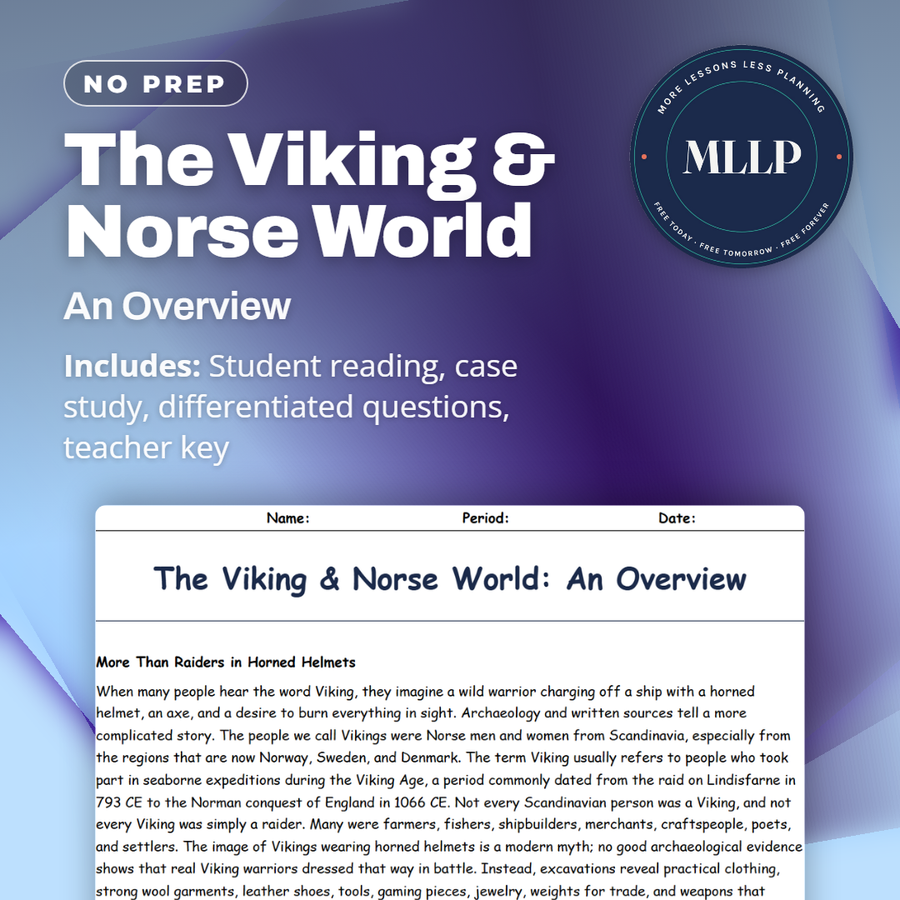
The Viking & Norse World: An Overview
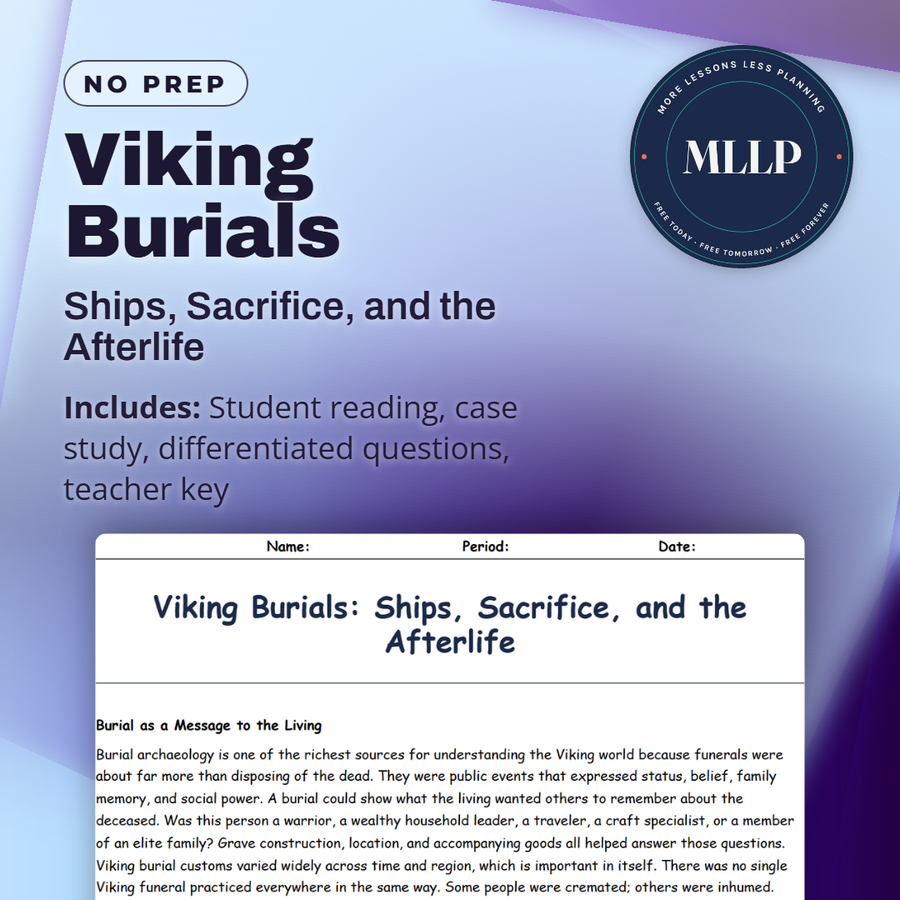
Viking Burials: Ships, Sacrifice, and the Afterlife
Every lesson on this site is free to download and use. If one of them saved you a prep period, you can chip in a few bucks toward my three kids' daycare fund. That's genuinely where tips go.