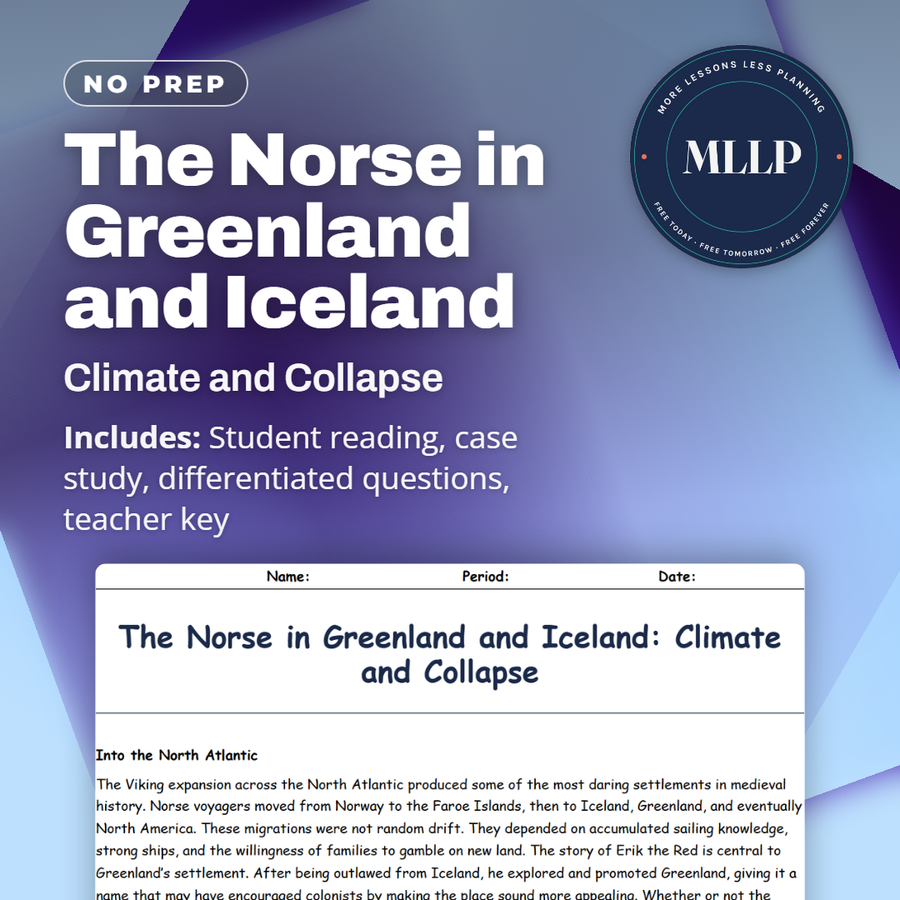
The Norse in Greenland and Iceland: Climate and Collapse
Quality reviewed September 2026
Facts verified September 21, 2026
- Subject
- Social Studies
- Grades
- Grades 9-12
- Length
- 9-page student worksheet
- Time
- About one 50-minute class period
- Great for
- Sub plans and independent work
- Includes
- Reading passage, comprehension questions + full answer key
- Format
- Print-and-go PDF
What students do
- Fill in three blanks naming Greenland, the Little Ice Age, and Iceland's law-centered society
- Three multiple-choice questions test why Iceland outlasted Greenland and what weakened Greenland's walrus ivory trade
- Sort five terms, including Erik the Red, Iceland, and collapse, into their matching definitions
- A case study follows Thora counting hay bundles as her family's Greenland farm quietly runs out of options
What it covers
- Erik the Red and the settlement of Iceland and Greenland
- Iceland's Althing and Commonwealth compared to Greenland's fragile economy
- Climate stress, trade decline, and the end of the Greenland colonies
Start reading this worksheet
Into the North Atlantic
The Viking expansion across the North Atlantic produced some of the most daring settlements in medieval history. Norse voyagers moved from Norway to the Faroe Islands, then to Iceland, Greenland, and eventually North America. These migrations were not random drift. They depended on accumulated sailing knowledge, strong ships, and the willingness of families to gamble on new land. The story of Erik the Red is central to Greenland’s settlement. After being outlawed from Iceland, he explored and promoted Greenland, giving it a name that may have encouraged colonists by making the place sound more appealing. Whether or not the name was partly marketing, the effort succeeded. In the late tenth century, Norse settlers established the Eastern and Western Settlements along Greenland’s southwestern coast, where conditions, while harsh, allowed limited pastoral farming. This expansion reveals both confidence and vulnerability. The Norse were capable of crossing open ocean and founding communities in extremely demanding environments. Yet every new colony depended on ships, imported materials, and social ties linking it to the wider Norse world. North Atlantic settlement therefore magnified both Viking strengths and Viking risks. It rewarded mobility and adaptability, but it also exposed communities to climate shifts, market failures, and demographic weakness. Archaeology in Iceland and Greenland allows us to track those pressures in extraordinary detail through farms, middens, animal bones, pollen, church ruins, imported goods, and abandoned buildings. Few historical stories show the interaction of environment and society as clearly as this one.
Iceland, Law, and a New Norse Society
Iceland became one of the most successful Norse colonies, and its development shaped later Viking memory more than almost any other Atlantic settlement. Colonized in the late ninth century, Iceland offered pasture, fishing grounds, and relative political freedom for settlers willing to endure isolation and a challenging landscape. Unlike Greenland, it could support a larger and more durable population. It also developed the Icelandic Commonwealth, a society famous for its assemblies, law speaking, and negotiated politics rather than centralized kingship. The Althing, established around 930, is often celebrated as an early parliamentary institution, though it was not democratic in the modern sense. Power still rested with chieftains and landholding families. Even so, Iceland demonstrates that Viking expansion did not always produce kingdoms built by conquest. It could also produce legal and social systems adapted to frontier conditions. Archaeology shows how settlers transformed the island. They cleared land, grazed sheep and cattle, built turf houses, and created farm networks that supported both daily life and long-distance exchange. But Icelandic success came at environmental cost. Deforestation, soil erosion, and pressure on fragile ecosystems began early. This is important because it shows that Norse adaptation was not always sustainable. People could survive and even flourish for generations while still damaging the land they depended on. Iceland therefore provides both a success story and a warning. It became a center of literature, law, and Norse identity, yet its archaeology also reveals how thin the margin for error could be in North Atlantic environments.
Greenland at the Edge of Habitability
Greenland was more precarious. The Norse settlements there relied on a narrow ecological strategy centered on pastoral farming, especially cattle, sheep, and goats, combined with hunting seals, caribou, and other local resources. Archaeological excavations show churches, farmsteads, byres, storage spaces, and imported goods, indicating that Greenland was fully tied into the Christian Norse world rather than existing as an isolated survival camp. Some farms were substantial, and elite households participated in trade networks, especially through exports such as walrus ivory, hides, and perhaps luxury goods from Arctic animals. Yet Greenland always sat at the edge of what was possible. The growing season was short, the sea could be blocked by ice, and the colony depended on ships from Iceland and Norway for iron, timber, and many essential goods. When communication weakened, life became harder. The Norse in Greenland were not simply stubborn Europeans refusing to adapt, as older narratives sometimes claimed. Zooarchaeology shows that they hunted extensively and adjusted diet over time, especially by increasing reliance on marine resources such as seals. They also built in turf, managed livestock carefully, and organized social life around church and farm. But they remained committed to a pastoral and Christian identity that tied them culturally to Europe. That commitment may have limited flexibility when conditions worsened. Greenland’s archaeology is compelling because it captures a society trying hard to remain itself while the world around it became less forgiving.
Like what you read? The full reading, the case study, and every question set are in the free download below, along with the answer key.
Why this matters
Students often expect collapse to look like a single catastrophe, but this reading shows Greenland's Norse settlements ending gradually, through climate stress, a weakening ivory trade, and a small population that could not easily change its own habits. That pattern shows up again in modern conversations about communities facing environmental pressure today, where the risk is rarely one storm but a slow accumulation of smaller failures that a society is unwilling or unable to adapt around in time. Iceland's story adds a second, less dramatic lesson. Even a colony that survived for centuries still damaged the land it depended on, which is a useful caution against treating any success story as proof that a way of living was sustainable.
From one teacher to another
Erik the Red gave Greenland an appealing name and a Norse population, and this reading follows that colony from confident founding to quiet disappearance centuries later. Iceland, settled slightly earlier, developed the Althing and a law-centered Commonwealth that let it survive on a larger, more sustainable population base, even as deforestation and soil erosion showed its own environmental costs. Greenland's farms depended on cattle, sheep, and seal hunting, plus walrus ivory exports that lost value as European markets shifted to elephant ivory from farther south. The reading traces how cooling temperatures linked to the Little Ice Age, shrinking trade contact, and a small, culturally committed population combined over generations rather than in a single disaster. A case study follows Thora, watching her family's hay supply, animal herd, and shipping contact shrink one season at a time.
What you get
Download
Where should I send the next one?
Everything here is free and it stays that way. Leave your email and I'll send you the new lessons as they go up. You can unsubscribe from any one of them.
Related resources
 A Viking City Revealed_COVER.png)
Jorvik (York): A Viking City Revealed
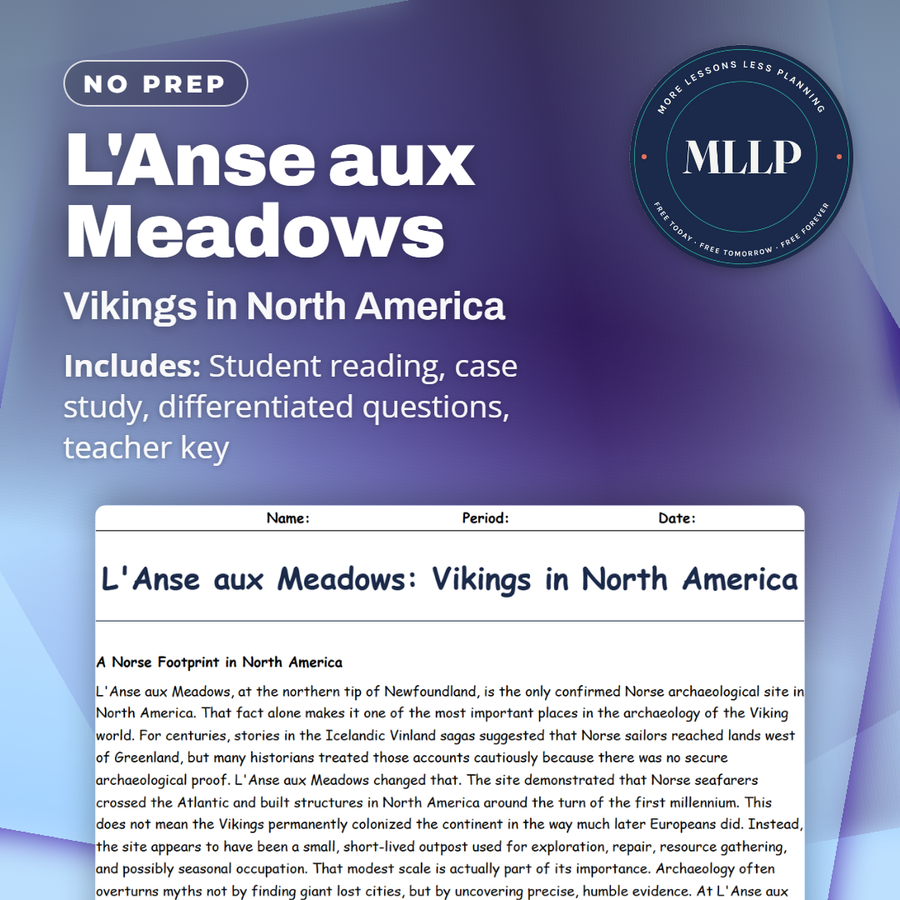
L'Anse aux Meadows: Vikings in North America
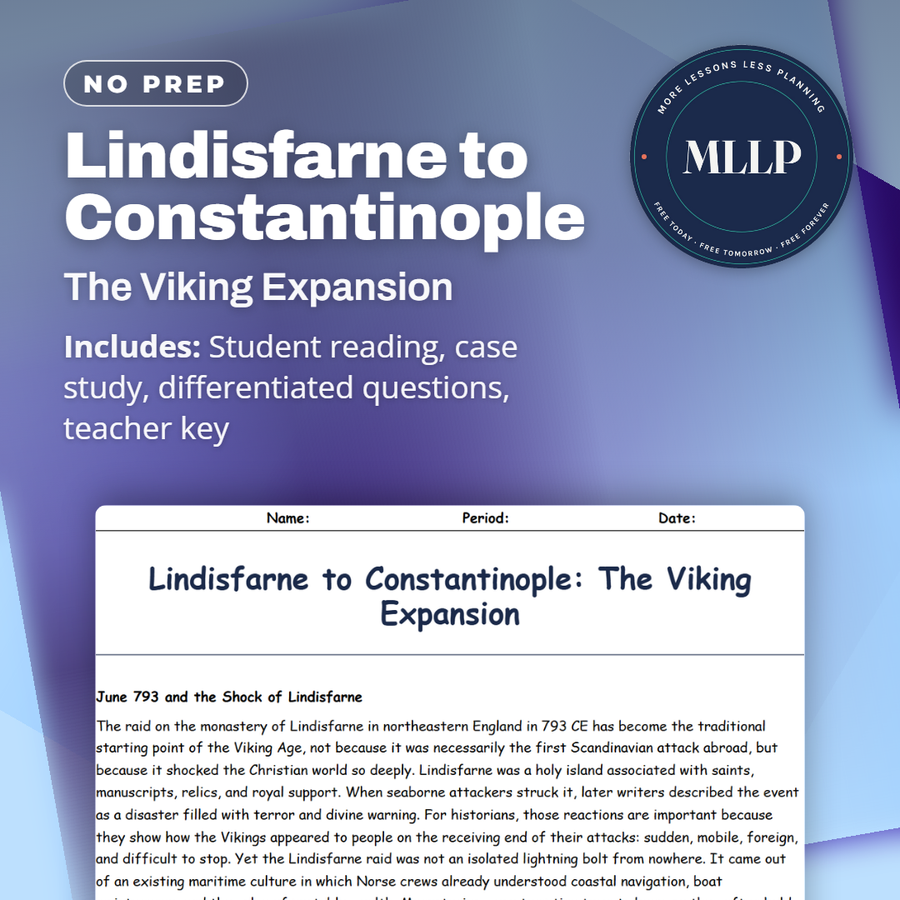
Lindisfarne to Constantinople: The Viking Expansion
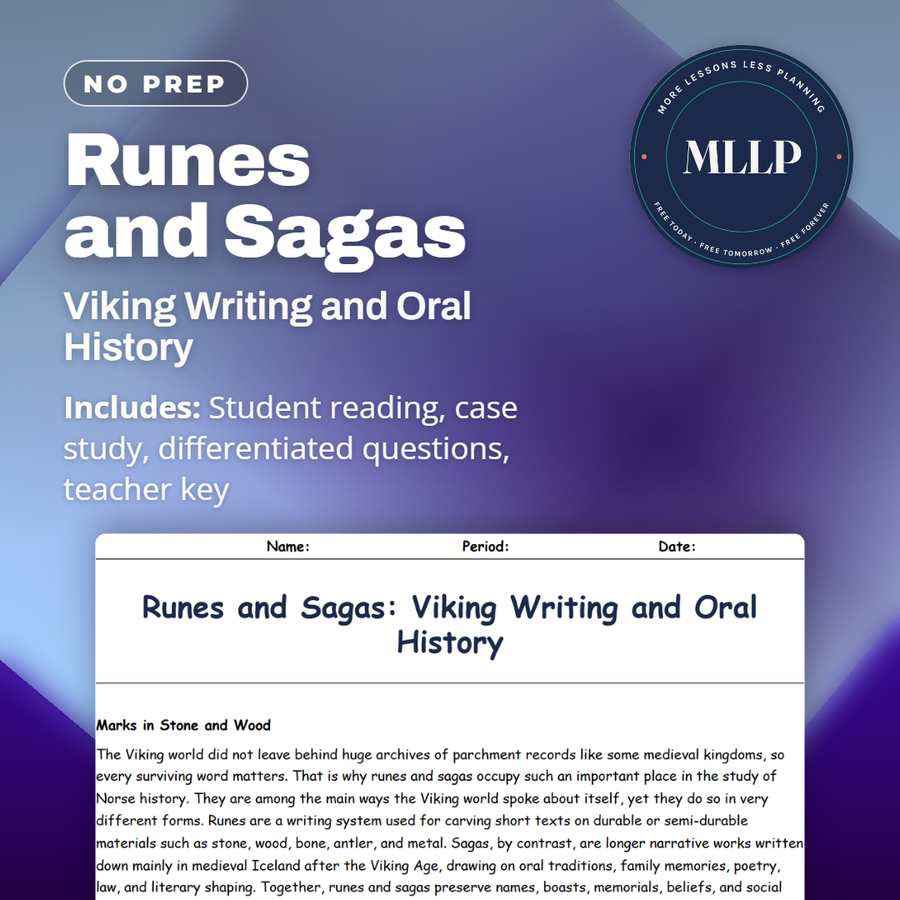
Runes and Sagas: Viking Writing and Oral History
The Viking & Norse World: An Overview
Viking Burials: Ships, Sacrifice, and the Afterlife
Every lesson on this site is free to download and use. If one of them saved you a prep period, you can chip in a few bucks toward my three kids' daycare fund. That's genuinely where tips go.