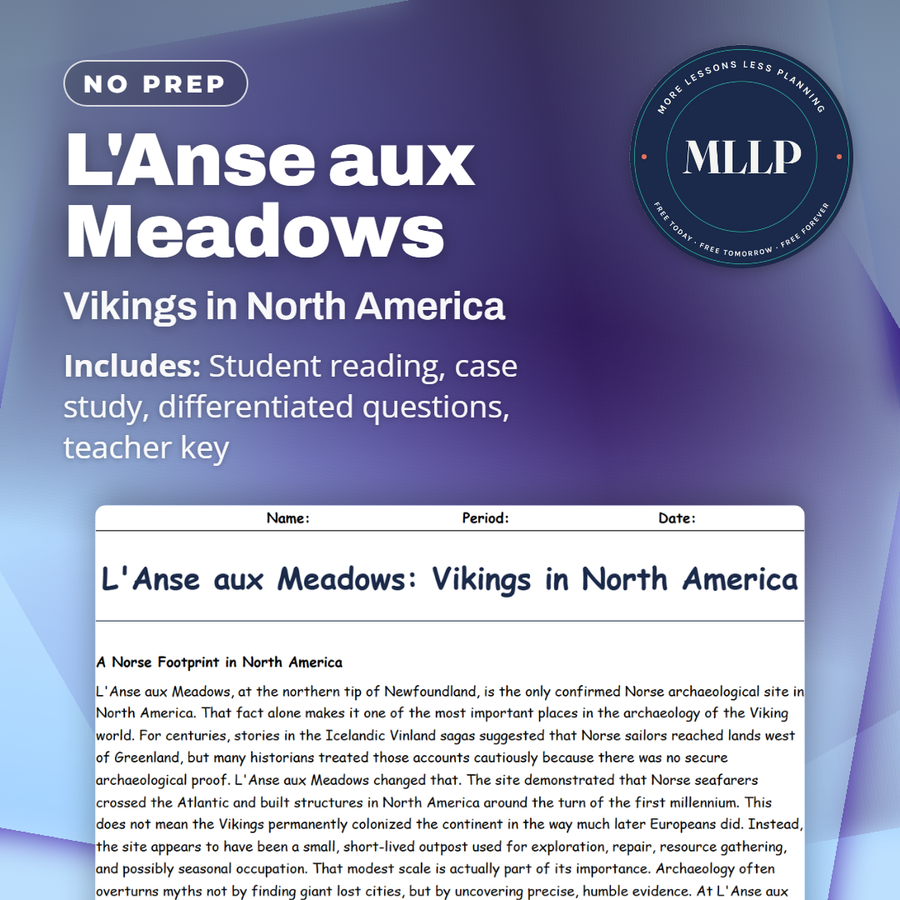
L'Anse aux Meadows: Vikings in North America
Quality reviewed September 2026
Facts verified September 21, 2026
- Subject
- Social Studies
- Grades
- Grades 9-12
- Length
- 9-page student worksheet
- Time
- About one 50-minute class period
- Great for
- Sub plans and independent work
- Includes
- Reading passage, comprehension questions + full answer key
- Format
- Print-and-go PDF
What students do
- Three multiple-choice questions cover why the site's ironworking evidence proved a Norse rather than Indigenous origin
- Sort five terms, including Vinland, smithy, and Ingstad, into their matching definitions
- A case study follows Gudrid weighing whether a resource-rich shore was worth the risk of staying
- Trace three blanks that name Newfoundland, the site's smithy, and the sagas remembering Vinland
What it covers
- The Ingstads' discovery of the only confirmed Norse site in North America
- Turf buildings, a smithy, and boat repair evidence at the site
- Butternut remains and why the Vinland outpost did not last
Start reading this worksheet
A Norse Footprint in North America
L'Anse aux Meadows, at the northern tip of Newfoundland, is the only confirmed Norse archaeological site in North America. That fact alone makes it one of the most important places in the archaeology of the Viking world. For centuries, stories in the Icelandic Vinland sagas suggested that Norse sailors reached lands west of Greenland, but many historians treated those accounts cautiously because there was no secure archaeological proof. L'Anse aux Meadows changed that. The site demonstrated that Norse seafarers crossed the Atlantic and built structures in North America around the turn of the first millennium. This does not mean the Vikings permanently colonized the continent in the way much later Europeans did. Instead, the site appears to have been a small, short-lived outpost used for exploration, repair, resource gathering, and possibly seasonal occupation. That modest scale is actually part of its importance. Archaeology often overturns myths not by finding giant lost cities, but by uncovering precise, humble evidence. At L'Anse aux Meadows, the proof lies in turf buildings, ironworking remains, boat repair evidence, and artifacts that fit known Norse traditions rather than Indigenous ones. The site places the Norse within a North Atlantic chain of movement that already linked Norway, Iceland, and Greenland. It also reminds us that exploration did not automatically lead to lasting settlement. Even highly skilled seafarers with ocean-going ships could reach a new shore and still decide that staying there was too difficult, too dangerous, or simply not worth the cost.
How the Ingstads Found the Site
The discovery of L'Anse aux Meadows is closely tied to the work of Helge Ingstad and Anne Stine Ingstad. Helge Ingstad, a Norwegian explorer, became interested in whether the Vinland sagas preserved a real memory of Norse travel to North America. Searching along the Atlantic coast, he followed local stories and geographical clues until he reached Newfoundland, where residents pointed him toward unusual grassy mounds at L'Anse aux Meadows. Anne Stine Ingstad, an archaeologist, then helped direct the excavation and turn speculation into evidence. This partnership matters because it shows how archaeology moves from possibility to proof. Local knowledge first suggested that the mounds were unusual. Excavation then revealed their structure, contents, and date. The Ingstads uncovered remains of turf-walled buildings with layouts similar to Norse structures in Greenland and Iceland. Crucially, the site also contained evidence of iron smelting and smithing, including slag and a furnace. Indigenous communities in that region at that time did not produce iron in this way, so the metallurgical evidence strongly supported a Norse origin. Excavation also produced artifacts such as a spindle whorl and a ring-headed pin associated with Norse material culture. By combining architecture, artifacts, and dating evidence, archaeologists established that the site was genuinely Scandinavian. The importance of the Ingstads’ work lies not only in finding the site but also in documenting it carefully enough to persuade the scholarly world. Discovery alone is never enough in archaeology; the evidence must be recorded, compared, and argued convincingly.
Buildings, Iron, and the Shape of a Settlement
What did the settlement look like? L'Anse aux Meadows was not a sprawling colony with fields, churches, and a large permanent population. Instead, it appears to have been a compact base composed of turf structures, including halls and workshops, arranged in a way familiar from the Norse North Atlantic. Turf construction made sense in places where timber could be used for framing but sod was an efficient wall material. The site also contains the remains of a smithy where iron was processed, probably to make or repair nails and rivets needed for ship maintenance. That single feature is hugely important. A smithy implies more than camping; it implies logistical planning. Ships crossing the Atlantic needed care, and the ability to repair them on site would have been essential. Evidence of woodworking and boat repair suggests that L'Anse aux Meadows may have served as a gateway station, where crews could overwinter, gather resources, or prepare for further travel southward. One especially interesting find is butternut, a plant that does not grow naturally in Newfoundland today. Its presence suggests that Norse travelers moved beyond the immediate site into more southerly regions where such resources could be collected. This fits the saga idea that Vinland was not just one pinpoint settlement, but a broader zone of exploration. Archaeology therefore shows L'Anse aux Meadows as part workshop, part camp, part staging area, and part proof of wider movement.
Like what you read? The full reading, the case study, and every question set are in the free download below, along with the answer key.
Why this matters
This reading lets students test a historical claim against physical evidence instead of taking a legend on faith, since the Vinland sagas describe voyages west of Greenland that historians once treated with real skepticism. The smithy, the turf halls, and the butternut remains at L'Anse aux Meadows show how a handful of careful finds settled a centuries-old argument about who reached North America first. It also pushes back against a simple discovery story, since the site proves contact, not colonization, and it never became a lasting European settlement. That distinction matters for how students think about exploration more broadly, since reaching a new shore and successfully staying there turn out to be two very different achievements, shaped by supply lines, distance, and relations with the people already living there.
From one teacher to another
Helge and Anne Stine Ingstad turned a debated saga tradition into an archaeological fact when they identified L'Anse aux Meadows, the only confirmed Norse site in North America. The reading walks through how they found it, what a Norwegian explorer's search along the Newfoundland coast led to, and why a smithy full of iron slag mattered more than any single artifact. Students see how turf buildings, boat repair evidence, and even butternut remains, a plant that does not grow locally, built a case that Norse crews reached and moved beyond this shore. The last passage asks a harder question: if the Vikings could cross the Atlantic, why did they not stay? A case study follows Gudrid, standing at the edge of a hard, uncertain coastline, deciding whether a rich place can still fail to be a home.
What you get
Download
Where should I send the next one?
Everything here is free and it stays that way. Leave your email and I'll send you the new lessons as they go up. You can unsubscribe from any one of them.
Related resources
 A Viking City Revealed_COVER.png)
Jorvik (York): A Viking City Revealed
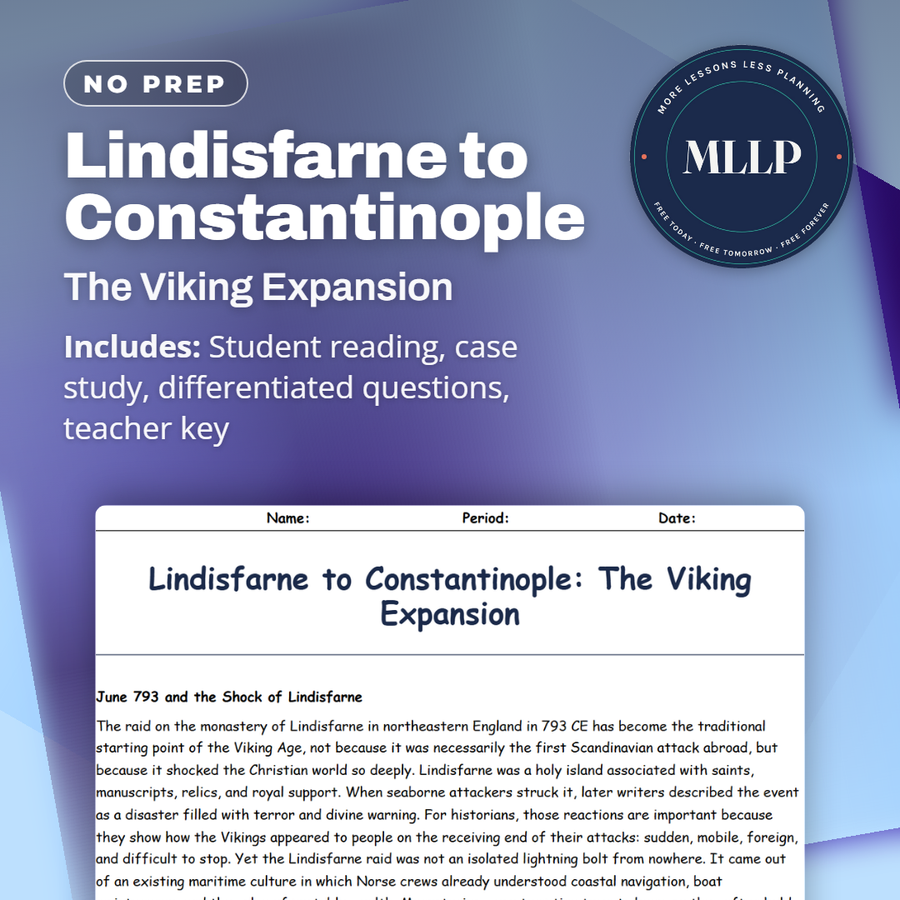
Lindisfarne to Constantinople: The Viking Expansion

Runes and Sagas: Viking Writing and Oral History
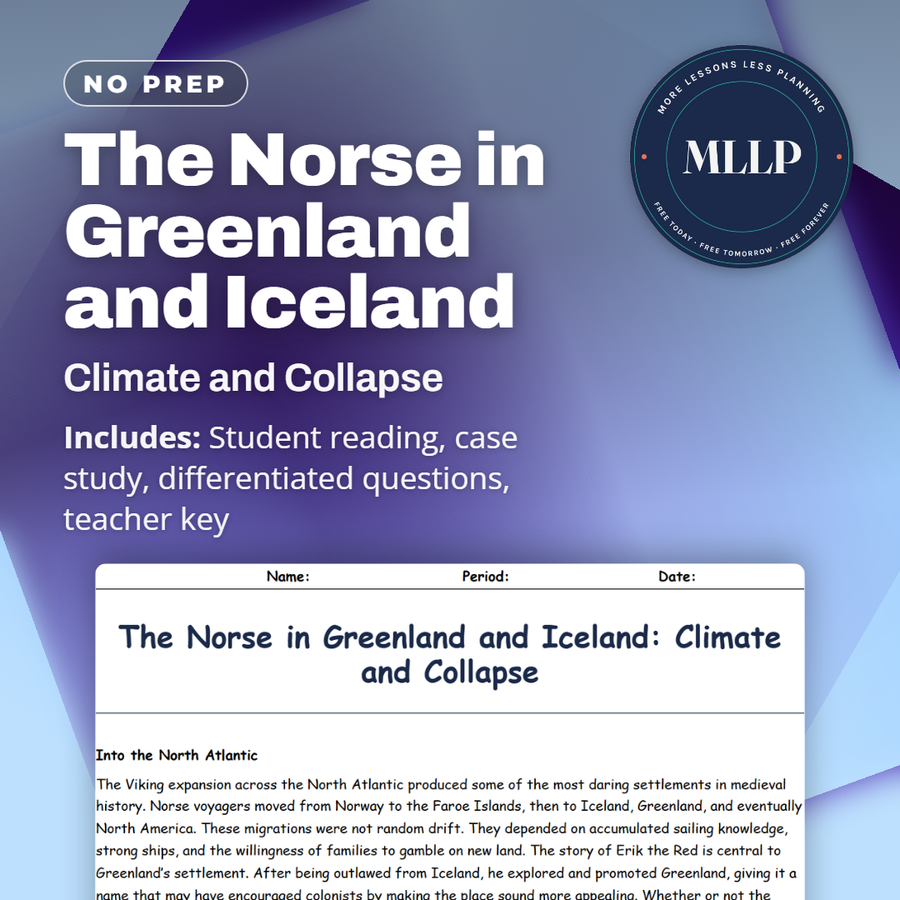
The Norse in Greenland and Iceland: Climate and Collapse
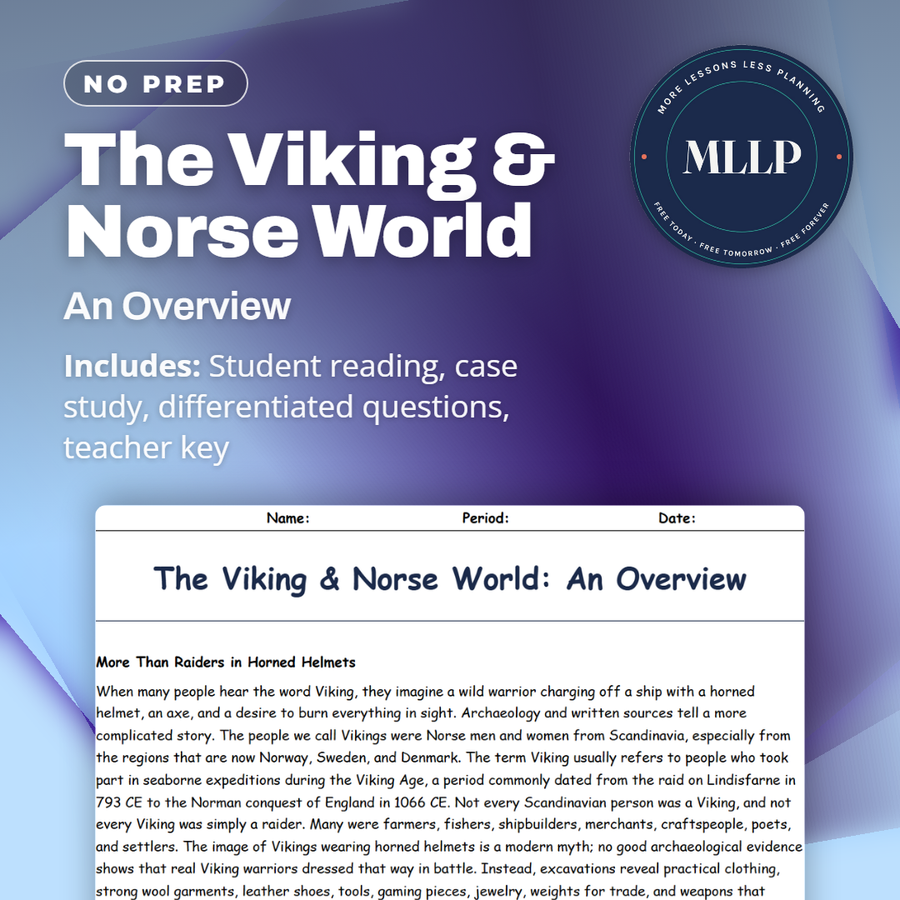
The Viking & Norse World: An Overview
Viking Burials: Ships, Sacrifice, and the Afterlife
Every lesson on this site is free to download and use. If one of them saved you a prep period, you can chip in a few bucks toward my three kids' daycare fund. That's genuinely where tips go.