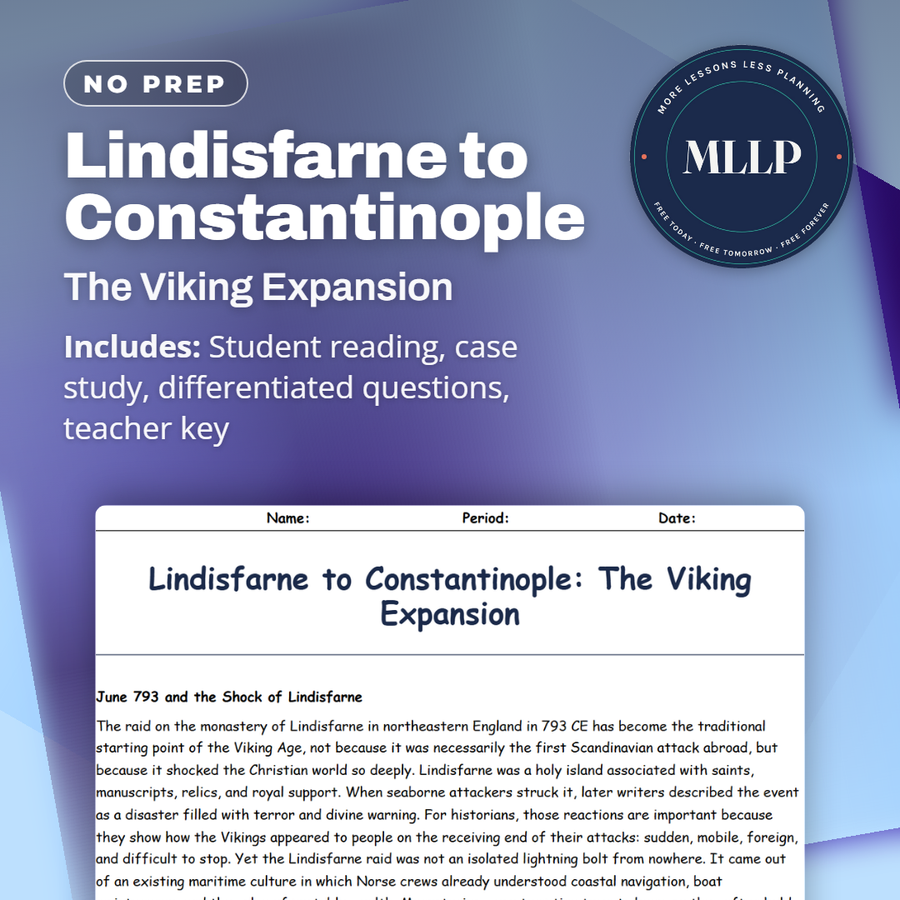
Lindisfarne to Constantinople: The Viking Expansion
Quality reviewed September 2026
Facts verified September 21, 2026
- Subject
- Social Studies
- Grades
- Grades 9-12
- Length
- 9-page student worksheet
- Time
- About one 50-minute class period
- Great for
- Sub plans and independent work
- Includes
- Reading passage, comprehension questions + full answer key
- Format
- Print-and-go PDF
What students do
- Three multiple-choice questions test what made the 793 CE raid so significant and how Norse traders reached the Black Sea
- Fill in three blanks naming Lindisfarne, the eastern river routes, and the Danelaw
- A case study follows the monk Eadric watching raiders land with speed and clear purpose
- Explain in three short-answer responses how western raiding and eastern river trade grew from different strategies
What it covers
- The 793 CE Lindisfarne raid and its place in Viking history
- Western expansion into Ireland, England, Francia, and Normandy
- Eastern river routes, Varangians, and trade in Arabic silver
Start reading this worksheet
June 793 and the Shock of Lindisfarne
The raid on the monastery of Lindisfarne in northeastern England in 793 CE has become the traditional starting point of the Viking Age, not because it was necessarily the first Scandinavian attack abroad, but because it shocked the Christian world so deeply. Lindisfarne was a holy island associated with saints, manuscripts, relics, and royal support. When seaborne attackers struck it, later writers described the event as a disaster filled with terror and divine warning. For historians, those reactions are important because they show how the Vikings appeared to people on the receiving end of their attacks: sudden, mobile, foreign, and difficult to stop. Yet the Lindisfarne raid was not an isolated lightning bolt from nowhere. It came out of an existing maritime culture in which Norse crews already understood coastal navigation, boat maintenance, and the value of portable wealth. Monasteries were tempting targets because they often held silver vessels, books with decorated bindings, food stores, and livestock, while lacking walls and garrisons. The lesson of Lindisfarne was military as well as psychological. A small force using fast ships could strike quickly and disappear before a larger army could organize. That strategy would be repeated across the North Sea world. Still, it is important not to let Lindisfarne define everything that followed. The same skills that made raiding possible also made trade, diplomacy, migration, and settlement possible. Lindisfarne marks the beginning of a wider expansion, not a story limited to monasteries in flames.
Westward Across the British Isles and Francia
Once Viking expeditions turned westward, they spread across a huge area. Scandinavian crews raided and settled in Ireland, Britain, and the Frankish world, while also moving into island chains in the North Atlantic. In Ireland, Vikings first appeared as raiders but later founded longphort camps that developed into towns such as Dublin, Waterford, and Limerick. These places became centers of trade linking Scandinavia, the Irish Sea, and continental Europe. In England, repeated attacks led to winter camps, tribute payments, and eventually conquest. The so-called Great Heathen Army that arrived in 865 CE was different from earlier hit-and-run raiders because it stayed, fought kingdoms, and carved out territories. Large parts of northern and eastern England came under Scandinavian influence in a region later called the Danelaw. Place names ending in -by, -thorpe, and -thwaite still reflect that settlement history. Viking armies also moved along rivers in Francia, where ships traveled up the Seine and other waterways to threaten major cities. Paris was attacked more than once, and Frankish rulers sometimes paid tribute rather than risk destruction. Over time, western expansion also produced political change. In 911, the Frankish king granted land to the Viking leader Rollo, helping create Normandy. What began as external pressure became incorporation. Raiders could become settlers, rulers, and cultural hybrids. Western Europe did not simply repel the Vikings; it absorbed them, negotiated with them, and was changed by them.
Eastward Rivers, Silver, and the Varangians
The eastern routes of Viking expansion are sometimes less famous in popular culture, but archaeology shows they were equally important. Swedish-centered networks moved across the Baltic and down the great river systems of eastern Europe. These Scandinavians are often called Varangians in Byzantine and Slavic sources, and in the lands of the Rus they became involved in trade, warfare, and state formation. Rivers such as the Dnieper and Volga functioned like highways connecting the Baltic to the Black Sea and the Caspian Sea. Ships could be rowed, sailed, dragged over portages, and relaunched, allowing merchants and warriors to move people and goods across astonishing distances. Along these routes, Norse traders exchanged furs, wax, honey, slaves, and other northern products for silver, silk, glassware, and luxury goods from the Islamic world and Byzantium. Huge quantities of Arabic silver dirhams found in Scandinavia prove how profitable these connections became. Some Norsemen served the Byzantine emperors as members of the Varangian Guard, an elite bodyguard famous for loyalty and foreign prestige. Others settled in trading towns such as Staraya Ladoga and Novgorod. Eastern expansion was therefore not mainly about monasteries and sudden raids; it was about controlling movement, building commercial ties, and inserting Scandinavian groups into broader political systems. It reminds us that the Viking world stretched from Newfoundland to the gates of Constantinople and from Atlantic islands to the marketplaces of the Islamic caliphates.
Like what you read? The full reading, the case study, and every question set are in the free download below, along with the answer key.
Why this matters
Students meet Lindisfarne as a single dramatic date in most textbooks, but this reading pushes them to see it as one entry point into a much larger network stretching from Ireland to Constantinople. That scale matters because it shows how quickly a regional maritime skill, once it exists, can reorganize trade, politics, and settlement across an entire continent within a few generations. The reading also gives students a useful habit for evaluating any historical explanation. When they are asked why the Vikings expanded, resisting a single tidy cause and instead weighing ship technology, political competition, and opportunity together is exactly the kind of reasoning historians rely on for messy, real events.
From one teacher to another
The raid at Lindisfarne in 793 CE did not invent Viking seafaring, but it gave later writers a single shocking date to mark the start of an age, and this reading uses that raid as a doorway into two very different directions of expansion. Heading west, Norse crews raided and settled in Ireland, England, and Francia, eventually carving out the Danelaw and, by 911, the duchy of Normandy. Heading east, Swedish-centered networks moved down the Dnieper and Volga toward Byzantium and the Islamic world, trading furs and slaves for the Arabic silver dirhams that still turn up in Scandinavian hoards. The reading argues that no single cause explains this reach, pointing instead to ship technology, political rivalry at home, and fractured kingdoms abroad. A case study follows a monk named Eadric watching the first ships land at Lindisfarne, realizing too late that the attack was planned, not random.
What you get
Download
Where should I send the next one?
Everything here is free and it stays that way. Leave your email and I'll send you the new lessons as they go up. You can unsubscribe from any one of them.
Related resources
 A Viking City Revealed_COVER.png)
Jorvik (York): A Viking City Revealed
L'Anse aux Meadows: Vikings in North America
Runes and Sagas: Viking Writing and Oral History
The Norse in Greenland and Iceland: Climate and Collapse
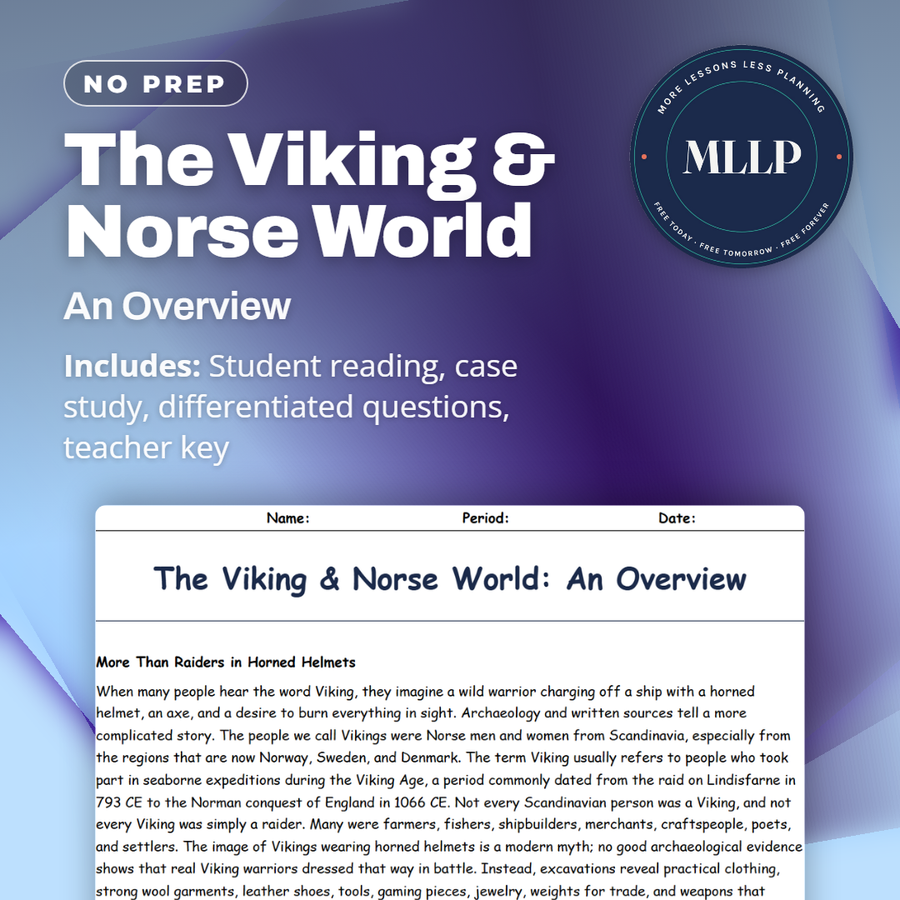
The Viking & Norse World: An Overview
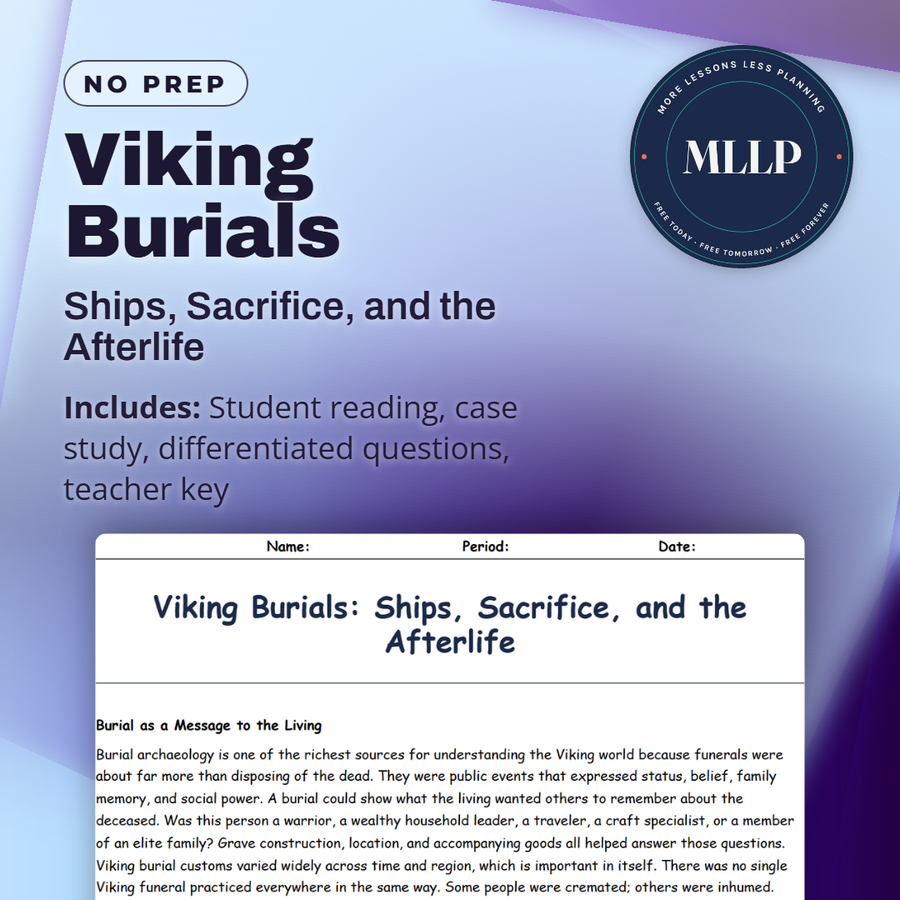
Viking Burials: Ships, Sacrifice, and the Afterlife
Every lesson on this site is free to download and use. If one of them saved you a prep period, you can chip in a few bucks toward my three kids' daycare fund. That's genuinely where tips go.