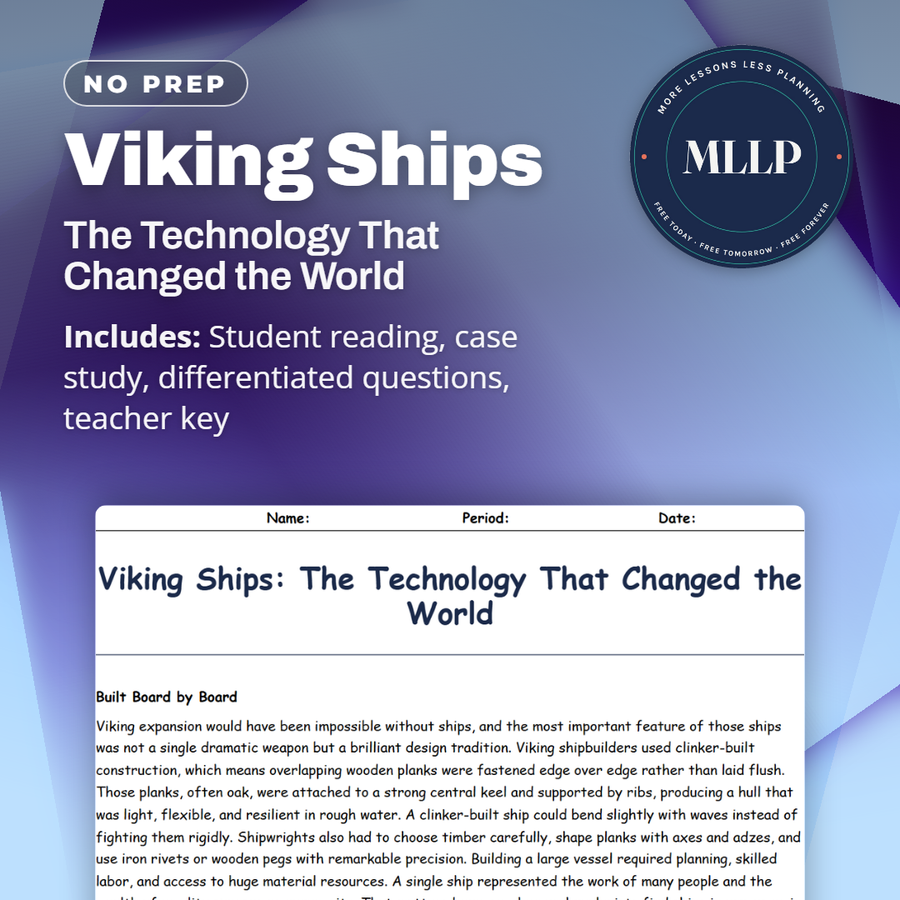
Viking Ships: The Technology That Changed the World
Quality reviewed September 2026
Facts verified September 21, 2026
- Subject
- Social Studies
- Grades
- Grades 9-12
- Length
- 9-page student worksheet
- Time
- About one 50-minute class period
- Great for
- Sub plans and independent work
- Includes
- Reading passage, comprehension questions + full answer key
- Format
- Print-and-go PDF
What students do
- Match five terms, including clinker-built, keel, and longship, to their definitions
- Three multiple-choice questions test what clinker-built construction meant and why the Oseberg and Gokstad finds matter
- Answer three short-answer questions about how ship design connected raiding, trade, and settlement
- A case study follows shipwright Eirik testing a new hull against rough water and a narrow inland channel
What it covers
- Clinker-built construction and the design of the Viking longship
- The Oseberg and Gokstad ships as both technology and grave monuments
- Navigation methods and modern experimental ship reconstructions
Start reading this worksheet
Built Board by Board
Viking expansion would have been impossible without ships, and the most important feature of those ships was not a single dramatic weapon but a brilliant design tradition. Viking shipbuilders used clinker-built construction, which means overlapping wooden planks were fastened edge over edge rather than laid flush. Those planks, often oak, were attached to a strong central keel and supported by ribs, producing a hull that was light, flexible, and resilient in rough water. A clinker-built ship could bend slightly with waves instead of fighting them rigidly. Shipwrights also had to choose timber carefully, shape planks with axes and adzes, and use iron rivets or wooden pegs with remarkable precision. Building a large vessel required planning, skilled labor, and access to huge material resources. A single ship represented the work of many people and the wealth of an elite sponsor or community. That matters because when archaeologists find ships in graves or in harbors, they are not just finding transportation. They are finding technology, politics, labor organization, and social status embodied in wood. Even the vocabulary of ship parts tells us how specialized the craft had become. The keel stabilized the vessel, strakes formed the hull planking, and the steering oar mounted on the right side gave us the modern word starboard. These ships were elegant because they solved several problems at once. They needed to be strong enough for open sea, light enough to haul or repair, and shallow enough to land on a beach or move up a river. Viking shipbuilding achieved that balance better than almost any maritime technology of its age.
Why the Longship Was So Powerful
The famous Viking longship is often remembered as a war machine, but its power came from versatility. Longships were narrow and swift, with shallow drafts that allowed crews to approach coastlines and riverbanks where deeper vessels would run aground. A square sail gave speed when the wind was favorable, while oars allowed movement when winds failed or when crews needed precise control in battle or river travel. This combination let Viking crews cross the North Atlantic, raid monasteries, move troops up inland waterways, and escape quickly after an attack. Yet not every Viking ship was a longship meant for fighting. Broader cargo ships, sometimes called knarrs, were better suited to carrying trade goods, livestock, and settlers. That distinction matters because popular culture often treats every Viking vessel as identical. Archaeology shows a maritime system with specialized craft adapted to different jobs. The ability to move armies, trade goods, and whole households meant that ships underpinned every part of Norse expansion. Ships also shaped social life. Laws regulated ship service. Communities contributed labor to naval levies. Leaders displayed power by owning or sponsoring impressive vessels. Poetry praised ships as living companions. Even warfare was transformed by maritime mobility, because Viking crews could choose where and when to strike. In many parts of Europe, defenses were built for roads, forts, and land armies, not for sudden attacks delivered from water. The longship’s real revolution, then, was not just speed. It was strategic freedom. It allowed the Norse to connect ocean, estuary, and river into a single operating space.
Oseberg, Gokstad, and Ships as Graves
Some of the most famous Viking ships survive because they were buried with the dead. The Oseberg ship, excavated in Norway in the early twentieth century, is one of the best-preserved Viking Age vessels ever found. Buried in 834 CE with two high-status women and a stunning collection of carved wood, textiles, sledges, wagons, and household goods, Oseberg shows that ships could carry deep symbolic meaning as well as practical value. The Gokstad ship, another major Norwegian find, was broader and more obviously seaworthy, and it was buried with a male elite individual and equipment linked to travel, status, and martial life. These discoveries transformed modern understanding of Viking craftsmanship because they preserved actual hulls instead of mere fragments or descriptions. They also raised questions. Were grave ships meant to carry the dead into the next world? Did they display the deceased person’s earthly power? Were they statements by surviving families about memory and rank? The answer is probably all of those at once. Ship burials turned a vessel into a monument. They announced that the dead belonged to a world of mobility, prestige, and command. Archaeology also reminds us that burial ships did not represent ordinary experience. Most people did not receive such spectacular funerals. Still, these finds matter because they reveal the highest levels of ship design and the cultural importance of seafaring. A buried ship is both machine and message, and that dual meaning is central to Viking archaeology.
Like what you read? The full reading, the case study, and every question set are in the free download below, along with the answer key.
Why this matters
Ship technology is easy to treat as a side detail in Viking history, but this reading makes the case that longships and cargo ships were the machines that made every other part of the story, raiding, trade, migration, and settlement, physically possible. That argument gives students a concrete example of how a single piece of technology can reshape a whole region's history, a pattern worth recognizing well beyond the Viking Age. The reading's section on experimental archaeology also models a kind of scientific thinking students can use elsewhere. Instead of guessing how a Viking ship performed, researchers built one and tested it in real water, turning a historical question into a measurable experiment.
From one teacher to another
Building a Viking longship took two years of cut oak, careful planning, and skilled labor, and this reading treats ship design as the single technology that made Viking expansion possible. Students learn what clinker-built construction actually means, how overlapping planks fastened to a central keel gave a hull that flexed instead of fighting rough water, and why a shallow draft let crews land on beaches or move up rivers that would strand a deeper ship. The reading also explains how the Oseberg and Gokstad ship burials preserved entire vessels, turning grave goods into evidence about both engineering and elite status, and how sailors navigated without a compass by reading stars, currents, and bird patterns. A closing section on experimental archaeology shows modern reconstructions being rowed and sailed to test claims that a museum display alone cannot answer. A case study follows the shipwright Eirik, proving his new hull's worth in a sudden squall and a narrow channel.
What you get
Download
Where should I send the next one?
Everything here is free and it stays that way. Leave your email and I'll send you the new lessons as they go up. You can unsubscribe from any one of them.
Related resources
 A Viking City Revealed_COVER.png)
Jorvik (York): A Viking City Revealed
L'Anse aux Meadows: Vikings in North America
Lindisfarne to Constantinople: The Viking Expansion
Runes and Sagas: Viking Writing and Oral History
The Norse in Greenland and Iceland: Climate and Collapse
The Viking & Norse World: An Overview
Every lesson on this site is free to download and use. If one of them saved you a prep period, you can chip in a few bucks toward my three kids' daycare fund. That's genuinely where tips go.