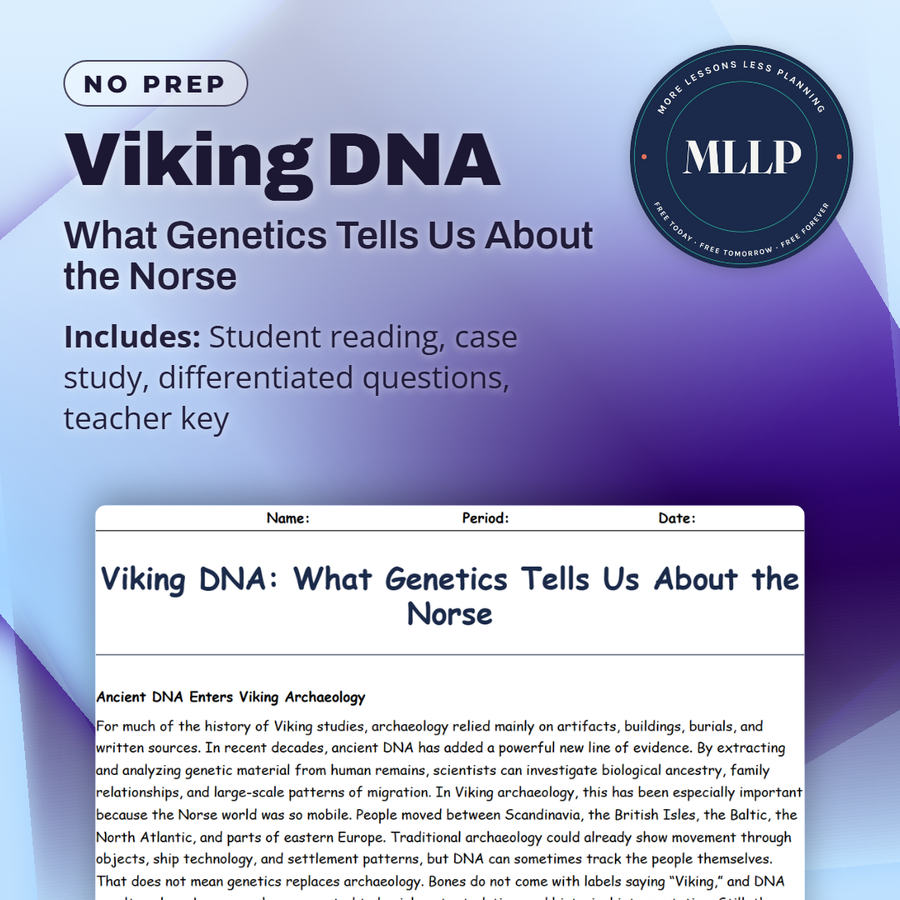
Viking DNA: What Genetics Tells Us About the Norse
Quality reviewed September 2026
Facts verified September 21, 2026
- Subject
- Social Studies
- Grades
- Grades 9-12
- Length
- 9-page student worksheet
- Time
- About one 50-minute class period
- Great for
- Sub plans and independent work
- Includes
- Reading passage, comprehension questions + full answer key
- Format
- Print-and-go PDF
What students do
- Match five terms, including ancient DNA, migration, and ancestry, to their definitions
- Three multiple-choice questions test what ancient DNA reveals about migration and why Viking ancestry was never uniform
- Write in three blanks the terms for genetic material from old bones, marrying into local populations, and archaeological context
- A case study follows Maya rethinking what a home DNA kit's Scandinavian result actually tells her
What it covers
- What ancient DNA reveals about Viking-age ancestry and migration
- The Birka BJ581 burial and the debate over a female warrior grave
- Why genetic ancestry does not equal Viking identity
Start reading this worksheet
Ancient DNA Enters Viking Archaeology
For much of the history of Viking studies, archaeology relied mainly on artifacts, buildings, burials, and written sources. In recent decades, ancient DNA has added a powerful new line of evidence. By extracting and analyzing genetic material from human remains, scientists can investigate biological ancestry, family relationships, and large-scale patterns of migration. In Viking archaeology, this has been especially important because the Norse world was so mobile. People moved between Scandinavia, the British Isles, the Baltic, the North Atlantic, and parts of eastern Europe. Traditional archaeology could already show movement through objects, ship technology, and settlement patterns, but DNA can sometimes track the people themselves. That does not mean genetics replaces archaeology. Bones do not come with labels saying “Viking,” and DNA results only make sense when connected to burial context, dating, and historical interpretation. Still, the impact has been major. Large genetic studies have shown that Viking-age populations were diverse and that mobility affected Scandinavia both outwardly and inwardly. People identified archaeologically as part of the Viking world could have ancestry from multiple regions, and some individuals buried in Scandinavian-style contexts were not simply local descendants of a single ancient population. Ancient DNA therefore broadens the field. It helps archaeologists move beyond assumptions based on hairstyle, saga imagery, or modern nationalism. The Viking world was connected, and connected worlds produce mixed people. It has also opened classroom discussions about how science and history work together, sometimes confirming old ideas and sometimes overturning them.
Not a Single Viking Look
One of the most important lessons from Viking DNA research is that there was no single biological “Viking type.” Popular stereotypes often imagine all Vikings as tall, blond, blue-eyed Scandinavians who shared a neat and uniform ancestry. Genetics does not support that image. Even within Scandinavia, populations were regionally varied, and Viking-age mobility increased that diversity. Some people buried in Viking contexts show ancestry linked to southern Europe, the Baltic, the British Isles, or farther east. This should not surprise us if we take the archaeology seriously. The Viking world was built through travel, slavery, marriage, mercenary service, trade, and settlement. Ships carried not only silver and weapons but also people, willingly or unwillingly. Over generations, communities changed. Genetic diversity is therefore evidence of history in motion. It also helps correct older romantic nationalism that tried to present Vikings as a pure ancestral race tied to modern identities. Archaeology has long warned against that thinking, and DNA reinforces the warning. A Viking was not defined by hair color. “Viking” was a cultural and historical role tied to participation in Norse-speaking maritime societies and expeditions during a specific period. Genetics can illuminate ancestry, but it does not reduce social identity to biology. The strongest conclusion is simple: the Viking world was more mixed, more dynamic, and more connected than the stereotype allows.
Migration, Mixing, and the Reach of Norse Networks
DNA evidence also helps trace where Viking-age people moved and how they interacted with other populations. In the west, Norse settlement in places such as the British Isles, Iceland, and Greenland involved both migration and intermarriage. Genetic studies of modern and ancient populations have shown Scandinavian influence in parts of Britain and the North Atlantic, but the patterns are uneven, reflecting local settlement histories rather than a single wave of replacement. In the east, Viking-linked groups moving through the Baltic and along river routes likewise entered complex zones of contact with Slavic and Finnic peoples. This matters because archaeology already shows the Viking world as a network of exchange rather than a sealed ethnic block. Genetics provides another way to see those entanglements. It can reveal, for example, whether people buried in the same cemetery were close relatives, whether individuals in a settlement grew up in different biological populations, or whether migration was sex-balanced or involved more men than women in certain regions. Those are big questions because they speak to colonization, marriage strategy, and social organization. Some Norse movements appear to have involved family groups, not only male war bands. Others may have begun more unevenly and later stabilized through local integration. DNA therefore turns broad historical claims into testable hypotheses. It helps archaeologists ask not just where ships went, but who was on them and how communities formed afterward. The story is demographic as well as geographic.
Like what you read? The full reading, the case study, and every question set are in the free download below, along with the answer key.
Why this matters
Genetic ancestry tests have become a common gift and a common source of confusion, and this reading gives students a clear, historically grounded way to think about what those results actually mean. Maya's realization, that a genome can point toward movement but cannot tell her who her ancestors thought they were, is a useful boundary for students to carry into any conversation about heritage, identity, or the popular idea of being part Viking. The reading also flags a real danger directly. Because Viking imagery gets used for racial and nationalist myths, understanding that DNA shows mixture and movement rather than a pure ancestral type is a defense against a specific kind of misinformation students are likely to encounter online.
From one teacher to another
For decades, Viking archaeology relied mainly on artifacts, buildings, and written sources, but this reading focuses on a newer tool, ancient DNA extracted from human remains. Students see how genetic evidence has already overturned the idea of a single blond, blue-eyed Viking type, revealing instead a population shaped by centuries of migration, intermarriage, and contact stretching from the British Isles to eastern Europe. The reading also returns to the Birka BJ581 burial, where DNA analysis confirmed that a weapon-rich grave long assumed to belong to a male warrior actually belonged to a biological female, reopening old debates about gender and combat in the Viking world. Throughout, the reading insists that genetics only makes sense alongside archaeological context, since ancestry alone cannot explain belief, culture, or identity. A case study follows Maya, whose home DNA kit links part of her ancestry to medieval Scandinavian migration and sends her back to a museum label for answers.
What you get
Download
Where should I send the next one?
Everything here is free and it stays that way. Leave your email and I'll send you the new lessons as they go up. You can unsubscribe from any one of them.
Related resources
 A Viking City Revealed_COVER.png)
Jorvik (York): A Viking City Revealed
L'Anse aux Meadows: Vikings in North America
Lindisfarne to Constantinople: The Viking Expansion
Runes and Sagas: Viking Writing and Oral History
The Norse in Greenland and Iceland: Climate and Collapse
The Viking & Norse World: An Overview
Every lesson on this site is free to download and use. If one of them saved you a prep period, you can chip in a few bucks toward my three kids' daycare fund. That's genuinely where tips go.