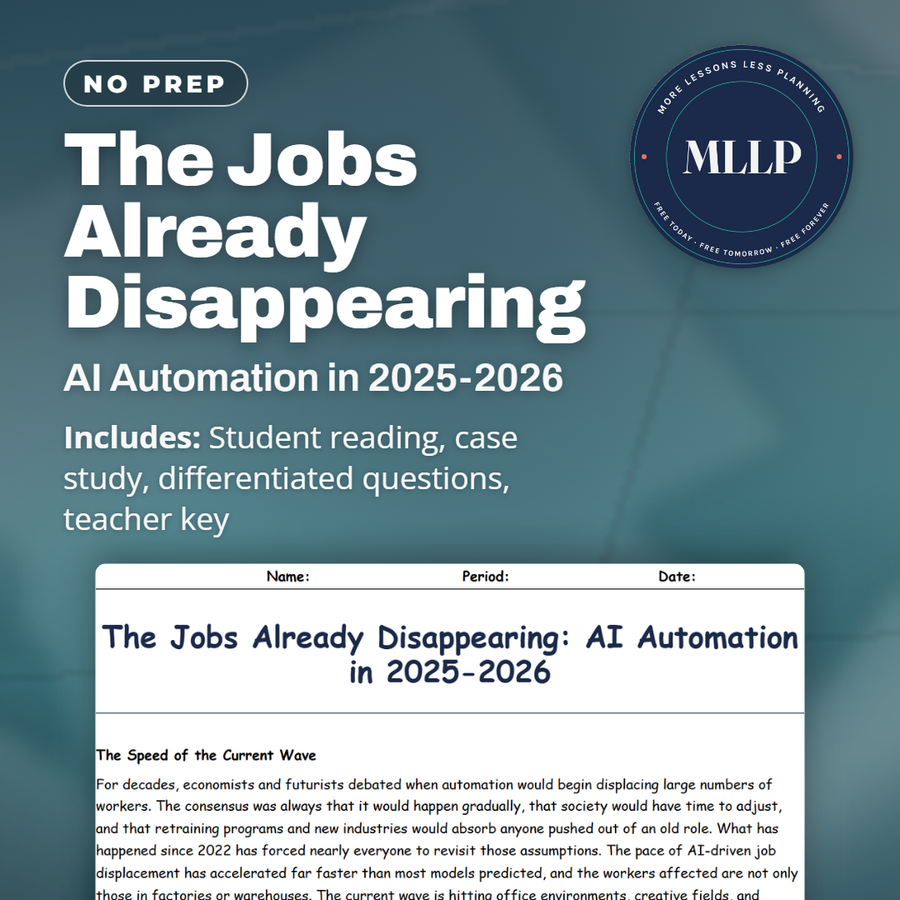
The Jobs Already Disappearing: AI Automation in 2025-2026
Quality reviewed September 2026
Facts verified September 20, 2026
- Subject
- Career & Life Skills
- Grades
- Grades 9-12
- Length
- 10-page student worksheet
- Time
- About one 50-minute class period
- Great for
- Sub plans and independent work
- Includes
- Reading passage, comprehension questions + full answer key
- Format
- Print-and-go PDF
What students do
- Five terms, including automation, displacement, and productivity multiplier, get matched to their definitions
- Fill in three blanks built from the Goldman Sachs and Klarna figures in the reading
- Marcus's case study, a call center team lead who watches his floor shrink from 340 agents to 90, gets read and unpacked
- Answer short answer questions on why the new jobs AI creates rarely go to the workers it displaces
What it covers
- Real 2024-2025 numbers on job displacement, from Goldman Sachs estimates to McKinsey's 2030 projections
- Sector-by-sector cases in manufacturing, warehouses, and customer service, including Klarna and Amazon
- A case study on a call center team lead whose staff shrinks from 340 to 90 almost overnight
Start reading this worksheet
The Speed of the Current Wave
For decades, economists and futurists debated when automation would begin displacing large numbers of workers. The consensus was always that it would happen gradually, that society would have time to adjust, and that retraining programs and new industries would absorb anyone pushed out of an old role. What has happened since 2022 has forced nearly everyone to revisit those assumptions. The pace of AI-driven job displacement has accelerated far faster than most models predicted, and the workers affected are not only those in factories or warehouses. The current wave is hitting office environments, creative fields, and service industries in ways that were not expected so soon. By early 2025, major research firms began publishing data showing that AI tools had already reduced headcount in certain job categories by measurable percentages. A Goldman Sachs analysis from late 2024 estimated that roughly 300 million full-time equivalent jobs globally could be exposed to automation, with a significant fraction of that exposure concentrated in knowledge work. The word exposed does not mean eliminated overnight, but it does mean that the tasks performed by those workers can now be partially or fully handled by AI systems. When tasks disappear, positions eventually follow. The speed of the current wave is partly explained by the rapid improvement in large language model capabilities. Tools that could barely write a coherent paragraph in 2021 were producing publishable content, passing professional licensing exams, and coding production software by 2024. Each capability jump eliminated another category of tasks that humans were previously paid to perform. The gap between each capability threshold has also been shrinking, meaning the next jump tends to arrive before the workforce has recovered from the last one.
Manufacturing and the Machines Taking Over
Manufacturing has lived with automation anxiety for a long time. Assembly lines replaced hand labor in the early twentieth century. Robots began replacing repetitive factory floor positions in the 1980s and 1990s. What is different about AI-driven automation in manufacturing is the ability of newer systems to handle tasks that require judgment, adaptability, and coordination with changing circumstances. Traditional industrial robots needed to be precisely programmed for a single task and would fail completely if the environment shifted. Modern AI systems can handle variability in real time. Amazon's warehouse network has become one of the most cited examples of what accelerated automation looks like in practice. In 2012, the company employed roughly one human for every task in its fulfillment centers. Over the following decade, robotic systems took over picking, sorting, packing, and quality control functions. By 2024, some Amazon facilities were operating with warehouse staffing levels that would have been unimaginable ten years earlier. Competitors including Walmart and Target have invested billions in similar systems, and the independent third-party logistics industry is following the same path. Automotive manufacturing has also seen significant shifts. While electric vehicle production has created some new jobs, the overall assembly process requires fewer labor hours than internal combustion engine vehicles. Paint robots, welding systems, and final inspection AI tools have reduced the per-vehicle labor requirement at multiple major automakers. Workers who were once essential to quality control are being replaced by camera-based AI systems that can detect microscopic defects faster and more consistently than any human inspector.
Service Jobs Fall Faster Than Expected
The assumption that service sector jobs were safer than manufacturing jobs because they require human interaction has proven partially wrong. Many service interactions, it turns out, do not actually require a human on the other end. They require a competent, responsive entity that can understand questions, access relevant information, and provide useful answers. AI tools have become that entity in a growing number of contexts. Customer service call centers, which once employed millions of workers globally, have been among the first service sectors to see significant AI-driven headcount reductions. Companies including Klarna, Chegg, and a number of major telecom providers publicly disclosed in 2024 that AI tools had taken over large percentages of their customer service interactions. Klarna's CEO announced that their AI assistant was doing the work of 700 human agents and handling customer conversations with satisfaction ratings comparable to human representatives. Chegg, an educational technology company, saw its stock price drop dramatically after acknowledging that students were turning to ChatGPT instead of paying for Chegg's tutoring and homework help services. These are not small companies or niche industries. The food service and retail sectors have also seen meaningful change. Self-checkout kiosks were just the beginning. AI-powered ordering systems, inventory management tools, and customer service robots are now operational in grocery chains and fast food outlets across the United States. Several fast food chains have tested fully automated food preparation for select menu items, and those tests have moved to rollout phases in multiple markets. These changes affect some of the most common entry-level job categories available to young workers without college degrees.
Like what you read? The full reading, the case study, and every question set are in the free download below, along with the answer key.
Why this matters
My students hear that AI is coming for jobs, but the abstraction lets them assume it means someone else's job, somewhere else, later. This reading names the actual companies, the actual numbers, and a specific person, Marcus, whose team went from full to nearly empty while he kept his own position and watched the change happen around him. It matters because several of the entry-level jobs described here, call center work, warehouse work, retail, are exactly the jobs many of my students will work first, so the reading gives them a realistic picture of what that first job might look like by the time they get there.
From one teacher to another
Marcus watched his call center staff shrink from 340 agents to 90 in a single quarter, and his own job changed from coaching twelve people to monitoring an AI system handling 800 conversations at once. The reading builds up to his story with real numbers: a Goldman Sachs estimate on jobs exposed to automation, Klarna's claim that its AI assistant does the work of 700 agents, and McKinsey's projection that 14 percent of the global workforce may need to change occupations by 2030. It also covers warehouses and auto plants, where the shift from rigid robots to adaptable AI systems has changed what counts as a safe manufacturing job. Some sentences here are short and blunt. Others carry a full statistic and take longer to read.
What you get
Download
Where should I send the next one?
Everything here is free and it stays that way. Leave your email and I'll send you the new lessons as they go up. You can unsubscribe from any one of them.
Related resources
"Vibe Coders" and Surface Workers: Why Real Skills Still Matter
AI Dependence: When the Tool Becomes a Crutch You Can't Put Down
AI and Inequality: Who Gets Left Behind When Tools Get Smarter
Cognitive Offloading: When You Stop Thinking for Yourself
Skill Atrophy in Real Life: Stories From College and the Workplace
The "Junior Employee Crisis": How Will Anyone Learn the Job?
Every lesson on this site is free to download and use. If one of them saved you a prep period, you can chip in a few bucks toward my three kids' daycare fund. That's genuinely where tips go.