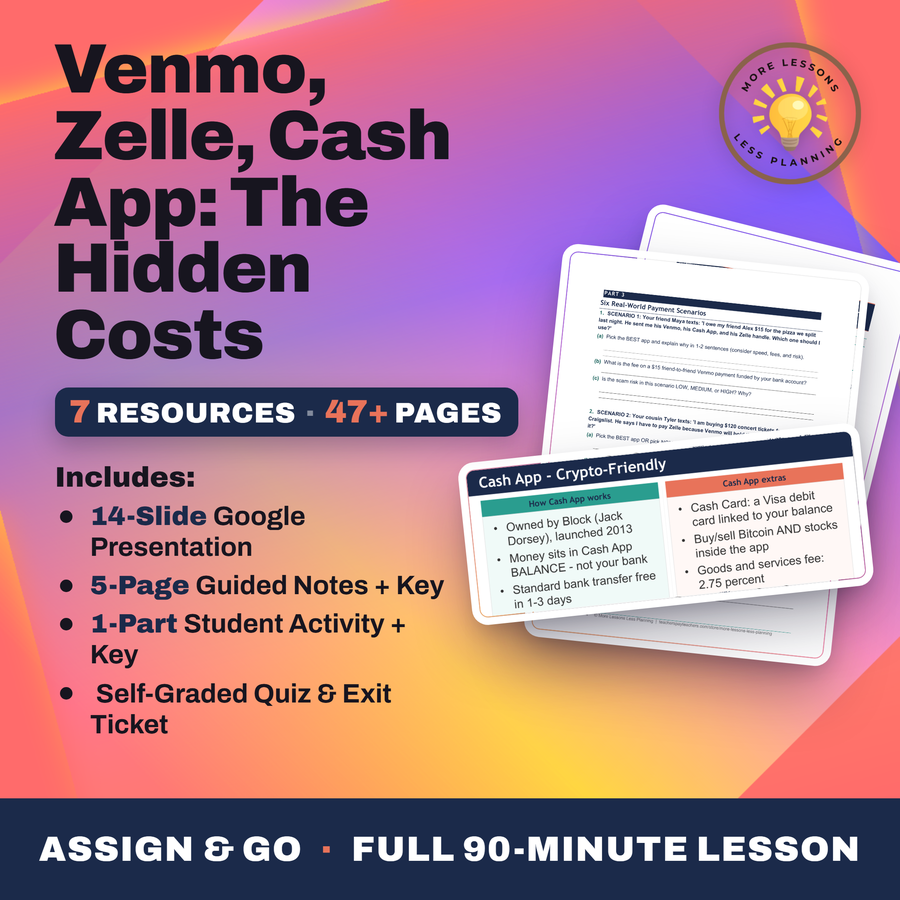
Venmo, Zelle, Cash App: The Hidden Costs
Quality reviewed September 2026
- Grades
- Grades 9-12
- Time
- About two 50-minute class periods
- Includes
- 11 ready-to-teach files
- Format
- Word (.docx) · PowerPoint (.pptx)
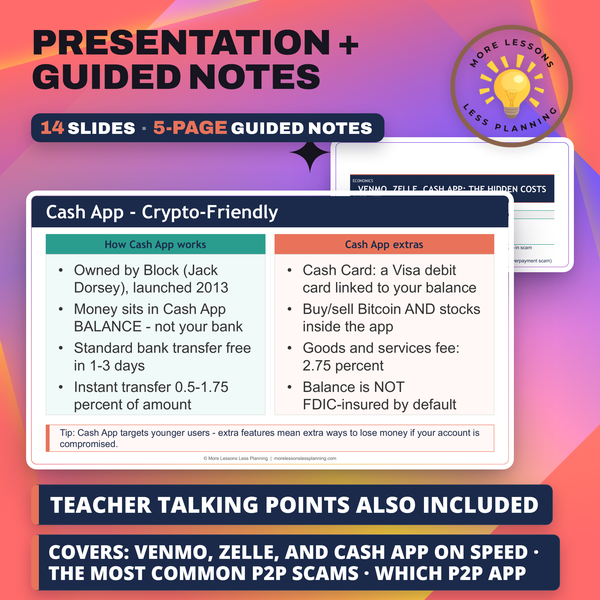
- Slide deck
- Guided notes
- Guided notes teacher key
- Activity + answer key
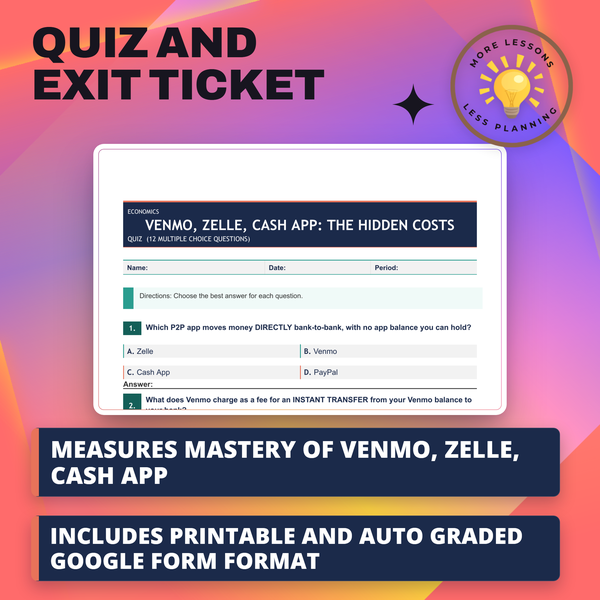
- Quiz + answer key
- Exit ticket + answer key
- Teacher guide
- Teacher presentation notes
What students do
- Compare Venmo, Zelle, and Cash App on transfer speed, instant-transfer fees, and FDIC insurance coverage
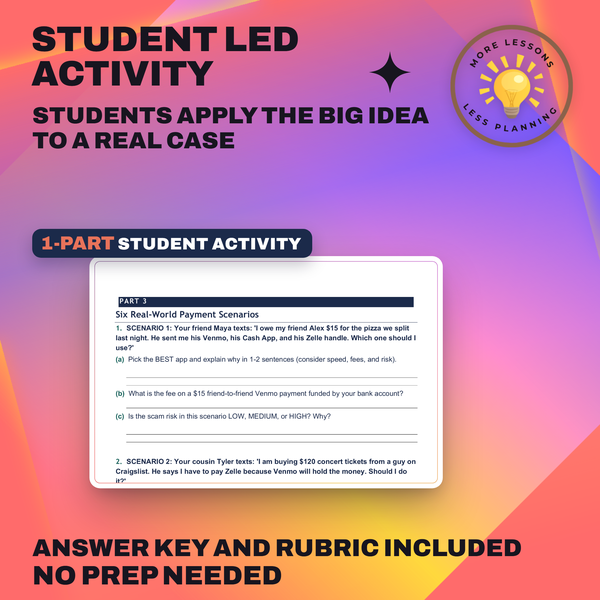
- Work six real-world payment scenarios, from splitting pizza with a friend to a Craigslist concert-ticket sale
- Identify the fake refund page, fake bank call, and Venmo overpayment scams and name the one rule that stops each
- Write a group-chat safety guide citing at least three specific numbers - a fee percentage, the FDIC cap, or a volume figure
What it covers
- How Zelle, Venmo, and Cash App actually move money, and which balances are FDIC-insured by default
- Six real payment scenarios, from splitting pizza with a friend to a Craigslist concert-ticket sale
- The fake refund page, fake bank call, and Venmo overpayment scams, and the one rule that stops each
- The $250,000 FDIC cap and other specific numbers a real safety guide needs to cite
Learning targets
- Compare Venmo, Zelle, and Cash App on speed of transfer, fees, and built-in scam protection.
- Identify the most common P2P scams (fake refund page, fake bank call, overpayment scam) and explain why apps generally do NOT refund victims.
- Evaluate which P2P app (or NONE of them) is safe to use for a given real-world payment scenario.
Peek inside
P2P apps moved over $1 TRILLION in U.S. payments in 2023-2024
Average American adult uses P2P at least once per week
Three apps dominate: Zelle, Venmo, Cash App
Replaced cash and checks for most everyday peer payments
Same speed and convenience that scammers love
P2P Apps Now Move the Most Everyday U.S. Payments
P2P apps moved over $ TRILLION in U.S. payments in 2023-2024.
The average American adult uses a P2P app at least once per .
Three apps dominate U.S. P2P: Zelle, Venmo, and Cash .
P2P apps have replaced cash and checks for most everyday peer .
The same speed and convenience that make P2P useful also make it perfect for .
1. The peer-to-peer app owned by PayPal, where money you receive sits in an app balance and the free bank transfer takes 1-3 business days, is .
Why this matters
Sending money through Zelle feels just like Venmo until it goes to the wrong person, and then the difference is permanent: Zelle moves cash bank-to-bank with no way to reverse it. Venmo and Cash App hold a balance that isn't FDIC-insured by default and charge 1.75 percent for an instant transfer.
The rule I drill hardest isn't technical: a real refund never asks for money first, a real bank never tells a customer to Zelle themselves, and a genuine overpayment gets returned in full, never just the difference. Students can describe a scam correctly on a quiz and still fall for one under pressure, so the safety guide needs an actual number.
From one teacher to another
This lesson treats Venmo, Zelle, and Cash App as the real financial tools students already use every week, not abstract vocabulary. They learn the actual mechanics that most adults get wrong too, that Zelle moves money bank-to-bank with no fee but is completely irreversible once sent, while Venmo and Cash App hold a balance that is not FDIC-insured by default and charge 1.75% for an instant transfer. Playing Jordan, the friend everyone in the group chat asks before sending money, students work six real scenarios and have to say which app fits and why, including the one where a Craigslist seller insists on Zelle for concert tickets, a red flag they have to name themselves before I confirm it. The scam section stays concrete and rule-based rather than vague: real refunds never ask you to send money first, real banks never tell you to Zelle yourself, and if a buyer overpays you send back the whole amount, never just the difference. Students finish by writing a safety guide for their own group chat that has to cite specific numbers, not just good intentions, because a fee percentage or the $250,000 FDIC cap is what actually makes advice useful instead of generic.
Every file in this toolkit
-
Activity (Student)
Jordan is the one friends text before they tap send on a payment, so you work six real scenarios from splitting pizza to a Craigslist ticket sale, pick the right app for each, name the fees and scam risks, then write a safety guide citing specific numbers like the FDIC cap.
-
Activity (Answer Key)
All six scenarios get a named app plus a scam-risk rating, the three scam scripts each get their one-line protective rule, and FDIC coverage gets sorted app by app. A safety guide citing the $250,000 cap gives the closing recommendation.
-
Exit Ticket (Student)
Three questions ask which app never lets money leave a normal FDIC-insured account, explain why apps usually deny a refund on a peer-to-peer scam, and pick the least safe of four peer-to-peer payment scenarios. A safety guide covering five required elements rounds out the answer.
-
Exit Ticket (Answer Key)
Zelle is the app that never holds a separate balance, an authorized push payment is why refunds usually get denied, and buying concert tickets from a stranger on Craigslist is the least safe scenario listed. This one earns a teacher's read, no fixed scale attached.
-
Guided Notes (Student)
Six real scenarios, splitting a bill with a friend through a stranger's Craigslist sale, put Zelle's bank-to-bank transfer against Venmo and Cash App's 1.75 percent instant-transfer charge and their lack of FDIC coverage by default. Students name the rule that stops each scam.
-
Guided Notes (Teacher Key)
The 1.75 percent instant-transfer charge, the $250,000 FDIC cap per depositor per bank, and the over $1 trillion P2P apps moved in 2023 to 2024 all come tallied with sources. The refund-page scam, the bank-impersonation call, and the overpayment script each carry the rule that stops it.
-
Quiz (Student)
A Craigslist scenario has a buyer insist on Zelle for a $300 iPhone, a fee item asks what Venmo charges for an instant transfer, and a matching item asks which app moves cash bank-to-bank directly.
-
Quiz (Answer Key)
That instant-transfer fee on Venmo runs 1.75 percent, the Zelle-only buyer gets flagged for a move with no refund protection, and Zelle's yearly transfer volume lands near $806 billion.
-
Slides
A 2023 to 2024 volume chart sets Zelle's $806 billion against Venmo's $270 billion and Cash App's $248 billion, then later slides cover the fake refund page and fake bank call scripts along with the $250,000 FDIC cap that applies per bank, not per app.
-
Teacher Guide
One assignment sends students into their own Venmo or Cash App settings to check five toggles, from the feed's privacy level to whether face-ID guards the login, and fix one tonight. Discussion work asks whether banks should refund Zelle scam losses the way credit cards do.
-
Teacher Presentation Notes
A total of $806 billion moved through Zelle in 2023 and 2024 alone, dwarfing Venmo's $270 billion and Cash App's $248 billion on the volume chart that opens the comparison. A later slide defines authorized push payment as the reason apps will not reverse a payment once someone hits send.
Download
Where should I send the next one?
Everything here is free and it stays that way. Leave your email and I'll send you the new lessons as they go up. You can unsubscribe from any one of them.
Related resources
Credit Scores: The Number That Runs Your Life
Cryptocurrency: Bitcoin, Ethereum & the Crypto Crash
How Banks Make Money: The Spread Explained
The FDIC: What's Insured & What's Not
Amazon Warehouses: Working Conditions Investigation
Anti-Trust Laws and Regulation: Promoting Fair Competition
Every lesson on this site is free to download and use. If one of them saved you a prep period, you can chip in a few bucks toward my three kids' daycare fund. That's genuinely where tips go.