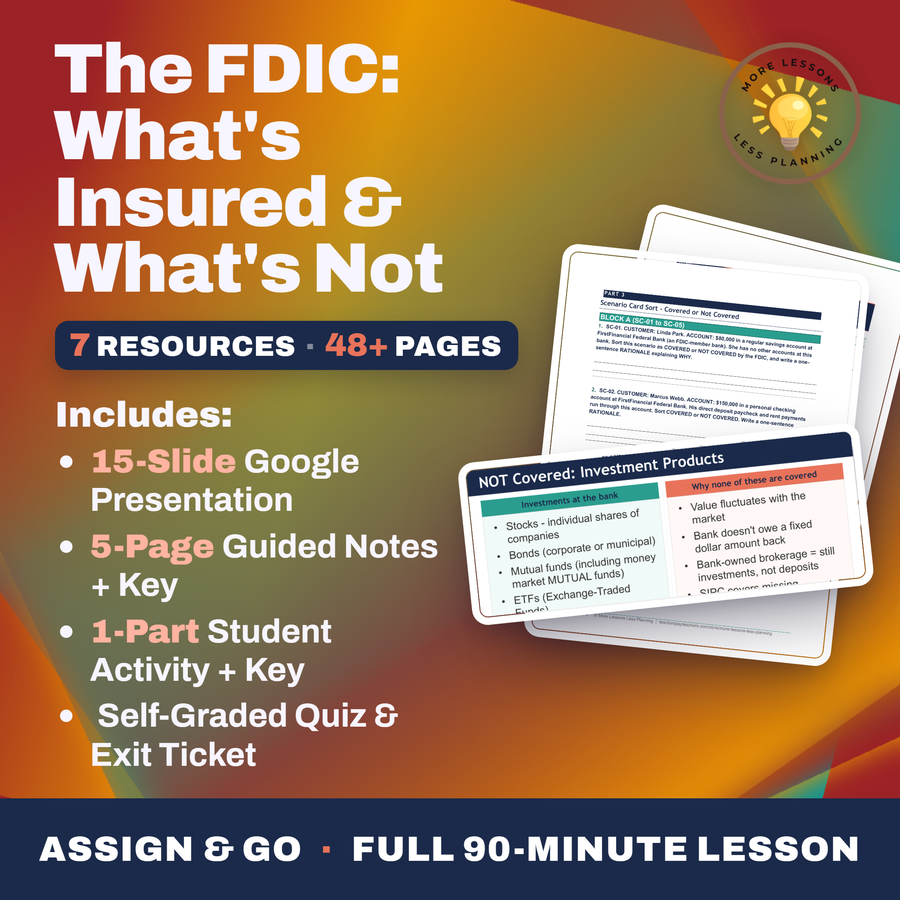

The FDIC: What's Insured & What's Not
Quality reviewed September 2026
- Grades
- Grades 9-12
- Time
- About two 50-minute class periods
- Includes
- 11 ready-to-teach files
- Format
- Word (.docx) · PowerPoint (.pptx)
- Slide deck
- Guided notes
- Guided notes teacher key
- Activity + answer key
- Quiz + answer key
- Exit ticket + answer key
- Teacher guide
- Teacher presentation notes
What students do
- Identify what FDIC insurance covers and the $250,000 per depositor, per bank, per ownership category limit
- Sort real accounts into covered bank deposits and uncovered investment products like stocks, mutual funds, and crypto
- Stack ownership categories, joint accounts, and POD beneficiaries to insure well past $250,000 at one bank
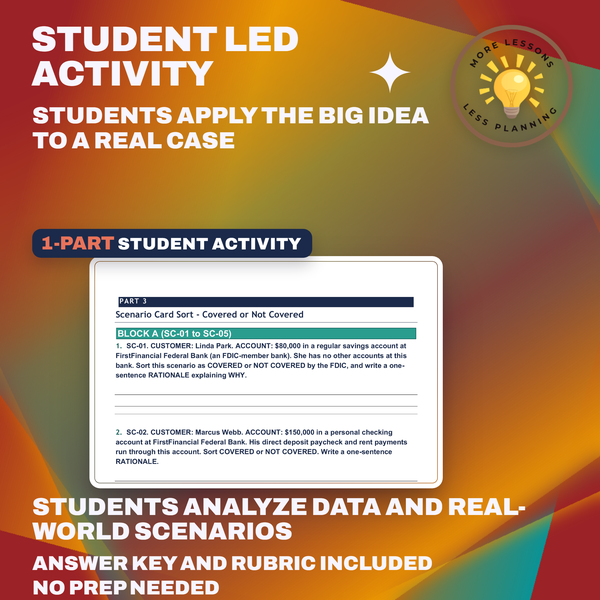
- Apply the FDIC's defining test to a set of customer account scenarios and write a compliance memo
What it covers
- The three multipliers, per depositor, per bank, per ownership category, that let a family insure well over $1,000,000 at a single bank
- Why crypto exchange balances, like the ones frozen when FTX collapsed in 2022, get zero FDIC protection
- How POD beneficiary accounts and joint accounts stack coverage on top of a single account at the same bank
- The one test that decides everything: does the bank actually owe you a fixed dollar amount back on demand
Learning targets
- Identify what FDIC insurance covers and the $250,000 per depositor per bank limit.
- Distinguish FDIC-covered deposit accounts from uncovered products like mutual funds, stocks, and crypto.
- Apply strategies for households or businesses that need to insure more than $250,000.
Peek inside
Federal Deposit Insurance Corporation - a U.S. government agency
Created in 1933 by the Banking Act after the Great Depression bank runs
Insures deposits at FDIC-member banks - automatic, no enrollment
Funded by premiums paid by member banks, not by taxpayers
When a bank fails, pays insured depositors within DAYS
The Federal Deposit Insurance Corporation
The FDIC is a U.S. government created in 1933.
It was created by the Banking Act after the Great bank runs.
The FDIC insures at FDIC-member banks - automatic, no enrollment needed.
It is funded by premiums paid by member , not by taxpayers.
When a bank fails, the FDIC pays insured depositors within .
1. The federal agency created in 1933 after the Great Depression that automatically protects depositors at member banks - funded by premiums the banks pay, not by taxpayers - is the .
Why this matters
The crypto balances frozen when FTX collapsed in 2022 sat inside accounts that felt exactly like a bank account, and none were protected by the FDIC. The instinct is to assume anything held at a financial company must be insured, and these fifteen customer scenarios exist to correct that, one account at a time.
Plenty of adults get this wrong too: $250,000 is not a hard ceiling on one account at one bank. A family stacking joint accounts and POD beneficiaries correctly can insure well past a million dollars there, and proving that with real scenarios lands harder than just stating the rule.
From one teacher to another
Riley is a new compliance trainee at a bank, handed fifteen real customer account scenarios and told to sort out what the FDIC actually protects before this quarter's disclosure audit, and students step straight into that stack of accounts. The instinct most of them start with is that anything sitting inside a bank must be insured, so I spend real time on the accounts that aren't, brokerage stocks, mutual funds, crypto balances, and a safe deposit box's contents, none of which the FDIC touches even when they're held at the exact same bank as a covered checking account. Where it gets interesting is the $250,000 limit itself, since it isn't one flat ceiling, joint accounts and POD beneficiaries each open up separate coverage at the same bank, and a family working the categories correctly can insure well past that number without ever opening a second bank account. By the end they're applying one defining test to every scenario Riley hands them and writing it up in an actual compliance memo.
Every file in this toolkit
-
Activity (Student)
Riley sorts fifteen customer accounts for a compliance audit, savings, joint checking, mutual funds, an annuity, a safe deposit box, and Bitcoin held at Coinbase, calling each one covered or not before writing the compliance memo.
-
Activity (Answer Key)
Sorted answers mark Diane and Robert Chen's $400,000 joint account as covered while Sasha Patel's Coinbase Bitcoin and Felix Wong's safe deposit box are not, then stack ownership categories to insure a family past $1,000,000 at one bank.
-
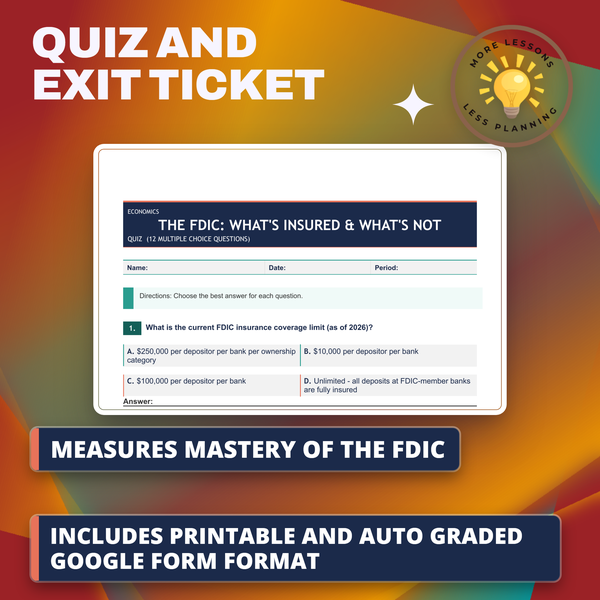
Exit Ticket (Student)
Multiple-choice items state the dollar limit the FDIC insures per depositor at one bank, identify which of four account types actually falls outside FDIC coverage, and pick the simplest way to fully insure $750,000 in cash. Four required elements for insuring $500,000 make up the answer.
-
Exit Ticket (Answer Key)
$250,000 marks the insured limit per category at one bank, a mutual fund is the product left uncovered even when sold through a bank, and splitting funds across three member banks answers the $750,000 case. The limit, two strategies, one uncovered product, and the coverage test all need to show up.
-
Guided Notes (Student)
Sections separate covered deposits like checking and CDs from investments and crypto that carry no coverage at all, then the $250,000 per-depositor per-bank cap gets multiplied through joint accounts and named beneficiaries until one family's total coverage there tops $1 million.
-
Guided Notes (Teacher Key)
Coverage compounds step by step in these answers, $500,000 across a two-owner joint account and $1,250,000 across five named beneficiaries, closing on the 2022 FTX collapse where balances held on the exchange got zero protection from deposit insurance.
-
Quiz (Student)
A safe deposit box of jewelry, a joint checking account, and crypto held at an exchange each get tested against the FDIC's coverage rule, with items on POD beneficiaries and IntraFi.
-
Quiz (Answer Key)
The FDIC caps coverage at $250,000 per depositor per ownership category, crypto and safe deposit box contents come up uncovered, and a joint account and an IRA open separate coverage at one bank.
-
Slides
Checking, savings, and CDs land in the covered pile while stocks, crypto, and safe deposit box contents do not, FTX's 2022 collapse among the examples used. Stacking a joint account with named beneficiaries pushes one couple's coverage at a single bank up to $3.5 million.
-
Teacher Guide
15 customer account scenarios drive the sorting activity, and Teaching Tips flag the money market deposit account versus money market mutual fund mix-up as the pitfall adults get wrong too.
-
Teacher Presentation Notes
Created in 1933 by the Banking Act after Great Depression bank runs, the agency's founding gets its own opening slide before the dollar math starts. Later slides name the IntraFi and CDARS networks that split one customer's money across banks automatically.
Download
Where should I send the next one?
Everything here is free and it stays that way. Leave your email and I'll send you the new lessons as they go up. You can unsubscribe from any one of them.
Related resources

Credit Scores: The Number That Runs Your Life

Cryptocurrency: Bitcoin, Ethereum & the Crypto Crash
How Banks Make Money: The Spread Explained

Venmo, Zelle, Cash App: The Hidden Costs
Amazon Warehouses: Working Conditions Investigation

Anti-Trust Laws and Regulation: Promoting Fair Competition
Every lesson on this site is free to download and use. If one of them saved you a prep period, you can chip in a few bucks toward my three kids' daycare fund. That's genuinely where tips go.