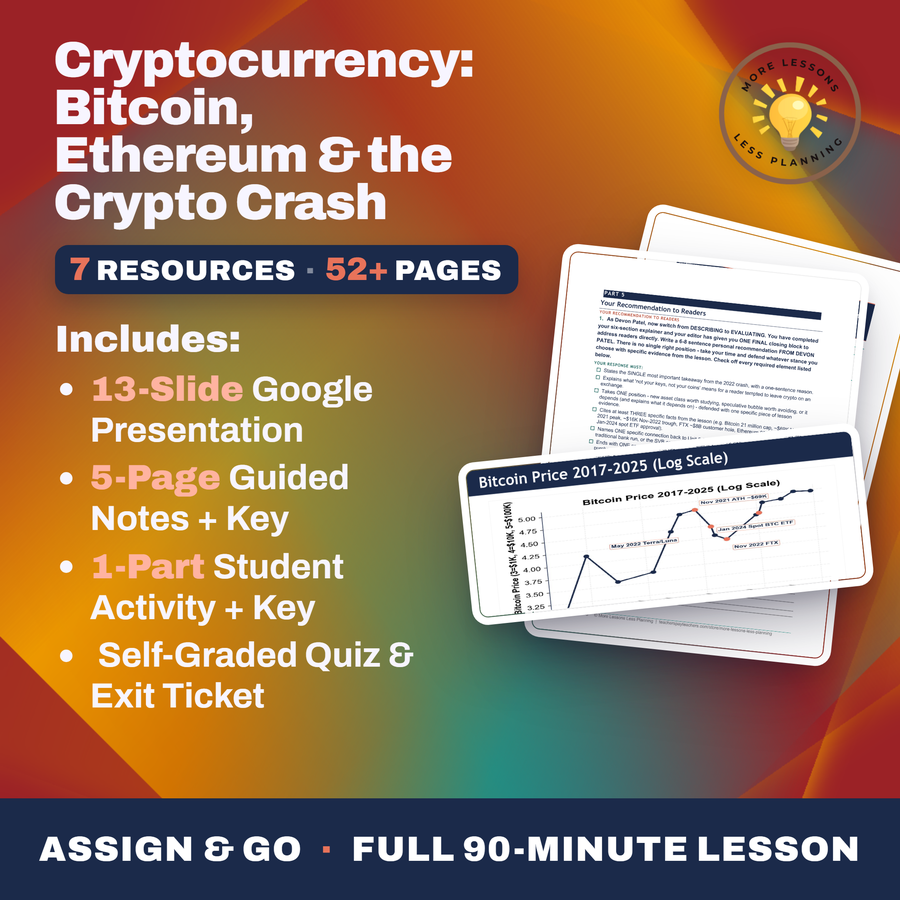

Cryptocurrency: Bitcoin, Ethereum & the Crypto Crash
Quality reviewed September 2026
- Grades
- Grades 9-12
- Time
- About two 50-minute class periods
- Includes
- 11 ready-to-teach files
- Format
- Word (.docx) · PowerPoint (.pptx)
- Slide deck
- Guided notes
- Guided notes teacher key
- Activity + answer key
- Quiz + answer key
- Exit ticket + answer key
- Teacher guide
- Teacher presentation notes
What students do
- Compare Bitcoin and Ethereum on design purpose, supply rules, and consensus mechanism
- Trace the 2022 crash chronologically, from the Terra/LUNA stablecoin collapse to the FTX bankruptcy
- Distinguish what failed in 2022, the centralized companies, from what kept working, the decentralized protocols
- Connect the FTX collapse to bank-run mechanics and compare its outcome to Silicon Valley Bank in 2023
What it covers
- Bitcoin's 21-million hard cap and proof of work, versus Ethereum's smart contracts and proof of stake
- The 2022 chronology, Terra/LUNA in May, Celsius and Three Arrows Capital in June, FTX in November
- How FTX loaned about $8 billion in customer deposits to Alameda Research and froze withdrawals
- Why "not your keys, not your coins" matters, and how FTX customers fared compared to SVB depositors
Learning targets
- Explain in plain language what cryptocurrency and blockchain are, and how a decentralized ledger differs from a bank's centralized ledger.
- Compare Bitcoin and Ethereum on three dimensions: design purpose, supply rules, and consensus mechanism (proof of work vs proof of stake).
- Trace the 2022 crypto crash from Terra/Luna in May to the FTX collapse in November, and evaluate the 'not your keys, not your coins' lesson against Unit 5 banking concepts.
Peek inside
Digital money recorded on a DECENTRALIZED network, not a bank
First cryptocurrency: Bitcoin, launched January 2009
No central issuer - no Fed, no Treasury, no bank in the middle
Ledger maintained by thousands of computers running open-source code
Transactions are recorded publicly and (mostly) cannot be reversed
Digital Money on a Decentralized Ledger
Cryptocurrency is digital money recorded on a network rather than a bank.
The first cryptocurrency, Bitcoin, was launched in the year .
There is no central issuer - no Fed, no Treasury, no in the middle.
The ledger is maintained by thousands of computers running -source code.
Crypto transactions are recorded publicly and (mostly) cannot be .
1. Q1. Digital money recorded on a decentralized ledger spread across thousands of computers worldwide, with no bank or central issuer controlling the record, is called .
Why this matters
A classmate who says they 'lost everything in the crypto crash' is usually describing a company collapsing, not the Bitcoin or Ethereum network itself, and telling those apart is most of the point here. Bitcoin kept producing blocks on its fixed 21-million-coin schedule straight through 2022, the same months Terra, Celsius, and FTX were failing.
Comparing how FTX customers fared after the exchange loaned $8 billion of deposits to its own trading firm against how Silicon Valley Bank depositors fared four months later gives students a faster route into deposit insurance than any definition on a slide. It sets up the FDIC lesson before I've even named the FDIC.
From one teacher to another
The line I have to correct every time is "crypto failed in 2022," because what actually failed were five specific companies, Terra Labs, Celsius, Three Arrows Capital, Voyager, and FTX, while the Bitcoin and Ethereum protocols kept producing blocks on schedule through the entire crash. Students play a financial-literacy reporter tracing the chain reaction month by month, from the Terra/LUNA stablecoin collapse in May through FTX freezing withdrawals in November after it turned out the exchange had loaned $8 billion of customer deposits to its own sister trading firm. I connect it straight back to our banking unit: FTX's run has the same mechanics as a bank run, and I have them compare how FTX customers fared against Silicon Valley Bank depositors four months later, which is a much shorter path to understanding deposit insurance than any textbook definition.
Every file in this toolkit
-
Activity (Student)
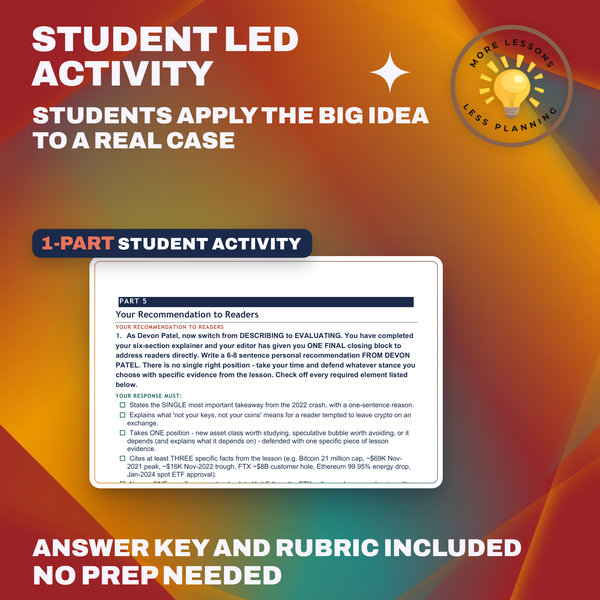
Devon Patel traces the 2022 crash company by company, from the Terra Labs stablecoin break through Celsius, Three Arrows Capital, and the FTX bankruptcy, sorting what failed from what the underlying networks kept doing.
-
Activity (Answer Key)
Founders Satoshi Nakamoto and Vitalik Buterin open the answers, then the proof of stake switch, the Terra Labs death spiral, and the $8 billion Alameda loan that froze customer withdrawals at FTX get worked out in full.
-
Exit Ticket (Student)
One question asks what actually separates Bitcoin from Ethereum, another asks whether the 2022 crash exposed a flaw in the protocols themselves or the centralized companies built on top of them, and a third ties FTX's collapse to Unit 5's banking concepts.
-
Exit Ticket (Answer Key)
Digital scarcity versus programmable contracts is the Bitcoin-Ethereum split, centralized intermediaries take the blame for 2022's failures over the protocols themselves, and FTX's collapse reads like a bank run on one ledger. A short paragraph closes this, judged for understanding, no checklist.
-
Guided Notes (Student)
Notes trace a decentralized ledger from its 2009 launch through the 21-million coin cap, then work through 2022 in order, the Terra and Luna stablecoin's May collapse, a lender and a hedge fund failing in the weeks after, and a major exchange's bankruptcy that November.
-
Guided Notes (Teacher Key)
Dollar figures fill in the trail, a firm founded in 2019, valued at $32 billion, then lending about $8 billion in depositor cash to its affiliated trading firm before filing bankruptcy on November 11, 2022, plus Bitcoin's fall from $69K to about $16K that year.
-
Quiz (Student)
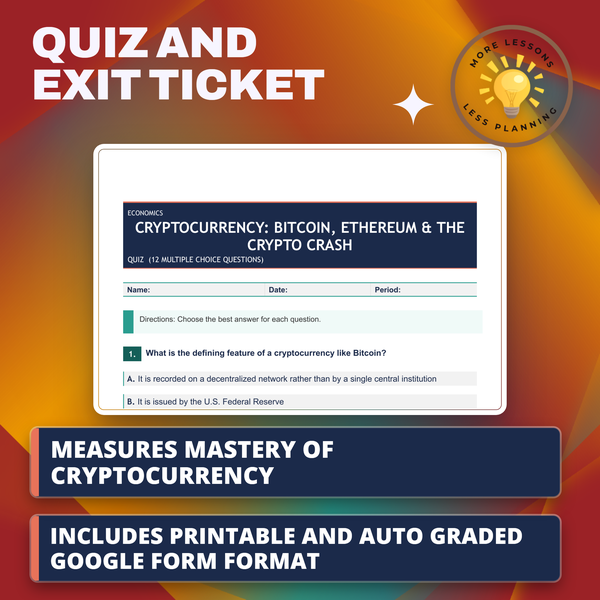
Multiple choice covers who launched Bitcoin, what a blockchain actually records, which consensus mechanism Ethereum switched to, and what event in May 2022 started the crash toward FTX.
-
Quiz (Answer Key)
Satoshi Nakamoto launches Bitcoin in 2009, the supply caps out at 21 million coins, Ethereum moves to proof of stake, and the May 2022 Terra USD collapse leads to FTX's November bankruptcy.
-
Slides
Blockchain gets defined slide by slide before Bitcoin's 21 million coin cap sits next to Ethereum's proof of stake switch. A month by month rundown of Terra, Celsius, and the FTX collapse follows, closing on why the protocols kept running while the companies failed.
-
Teacher Guide
A hook slide corrects the assumption that crypto itself failed in 2022, naming five specific companies. Teaching Tips then route discussion toward comparing FTX depositors with SVB customers.
-
Teacher Presentation Notes
The Lehman Brothers collapse sets the context for the October 2008 whitepaper that followed weeks later. Talking points cover the Ethereum Merge on September 15, 2022 and the SHA-256 hash function, then ask who actually confirms ownership of a coin if no bank does.
Download
Where should I send the next one?
Everything here is free and it stays that way. Leave your email and I'll send you the new lessons as they go up. You can unsubscribe from any one of them.
Related resources
Credit Scores: The Number That Runs Your Life
How Banks Make Money: The Spread Explained
The FDIC: What's Insured & What's Not
Venmo, Zelle, Cash App: The Hidden Costs
Amazon Warehouses: Working Conditions Investigation

Anti-Trust Laws and Regulation: Promoting Fair Competition
Every lesson on this site is free to download and use. If one of them saved you a prep period, you can chip in a few bucks toward my three kids' daycare fund. That's genuinely where tips go.