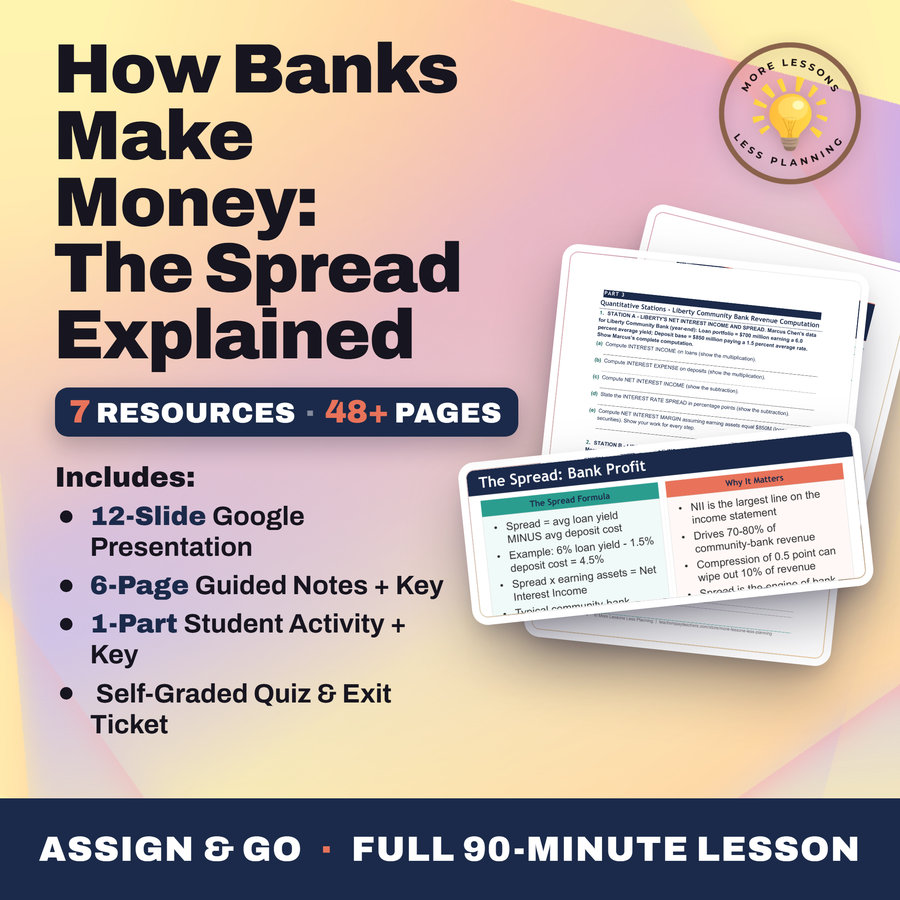


How Banks Make Money: The Spread Explained
Quality reviewed September 2026
- Grades
- Grades 9-12
- Time
- About two 50-minute class periods
- Includes
- 11 ready-to-teach files
- Format
- Word (.docx) · PowerPoint (.pptx)
- Slide deck
- Guided notes
- Guided notes teacher key
- Activity + answer key
- Quiz + answer key
- Exit ticket + answer key
- Teacher guide
- Teacher presentation notes
What students do
- Calculate a bank's net interest income and interest rate spread from real loan and deposit figures
- Compute total annual revenue by combining net interest income, fee income, and investment income
- Run a spread-compression stress test to see how rising deposit competition cuts net interest income
- Write a board memo recommending a strategic response to protect the bank's revenue
What it covers
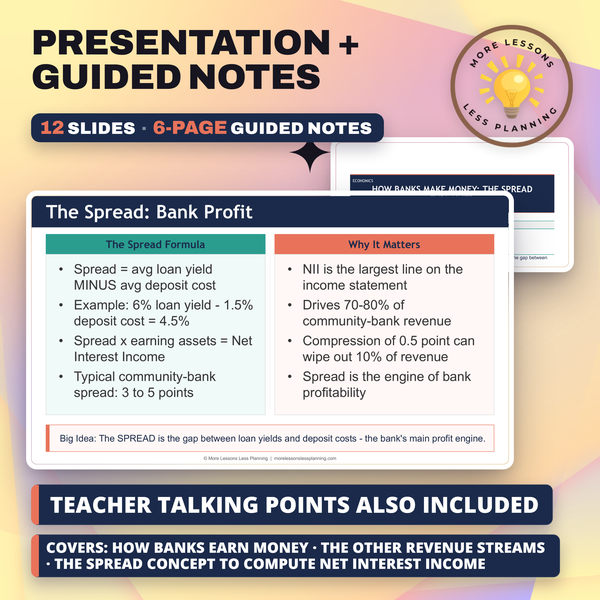
- The interest rate spread, loan yield minus deposit cost, and why it drives about 78% of bank revenue
- A full worked calculation for a $1 billion bank, $42M in loan interest minus $12.75M in deposit interest
- A stress test showing how online-bank competition pushing deposit costs up cuts into net interest income
- The loan-to-deposit ratio and the tradeoff between capturing more spread and keeping enough liquidity
Learning targets
- Explain how banks earn money through the INTEREST RATE SPREAD - the gap between the interest they receive on loans and the interest they pay on deposits.
- Identify the other revenue streams that supplement the spread - fees and service charges, investment income on the securities portfolio, and miscellaneous income.
- Apply the spread concept to compute net interest income, total fee income, total investment income, and total annual revenue for a $1 billion-asset community bank.
Peek inside
Banks stand BETWEEN savers (depositors) and borrowers
Savers want safety, liquidity, and a small return on idle cash
Borrowers want capital - mortgages, business loans, auto loans
Bank's job: aggregate small deposits and recycle them as larger loans
Profit comes from the GAP between what loans earn and what deposits cost
Banks Stand Between Savers and Borrowers
Banks stand BETWEEN savers (depositors) and .
Savers want safety, liquidity, and a small return on idle .
The bank's job is to AGGREGATE small deposits and recycle them as larger .
Profit comes from the GAP between what loans earn and what deposits .
1. Federal coverage that protects each depositor up to $250,000 per insured bank, per ownership category, in the event of a bank failure is . It is one major reason customers accept low rates on their savings.
Why this matters
Overdraft fees are the answer most students give when asked how a bank makes money, and the real math says otherwise. A $1 billion community bank here earns $42 million a year in loan interest while paying only $12.75 million on deposits, and that gap, the spread, drives roughly 78 percent of its revenue.
I built the stress test because it turns arithmetic into a decision: once a competing online bank pays 4 percent on savings and this bank has to match it, students calculate exactly how much of that spread disappears. Running it themselves makes the loan-to-deposit ratio click, since protecting the spread and staying liquid are in direct tension.
From one teacher to another
The same question opens this lesson every year: you deposit $1,000 at 1.5 percent, the bank lends it out at 6 percent, so where does that 4.5-point gap actually go? That gap is the spread, and it's the engine behind roughly 78 percent of a community bank's revenue, which surprises students who assumed banks mostly live on overdraft fees. They work the full math for a real $1 billion bank, $700 million in loans earning $42 million a year against $850 million in deposits costing $12.75 million, calculating net interest income themselves before fees and investment income even get added in. The part that makes it stick is the stress test: when a competing online bank starts paying 4 percent on savings and this bank has to match it, students calculate exactly how hard net interest income gets hit, and "the spread" stops being an abstract vocabulary word and becomes the thing an entire board meeting would be about.
Every file in this toolkit
-
Activity (Student)
Marcus Chen's revenue stations have students compute Liberty Community Bank's loan interest, deposit cost, and net interest income from real dollar figures, then stress-test what a competitor's 4 percent savings rate does to that spread before a board memo.
-
Activity (Answer Key)
Liberty's figures resolve to $42 million in loan interest against $12.75 million paid to depositors, a 4.5 point spread, and this key runs the same math again after a compression scenario cuts net interest income by 43.6 percent.
-
Exit Ticket (Student)
Short questions define the interest rate spread in plain terms, calculate net interest income for a bank with $700M in loans at 6 percent against $850M in deposits at 1.5 percent, and name the typical share of revenue the spread drives. A separate loan-and-deposit example closes out the section.
-
Exit Ticket (Answer Key)
The gap between loan yield and deposit cost is the spread itself, $29.25 million is what that $700M-versus-$850M math yields for net interest income, and about 78 percent is the spread's typical share of revenue. A full worked calculation plus a named risk and response round out full credit.
-
Guided Notes (Student)
Every blank fills in a community bank's full income statement, a loan book of $700 million yielding 6.0 percent set against $850 million of deposits priced at 1.5 percent, before fees and securities income get added into one bottom-line total.
-
Guided Notes (Teacher Key)
Every line of the bank's statement gets completed, $29.25 million in net interest income, $5.25 million in fees, $6 million in investment income, for $40.5 million total, with net interest income landing at 72 percent of revenue against the 78 percent industry norm.
-
Quiz (Student)
Word problems have students work Liberty Community Bank's numbers, its $700 million in loans and 850 million in deposits, then price the hit from a 4 percent competitor rate.
-
Quiz (Answer Key)
Liberty earns 42 million in yearly loan income against 12.75 million paid out on deposits, its net interest income lands at 29.25 million, and the spread makes up roughly 78 percent of typical bank revenue.
-
Slides
Deposits paying under 2 percent sit against loans yielding 5 to 8 percent, and the gap between them gets a name, the spread, before the deck works full revenue math on a $1 billion bank. Fees and investment income round out the smaller two revenue streams.
-
Teacher Guide
A board memo built on Liberty's $42 million loan interest figure closes the rubric, while Teaching Tips redirect the overdraft fee assumption toward where community bank revenue actually comes from.
-
Teacher Presentation Notes
Overdraft charges of $30 to $35 each get named as the biggest single fee line before the script moves to the full worked math on a $1 billion bank's loan and deposit interest.
Download
Where should I send the next one?
Everything here is free and it stays that way. Leave your email and I'll send you the new lessons as they go up. You can unsubscribe from any one of them.
Related resources

Credit Scores: The Number That Runs Your Life

Cryptocurrency: Bitcoin, Ethereum & the Crypto Crash
The FDIC: What's Insured & What's Not

Venmo, Zelle, Cash App: The Hidden Costs
Amazon Warehouses: Working Conditions Investigation

Anti-Trust Laws and Regulation: Promoting Fair Competition
Every lesson on this site is free to download and use. If one of them saved you a prep period, you can chip in a few bucks toward my three kids' daycare fund. That's genuinely where tips go.