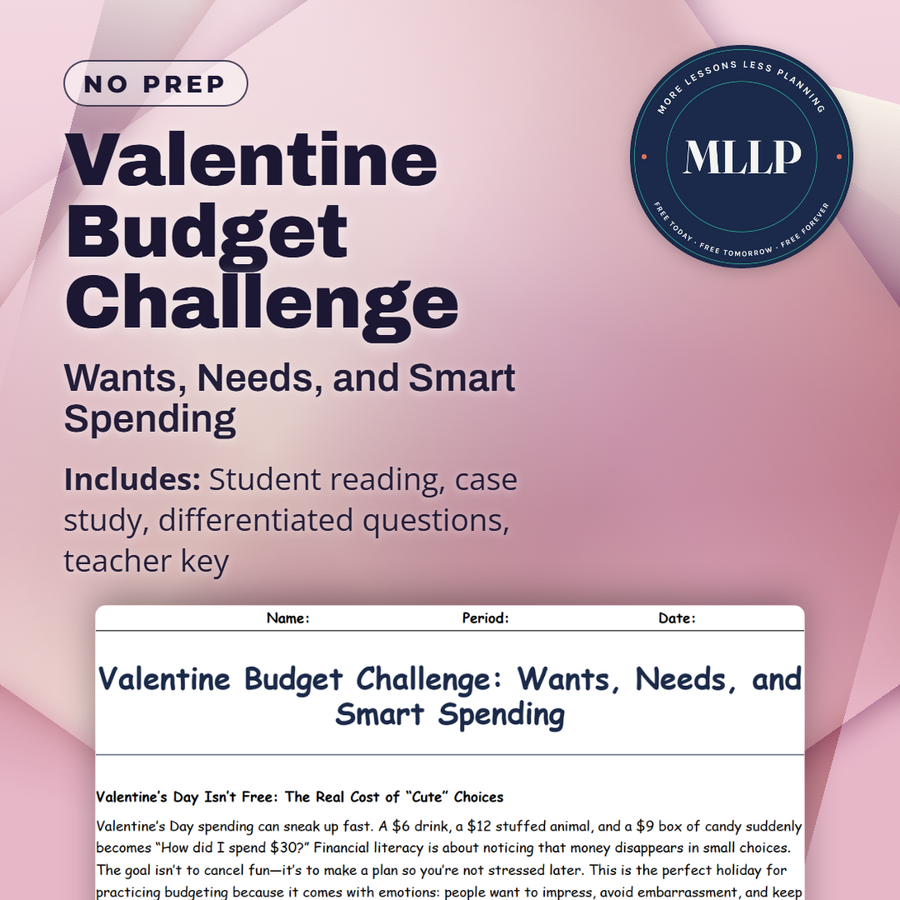
Valentine Budget Challenge: Wants, Needs, and Smart Spending
Quality reviewed September 2026
Facts verified September 9, 2026
- Subject
- Career & Life Skills
- Grades
- Grades 9-12
- Length
- 7-page student worksheet
- Time
- About one 50-minute class period
- Great for
- Sub plans and independent work
- Includes
- Reading passage, comprehension questions + full answer key
- Format
- Print-and-go PDF
What students do
- Separate needs from wants and rank priorities within a fixed budget
- Calculate opportunity cost by comparing what gets sacrificed for each purchase choice
- Spot "deal traps" like buy-two-get-one-free and sales tax surprises
- Design a realistic Valentine spending plan that prevents post-holiday stress
What it covers
- Budgeting fundamentals: income, fixed costs, variable costs
- Opportunity cost and trade-off thinking
- Recognizing sales pressure and social spending influence
Start reading this worksheet
Valentine’s Day Isn’t Free: The Real Cost of “Cute” Choices
Valentine’s Day spending can sneak up fast. A $6 drink, a $12 stuffed animal, and a $9 box of candy suddenly becomes “How did I spend $30?” Financial literacy is about noticing that money disappears in small choices. The goal isn’t to cancel fun. The goal is to make a plan so you’re not stressed later. This is the perfect holiday for practicing budgeting because it comes with emotions: people want to impress, avoid embarrassment, and keep up with what others are doing. Those feelings can lead to impulse spending. A budget is simply a plan for limited resources. The key ideas are income, fixed costs, variable costs, and opportunity cost. Opportunity cost means when you choose one thing, you give up another. If you spend $25 on a gift, you might give up two lunches out, saving for shoes, or adding money to a game account. That trade-off exists whether you think about it or not, so smart spenders think about it first. Another important budgeting skill is separating needs and wants. Needs are essentials (food, transportation, required school expenses). Wants are extras (snacks, gifts, decorations, upgrades). Valentine spending is mostly wants, which means it should be planned around your needs and your goals. Finally, remember that expensive doesn’t automatically mean meaningful. A thoughtful note can be worth more than a pricey item. A budget helps you choose something intentional instead of something rushed.
The Budget Formula That Actually Works for Teens
Most teens don’t have a steady salary. They have allowance, occasional jobs, or small income streams. That makes budgeting even more important because money comes in chunks and goes out quickly. A simple student-friendly approach is: Write your total money available for the week (income + cash on hand). Subtract non-negotiables (lunch money, bus fare, club dues). Decide what you’re saving (even a small amount). Spend what’s left with intention. This is where people get stuck: they forget “hidden” costs like tax, delivery fees, or buying two of something (“I’ll get one for my friend too”). Students also underestimate how quickly small purchases add up. That’s why tracking matters. Even a basic list (item + price) can stop a budget from collapsing. Another helpful tool is setting a spending cap before shopping. If your Valentine budget is $15, then every item has to fit that limit. If you want a $12 item, you only have $3 left. That forces trade-offs, which is how real financial decisions work. Budgeting also includes the idea of value. Value isn’t always “cheapest.” Sometimes it means “best use of money.” A $6 snack that disappears in five minutes might feel less valuable than a $6 craft gift you make with supplies you already have. A budget pushes you to compare value, not just price.
Like what you read? The full reading, the case study, and every question set are in the free download below, along with the answer key.
Why this matters
Six dollars for a drink, twelve for a stuffed animal, nine more for candy, and a budget disappears before anyone notices. Riley's choices show how those small purchases stack up: skip the drink to protect lunch money, or write a card instead of buying something expensive that gets forgotten by March.
The deal traps section teaches the most. A buy-two-get-one-free sign and a sales tax surprise both look like savings until Riley's math shows what actually left the wallet. Students stop asking what is left in their pocket and start asking what they gave up to get it.
From one teacher to another
Money disappears in small choices. A six-dollar drink, a twelve-dollar stuffed animal, nine dollars of candy, suddenly it's thirty. This worksheet makes budgeting practical by using Valentine's Day as the pressure point. Students trace Riley's decision-making: skip a drink to protect lunch money, write a card instead of buying something expensive. The case study shows that planning actually gives you freedom, not restriction. Best part: they see that a thoughtful note beats a pricey gift every time. They leave understanding that a budget isn't punishment. It's the difference between thoughtful and panicked.
What you get
Download
Where should I send the next one?
Everything here is free and it stays that way. Leave your email and I'll send you the new lessons as they go up. You can unsubscribe from any one of them.
Related resources
Animal Courtship Biology: Sexual Selection in the Wild
Famous Relationship Cases in Forensics: Evidence vs. Emotion in the Public Eye
Forensic Science and Domestic Violence
Forensic Science: Online Romance Scams
Government and Relationships: How Laws Have Shaped “Love” in U.S. History
Love Hormones: Oxytocin, Dopamine, and the Brain
Every lesson on this site is free to download and use. If one of them saved you a prep period, you can chip in a few bucks toward my three kids' daycare fund. That's genuinely where tips go.