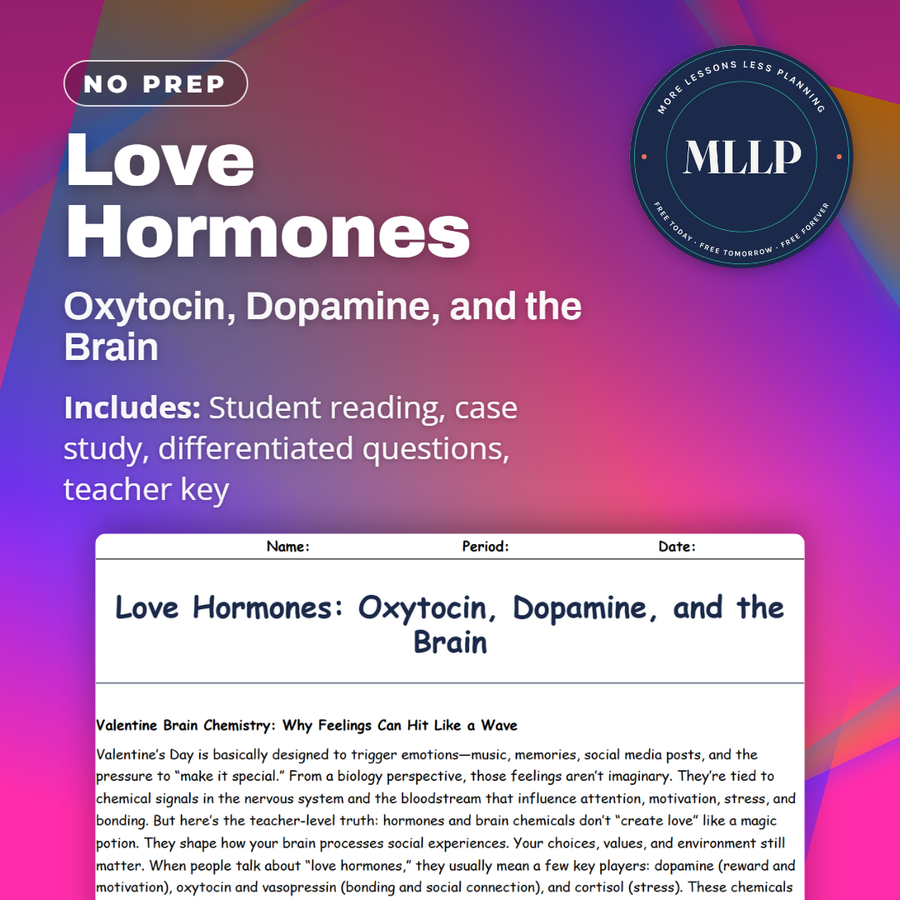
Love Hormones: Oxytocin, Dopamine, and the Brain
Quality reviewed September 2026
Facts verified September 9, 2026
- Subject
- Science
- Grades
- Grades 9-12
- Length
- 9-page student worksheet
- Time
- About one 50-minute class period
- Great for
- Sub plans and independent work
- Includes
- Reading passage, comprehension questions + full answer key
- Format
- Print-and-go PDF
What students do
- Trace how dopamine drives reward-seeking and why uncertainty can feel addictive
- Explain why oxytocin supports bonding but depends on context and consistency
- Analyze how cortisol shapes decision-making under stress and uncertainty
- Apply prefrontal reasoning to slow down and choose boundaries over impulsivity
What it covers
- Dopamine, reward pathways, and motivation
- Oxytocin, vasopressin, and bonding chemistry
- Stress hormones and decision-making
Start reading this worksheet
Valentine Brain Chemistry: Why Feelings Can Hit Like a Wave
Valentine’s Day is basically designed to trigger emotions: music, memories, social media posts, and the pressure to “make it special.” From a biology perspective, those feelings aren’t imaginary. They’re tied to chemical signals in the nervous system and the bloodstream that influence attention, motivation, stress, and bonding. But here’s the teacher-level truth: hormones and brain chemicals don’t “create love” like a magic potion. They shape how your brain processes social experiences. Your choices, values, and environment still matter. When people talk about “love hormones,” they usually mean a few key players: dopamine (reward and motivation), oxytocin and vasopressin (bonding and social connection), and cortisol (stress). These chemicals affect how strongly you remember someone, how much you crave interaction, how safe you feel, and how you respond to rejection. That’s why a crush can feel distracting, why a relationship can feel comforting, and why a breakup can feel physically painful. Your brain treats social connection like a survival-relevant event. Another important point is that the brain is a learning machine. If your brain connects a person with positive rewards (laughter, support, attention), it strengthens that association over time. If it connects a person with anxiety, pressure, or fear, that association strengthens too. Valentine’s Day can intensify either pattern because expectations are high. In this reading, you’ll learn how the reward pathway works, how bonding signals work, and how stress chemistry can change decision-making. The goal isn’t to label feelings as “just chemicals.” The goal is to understand why emotions feel real and how to make healthier choices when emotions are loud.
Dopamine: The Reward Pathway and the Power of “Wanting”
Dopamine is often called the “pleasure chemical,” but that’s only half the story. Dopamine is more accurately a motivation-and-learning signal. It helps your brain notice rewards, chase them, and remember what led to them. That’s why dopamine is involved in everything from food cravings to social media scrolling, and yes, romantic attraction. A simplified version of the reward pathway goes like this: when your brain predicts something rewarding (a text notification, a smile from a crush, a fun date), dopamine activity increases in reward-related circuits, including areas often summarized in classes as the VTA (ventral tegmental area) and nucleus accumbens. That dopamine signal helps your brain focus, pursue, and repeat behaviors that might lead to the reward. In other words, dopamine is a “do it again” message. This can be useful. Dopamine can motivate bonding and effort. But it can also make people impulsive, especially when paired with novelty and uncertainty. That’s one reason “mixed signals” can feel addictive: the brain keeps chasing the next reward because it can’t predict when it will arrive. Around Valentine’s Day, dopamine-driven behavior can look like over-checking messages, spending money impulsively, or tying your self-worth to someone else’s attention. A key biology lesson is that dopamine is not a relationship advisor. It doesn’t care about long-term compatibility; it cares about reward prediction. That’s why healthy decision-making requires your prefrontal cortex (planning and self-control) to balance the reward system. The strongest Valentine skill is not “more dopamine.” It’s using your thinking brain to guide your choices.
Oxytocin and Vasopressin: Bonding, Trust, and Context
If dopamine is the “pursuit” signal, oxytocin is often described as a “bonding” signal. Oxytocin is released in social situations that involve closeness and connection, such as supportive touch, comforting conversations, and caregiving. It can increase feelings of trust and social warmth, especially within an established relationship. Vasopressin is also linked to bonding and social behavior, and in some animal studies it’s associated with pair bonding and protective behaviors. But students need a mature view: oxytocin doesn’t automatically make everyone kind or trusting. Context matters. Oxytocin can strengthen bonds within a group, but it can also increase “us vs. them” feelings in certain situations. It’s not a morality hormone; it’s a social-attention hormone. It amplifies what your brain is already interpreting. If a relationship is safe, oxytocin can support calm and closeness. If a relationship is stressful, bonding chemistry can still make it hard to detach, because the brain is wired to value connection. This helps explain why people sometimes stay attached to relationships that aren’t healthy. The brain can confuse familiarity with safety. That’s not weakness; it’s biology. It’s also why supportive friendships and trusted adults matter. Healthy connection chemistry can be built in many relationships, not only romantic ones. Valentine’s Day often treats bonding as something you prove with gifts. Biology says bonding is built through repeated experiences of reliability: showing up, listening, respecting boundaries, and repairing mistakes. Oxytocin supports connection, but the foundation is behavior.
Like what you read? The full reading, the case study, and every question set are in the free download below, along with the answer key.
Why this matters
A racing heart around someone new feels like proof a relationship is right, but that feeling is dopamine doing its job, not evidence of compatibility. Dopamine tracks reward and uncertainty, so it fires hardest for people who are unpredictable, a strange thing for a chemical to be steering when the decision is who you trust.
Once students learn oxytocin can bond you to someone even while the relationship is stressing you out, they stop treating strong feelings as a verdict. The cortisol section is where the biology turns useful: stress narrows thinking right when a calm decision matters most. Naming the chemistry gives students a reason to pause instead of just reacting.
From one teacher to another
I open this unit saying feelings aren't imaginary. They're tied to real chemical signals in your brain. That matters because when students feel intense attraction on Valentine's Day, they sometimes think intensity proves the relationship is healthy. But dopamine doesn't care about long-term compatibility. It just chases rewards. Oxytocin can make you feel bonded to someone even when the relationship stresses you out. The worksheet walks through how your prefrontal cortex is supposed to pause and guide your choices, but stress and fatigue make that harder. Knowing the biology is the first step to managing it.
What you get
Download
Where should I send the next one?
Everything here is free and it stays that way. Leave your email and I'll send you the new lessons as they go up. You can unsubscribe from any one of them.
Related resources
Animal Courtship Biology: Sexual Selection in the Wild
Famous Relationship Cases in Forensics: Evidence vs. Emotion in the Public Eye
Forensic Science and Domestic Violence
Forensic Science: Online Romance Scams
Government and Relationships: How Laws Have Shaped “Love” in U.S. History
Psychology Meets Hollywood: Romance Movies vs. Real Relationship Science
Every lesson on this site is free to download and use. If one of them saved you a prep period, you can chip in a few bucks toward my three kids' daycare fund. That's genuinely where tips go.