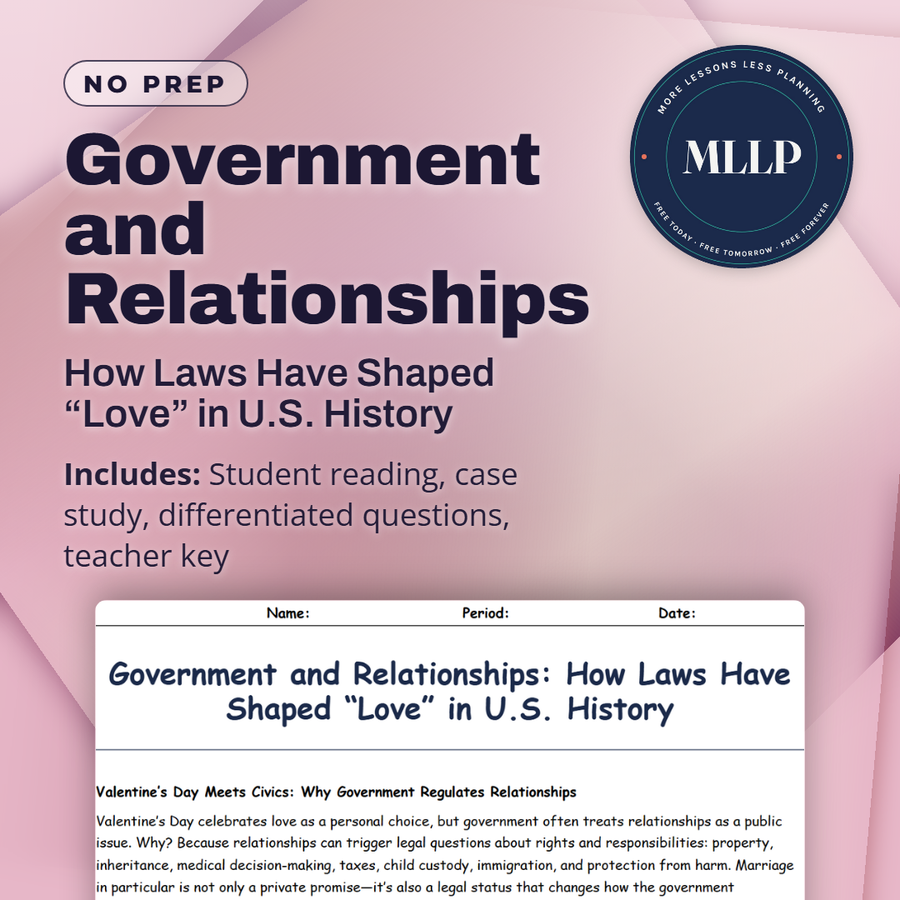
Government and Relationships: How Laws Have Shaped “Love” in U.S. History
Quality reviewed September 2026
Facts verified September 9, 2026
- Subject
- Social Studies
- Grades
- Grades 9-12
- Length
- 9-page student worksheet
- Time
- About one 50-minute class period
- Great for
- Sub plans and independent work
- Includes
- Reading passage, comprehension questions + full answer key
- Format
- Print-and-go PDF
What students do
- Explain why marriage is a legal status the government regulates, not an emotion it polices
- Analyze how Loving v. Virginia, Lawrence v. Texas, and Obergefell v. Hodges expanded rights
- Distinguish equality-based relationship laws from protection-based laws like age of consent and domestic violence statutes
- Evaluate Talia's question about whether a relationship law serves equality or safety
What it covers
- Why government regulates marriage and relationships
- Race, LGBTQ+ rights, and landmark Supreme Court rulings
- Consent, protective orders, and digital harassment law
Start reading this worksheet
Valentine’s Day Meets Civics: Why Government Regulates Relationships
Valentine’s Day celebrates love as a personal choice, but government often treats relationships as a public issue. Why? Because relationships can trigger legal questions about rights and responsibilities: property, inheritance, medical decision-making, taxes, child custody, immigration, and protection from harm. Marriage in particular is not only a private promise. It’s also a legal status that changes how the government recognizes a pair of people. That’s why “who can marry whom” has been a major political and legal debate in U.S. history. When students hear “relationship laws,” they sometimes imagine rules about feelings. That’s not the point. The government doesn’t regulate love as an emotion; it regulates behavior, contracts, and safety. For example, laws set minimum ages for consent to protect minors from exploitation, and laws against domestic violence aim to prevent harm inside families. The challenge is that laws can protect people, or they can reflect discrimination. Throughout U.S. history, some relationship rules were designed to enforce social hierarchies, especially around race and gender. Others were later created to expand freedom and equality. A big civics skill is learning how laws change. Sometimes change happens through legislation (elected officials passing laws). Sometimes it happens through courts (judges interpreting the Constitution). Sometimes it happens through activism and public pressure. When it comes to relationships, U.S. history shows all three paths. As you read, keep one guiding question: Is a law protecting people from harm and unequal power, or is it restricting rights based on identity? That question helps students understand why relationship laws are still debated today.
Race and Marriage: From Bans to a Landmark Supreme Court Ruling
For much of U.S. history, many states enforced bans on interracial marriage, often called anti-miscegenation laws. These laws weren’t about protecting anyone; they were about enforcing racial separation and maintaining white supremacy. Couples could be arrested, fined, or forced to leave their home state. That reality is hard to imagine today, which is exactly why it matters in a government class: it shows how law can be used to control private life. A major turning point came in Loving v. Virginia (1967), when the U.S. Supreme Court struck down state bans on interracial marriage as unconstitutional. The decision mattered not just for one couple, but for the principle it established: marriage is a fundamental right, and the government cannot restrict that right based on race. This case is often taught alongside the Fourteenth Amendment because it connects equal protection and due process to real-life consequences. From a civics perspective, Loving also shows how federal courts can override state laws when those laws violate constitutional rights. It’s a reminder that “states’ rights” has limits, especially when state rules deny equal citizenship. Valentine’s Day might feature hearts and roses, but this history reminds students that not all couples have been equally free to celebrate their relationships openly. Understanding that legal history helps explain why civil rights debates about relationships have been so emotionally powerful and politically significant.
LGBTQ+ Relationships: Privacy, Equality, and Marriage Rights
Laws have also shaped LGBTQ+ relationships in dramatic ways. For decades, many states had laws criminalizing same-sex intimacy. In Lawrence v. Texas (2003), the Supreme Court struck down a Texas law and effectively ended the legal foundation for criminalizing consensual same-sex intimacy between adults. That decision matters because it connects privacy and liberty rights to real people’s lives, and it shows how government power can reach into private spaces unless limited by constitutional protections. Marriage rights came later. In Obergefell v. Hodges (2015), the Supreme Court held that states must license and recognize same-sex marriages. This did not erase disagreement in society, but it established nationwide legal recognition. In 2022, Congress passed the Respect for Marriage Act, which provides federal statutory protections for recognition of marriages that are valid under state law, including same-sex and interracial marriages. (Congress.gov) A helpful civics lesson is that rights can be recognized in multiple ways: through Supreme Court rulings and through laws passed by Congress. Students can also see how legal debates continue even after landmark decisions. For example, news coverage in late 2025 reported that the Supreme Court declined to take a case seeking to overturn Obergefell, keeping its legal standing in place. (Reuters) Valentine’s Day connects here because public celebration often follows legal recognition. When the law changes, people’s daily lives change: how safe they feel, what their families can access, and whether they are treated equally by government institutions.
Like what you read? The full reading, the case study, and every question set are in the free download below, along with the answer key.
Why this matters
Most students think love is the one part of life government stays out of, until they learn interracial couples once needed the Supreme Court to marry legally. Loving v. Virginia struck down that ban, and Lawrence and Obergefell extended the same reasoning: who may marry whom is a question government keeps answering.
Every relationship law looks identical to students at first, until they sort Talia's grandmother, uncle, and family friend into separate categories. Age of consent laws and protective orders reduce harm, while Loving, Lawrence, and Obergefell remove unequal treatment. I ask students to name which purpose a law serves before they judge laws they have never seen before.
From one teacher to another
Students hear "relationship laws" and picture rules about feelings, so the reading starts by drawing the line: government regulates contracts, status, and safety, never love itself. From there it works through interracial marriage bans and Loving v. Virginia, then Lawrence and Obergefell, then the laws that exist to reduce harm when power is unequal, including age of consent, protective orders, and cyberstalking statutes. The case study follows Talia interviewing her grandmother, her uncle, and a family friend about three different legal realities. I use it in government around Valentine's Day because the equality-versus-safety question at the end gives students a real framework for evaluating any law about private life.
What you get
Download
Where should I send the next one?
Everything here is free and it stays that way. Leave your email and I'll send you the new lessons as they go up. You can unsubscribe from any one of them.
Related resources
Animal Courtship Biology: Sexual Selection in the Wild
Famous Relationship Cases in Forensics: Evidence vs. Emotion in the Public Eye
Forensic Science and Domestic Violence
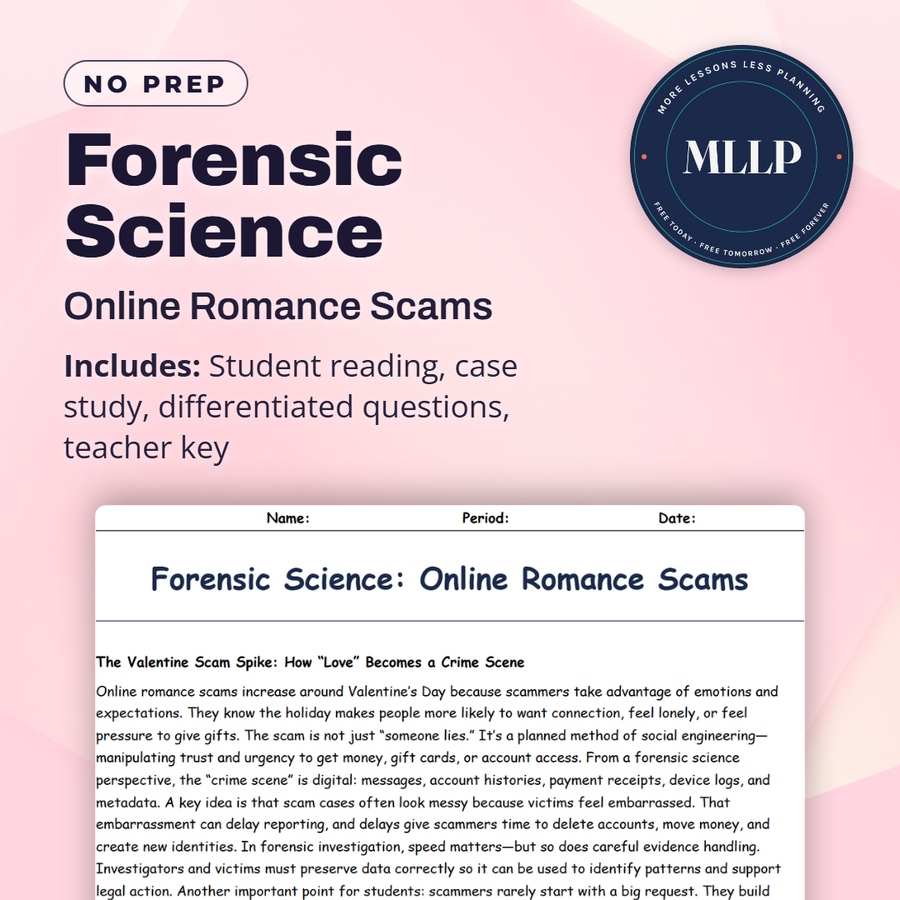
Forensic Science: Online Romance Scams
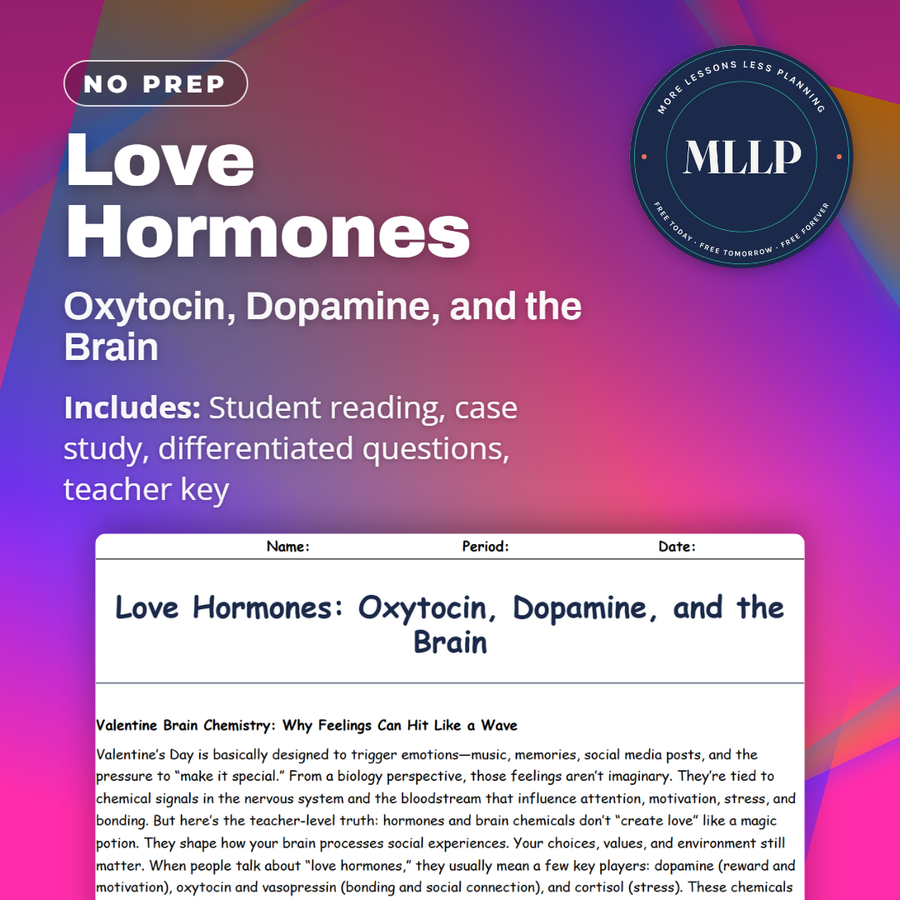
Love Hormones: Oxytocin, Dopamine, and the Brain
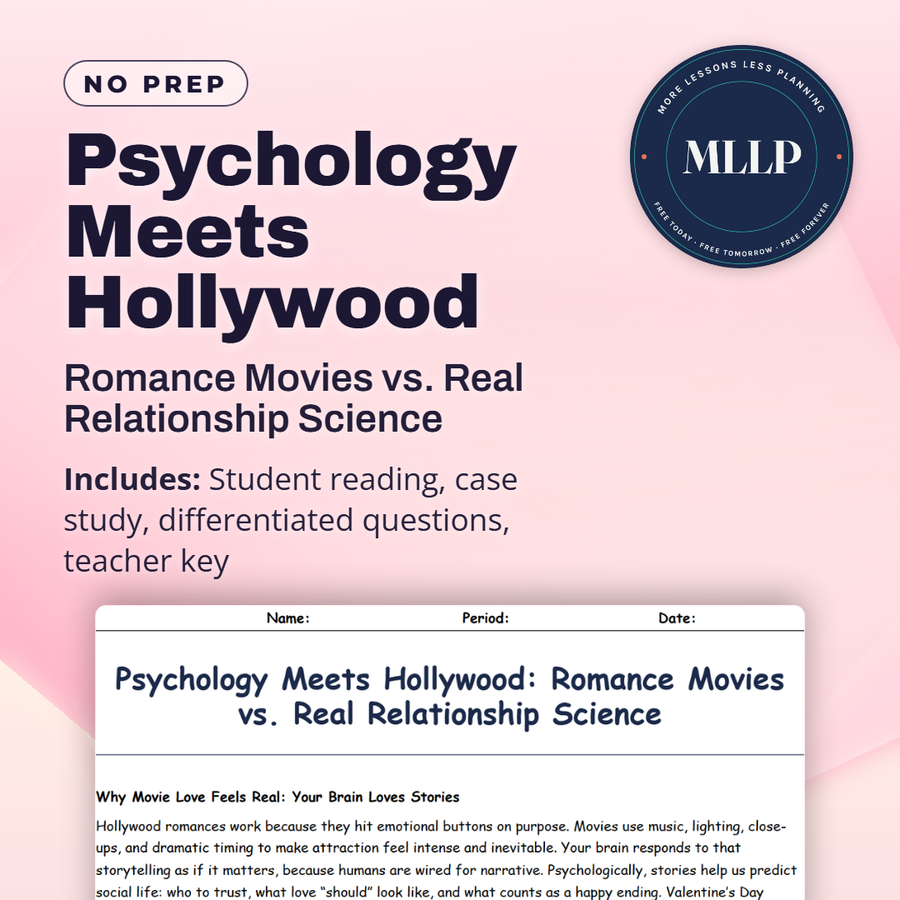
Psychology Meets Hollywood: Romance Movies vs. Real Relationship Science
Every lesson on this site is free to download and use. If one of them saved you a prep period, you can chip in a few bucks toward my three kids' daycare fund. That's genuinely where tips go.