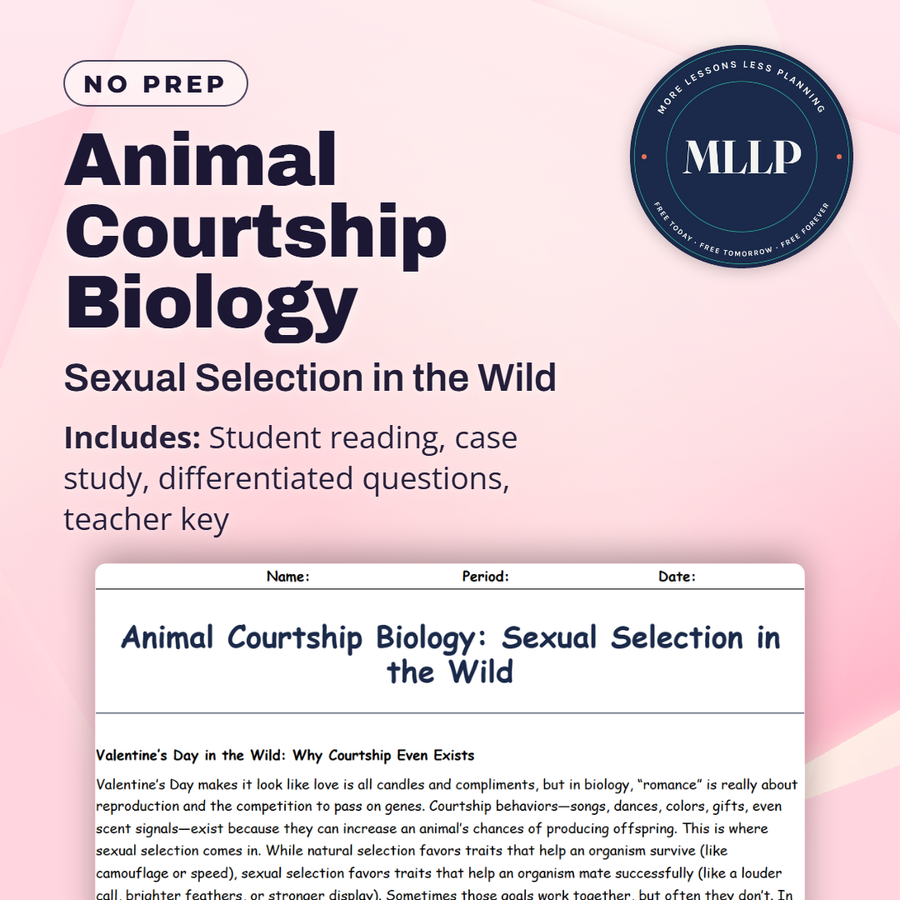
Animal Courtship Biology: Sexual Selection in the Wild
Quality reviewed September 2026
Facts verified September 9, 2026
- Subject
- Science
- Grades
- Grades 9-12
- Length
- 9-page student worksheet
- Time
- About one 50-minute class period
- Great for
- Sub plans and independent work
- Includes
- Reading passage, comprehension questions + full answer key
- Format
- Print-and-go PDF
What students do
- Explain why costly signals evolve and persist in animal populations
- Compare how sexual selection and natural selection can pull traits in opposite directions
- Analyze the peacock tail as evidence of fitness trade-offs
- Evaluate how environment shapes which courtship signals succeed
What it covers
- Sexual selection and mating behavior
- Costly signaling and honest advertisement
- Trade-offs between survival and reproduction
Start reading this worksheet
Valentine’s Day in the Wild: Why Courtship Even Exists
Valentine’s Day makes it look like love is all candles and compliments, but in biology, “romance” is really about reproduction and the competition to pass on genes. Courtship behaviors (songs, dances, colors, gifts, even scent signals) exist because they can increase an animal’s chances of producing offspring. This is where sexual selection comes in. While natural selection favors traits that help an organism survive (like camouflage or speed), sexual selection favors traits that help an organism mate successfully (like a louder call, brighter feathers, or stronger display). Sometimes those goals work together, but often they don’t. In many species, one sex invests more in offspring (pregnancy, egg production, feeding young). That investment changes the “dating market” in the wild. The sex that invests more tends to be choosier about mates, while the other sex competes harder to be chosen. That’s not a rule for every species, but it’s a pattern scientists use to predict courtship behaviors. You can think of courtship as an advertisement: an animal is sending information about fitness (its ability to survive, find resources, avoid disease, and produce healthy offspring). Here’s the Valentine connection: people often focus on the look of courtship (the flashy feathers, the heart-shaped gifts), but biology focuses on the function. A courtship display is not just “pretty.” It’s a strategy, shaped by evolution, to answer a silent question: “Are you a good investment?” Once you see courtship this way, animal behaviors stop being random and start looking like a complicated, competitive communication system.
Signals That Mean Something: The Science of “Honest” Advertising
In the animal world, it’s easy to claim you’re the best. But it’s harder to prove it. That’s why many courtship signals work because they are costly. A costly signal is one that takes energy, increases risk, or requires skill. The logic is simple: if the signal is expensive to produce, only high-quality individuals can afford to produce it well. This idea connects to the costly signal hypothesis (often discussed alongside the “handicap principle” in biology classes). Think about a bird singing for long periods. Singing takes energy, attracts attention, and can even alert predators. If a bird can sing loudly and frequently and still survive, that may signal strong health, good territory, or strong immune function. Similarly, bright coloration can be risky because it makes an animal easier to see. If an animal survives while being noticeable, the signal may suggest it’s fast, alert, or living in a safe territory it can defend. Even scent signals and pheromones can be costly because producing them requires resources and may depend on hormone levels and nutrition. Not all signals are honest, though. Some species use deception: bluffing strength or copying other signals. That creates an evolutionary “arms race” where receivers (the choosy individuals) evolve better ways to detect quality, and signalers evolve better ways to persuade. Over time, reliable signals tend to remain reliable because the receiver’s choice has consequences. If choosy individuals keep selecting low-quality mates, their offspring may be less likely to survive or reproduce. Valentine’s Day is a good reminder: signals matter because they communicate something. In biology, the big question is always: what information is being sent, and how does that information change reproductive success?
Mate Choice and Trade-Offs: Beauty Has a Price Tag
Courtship traits often come with fitness trade-offs. A trade-off means improving one trait can reduce another. For example, putting energy into elaborate feathers might reduce energy available for immune defense. Spending time displaying might reduce time for feeding or hiding. These trade-offs are why sexual selection can create traits that look “impractical” from a survival standpoint, but make sense from a reproduction standpoint. Scientists describe two broad categories of benefits from mate choice. One is direct benefits, like choosing a mate that provides resources, protection, or parental care. For example, a mate might bring food, defend a nest site, or help raise young. The other is indirect benefits, like selecting for “good genes” that improve offspring survival (better disease resistance, stronger body condition, etc.). Real life is messy: animals may use a mix of both. Another important idea is sexual dimorphism, where males and females look different (size, coloration, ornaments). This often happens when sexual selection pressures act strongly on one sex. But mate choice isn’t always “female chooses male.” In species where males invest heavily (like some birds that incubate eggs or raise young), females may compete and males may be choosier. Biology doesn’t pick sides. It follows investment and opportunity. A final layer is the environment. In bright, open habitats, visual signals may dominate. In dense forests, sound may matter more. In nocturnal species, scent or light signals might be key. Courtship is always shaped by what a species can realistically communicate in its ecosystem. That’s why “romance in the wild” is incredibly diverse, and deeply logical once you know what to look for.
Like what you read? The full reading, the case study, and every question set are in the free download below, along with the answer key.
Why this matters
A peacock's tail is enormous and genuinely dangerous, slowing him down and making him easier to catch, the opposite of what evolution should reward. Peahens prefer the biggest handicap anyway, and the costly signal hypothesis explains why: surviving that much dead weight only happens if his health is strong enough to cover the cost.
Natural and sexual selection are supposed to pull the same direction, toward whatever helps an animal survive, and the peacock breaks that rule in front of the whole class. Once students accept animals compete to reproduce and not simply to live, a trait built for capture starts making sense.
From one teacher to another
I use the peacock's tail to show how evolution doesn't always make animals better at surviving, it makes them better at mating. Peacocks carry an enormous, energy-draining tail that makes escape harder, yet peahens prefer males with bigger tails. That seems backward until you learn the costly signal hypothesis: if a male survives despite the handicap, his health, muscles, or immune system must be genuinely strong. The worksheet guides students through why this matters: animals aren't just trying to live. They're competing to pass on genes, and sometimes those goals create traits that look illogical until you understand the function.
What you get
Download
Where should I send the next one?
Everything here is free and it stays that way. Leave your email and I'll send you the new lessons as they go up. You can unsubscribe from any one of them.
Related resources
Famous Relationship Cases in Forensics: Evidence vs. Emotion in the Public Eye
Forensic Science and Domestic Violence
Forensic Science: Online Romance Scams
Government and Relationships: How Laws Have Shaped “Love” in U.S. History
Love Hormones: Oxytocin, Dopamine, and the Brain
Psychology Meets Hollywood: Romance Movies vs. Real Relationship Science
Every lesson on this site is free to download and use. If one of them saved you a prep period, you can chip in a few bucks toward my three kids' daycare fund. That's genuinely where tips go.