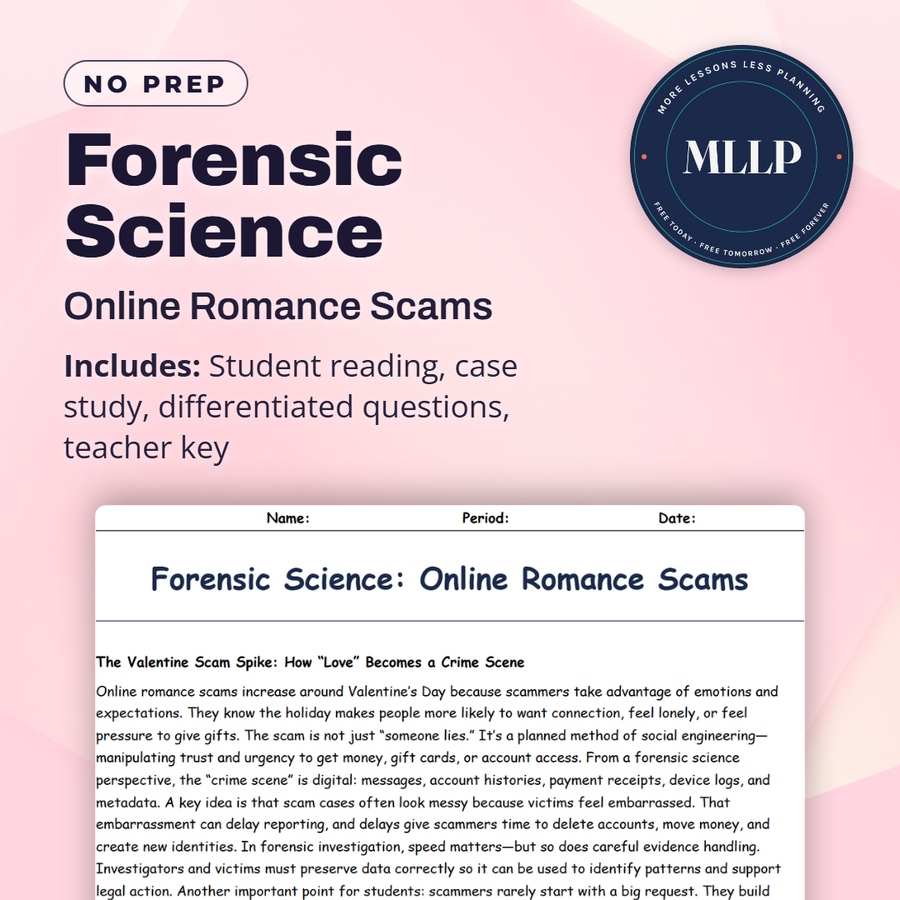
Forensic Science: Online Romance Scams
Quality reviewed September 2026
Facts verified September 9, 2026
- Subject
- Science
- Grades
- Grades 9-12
- Length
- 8-page student worksheet
- Time
- About one 50-minute class period
- Great for
- Sub plans and independent work
- Includes
- Reading passage, comprehension questions + full answer key
- Format
- Print-and-go PDF
What students do
- Identify red flags that distinguish authentic connection from social engineering
- Trace escalation patterns in scam messages and financial requests
- Preserve digital evidence by documenting usernames, timestamps, and payment trails
- Explain why gift cards are preferred by scammers
What it covers
- Social engineering and manipulation tactics
- Digital metadata and message timestamps
- Gift card laundering and money movement
Start reading this worksheet
The Valentine Scam Spike: How “Love” Becomes a Crime Scene
Online romance scams increase around Valentine’s Day because scammers take advantage of emotions and expectations. They know the holiday makes people more likely to want connection, feel lonely, or feel pressure to give gifts. The scam is not just “someone lies.” It’s a planned method of social engineering: manipulating trust and urgency to get money, gift cards, or account access. From a forensic science perspective, the “crime scene” is digital: messages, account histories, payment receipts, device logs, and metadata. A key idea is that scam cases often look messy because victims feel embarrassed. That embarrassment can delay reporting, and delays give scammers time to delete accounts, move money, and create new identities. In forensic investigation, speed matters, but so does careful evidence handling. Investigators and victims must preserve data correctly so it can be used to identify patterns and support legal action. Another important point for students: scammers rarely start with a big request. They build trust first, then test compliance with a small request (“Can you help me just once?”), then escalate. That step-by-step pattern is evidence. Investigators look for repeating structures: fast intimacy, refusal to verify identity, isolation tactics (“don’t tell anyone”), and financial pressure. This topic fits Valentine’s Day because it teaches a real-life safety skill: love never requires secrecy, payment deadlines, or sharing codes. If a person turns affection into a transaction, that’s not romance. It’s a red flag.
Digital Fingerprints: Metadata, Message Patterns, and Identity Clues
Digital forensics focuses on what can be proven from data. Investigators start with account-level evidence: usernames, profile creation dates, linked emails, phone numbers, device information (when available), and IP-related logs (usually accessed through legal requests). Students should understand that investigators don’t “magically hack” people. They use lawful processes and preserved records to connect actions to accounts and, sometimes, to individuals. Even without advanced tools, message patterns can reveal a lot. Scammers often reuse scripts: dramatic backstories, fast declarations of love, and repeated crises. They may avoid specific details, dodge video calls, or claim their camera is broken. They often push victims to move platforms (“let’s talk on a private app”), which reduces oversight and makes reporting harder. That behavior pattern becomes part of the evidence file. Metadata matters too. A screenshot shows what you saw, but a full message log can show timestamps, edits, deletions, and context. Email scams can be traced through email headers, which may reveal the route a message took (not always the scammer’s true location, but a clue). Images can contain hidden information like metadata (sometimes stripped by apps), and reverse-image searching can reveal stolen photos (a common scam strategy). For students, the big lesson is practical: keep evidence. Don’t just block and delete immediately. Save messages, usernames, payment details, and dates first. Then block and report. Evidence preservation turns “I feel like I was scammed” into “Here is proof.”
Money Trails: Gift Cards, Wires, and Why Scammers Love Speed
Once money moves, scammers try to make it untraceable or difficult to recover. That’s why they prefer gift cards, wire transfers, and money apps. Gift cards are especially attractive because once someone sends a code, the value can be spent immediately. That doesn’t mean investigation is impossible: investigators can sometimes track where the card was redeemed, but it is harder than reversing a normal purchase. Another common method is money “mules,” where scammers convince or pay someone else to receive funds and forward them. This creates distance between the scammer and the money. In forensic terms, that’s a laundering step. Investigators look at account histories, transaction timestamps, and patterns across multiple victims. When many people send money to the same account, that account becomes a major lead. Crypto is sometimes used, but students should avoid the myth that “crypto is invisible.” Transactions can be traced on public ledgers, though identifying the person behind an address may require additional evidence and legal steps. The main scammer advantage is speed and victim confusion, not magic invisibility. A strong prevention habit is simple and powerful: never send money, gift cards, or verification codes to someone you haven’t verified. If someone reacts with anger, guilt, or urgency, that reaction is evidence of manipulation. Healthy people respect boundaries. Scammers punish them.
Like what you read? The full reading, the case study, and every question set are in the free download below, along with the answer key.
Why this matters
Romance scams spike every year around Valentine's Day, because scammers know loneliness and hope make people want to believe someone. The reading follows a case named Evan through a predictable script: fast intimacy, a refusal to ever video call, a manufactured crisis, and money requests that escalate once trust is established.
Solving a case like this was never about figuring out who really loved whom, an assumption students bring in that needs correcting first. What actually closes it is preserved proof: timestamped screenshots, profile links, payment receipts, documentation that turns suspicion into something a bank or police report can act on.
From one teacher to another
Romance scams spike around Valentine's Day because scammers know loneliness and hope make people want to believe. I show students the Evan case in the worksheet: a scammer builds fast intimacy, refuses video calls, creates urgency with a crisis, and escalates money requests. Each step is predictable. The forensic angle is that scam cases aren't solved by guessing who feels sincere. They're solved by preserving proof: chat screenshots with timestamps, profile links, payment receipts. Evidence turns "I think I was scammed" into "here is proof."
What you get
Download
Where should I send the next one?
Everything here is free and it stays that way. Leave your email and I'll send you the new lessons as they go up. You can unsubscribe from any one of them.
Related resources
Animal Courtship Biology: Sexual Selection in the Wild
Famous Relationship Cases in Forensics: Evidence vs. Emotion in the Public Eye
Forensic Science and Domestic Violence
Government and Relationships: How Laws Have Shaped “Love” in U.S. History
Love Hormones: Oxytocin, Dopamine, and the Brain
Psychology Meets Hollywood: Romance Movies vs. Real Relationship Science
Every lesson on this site is free to download and use. If one of them saved you a prep period, you can chip in a few bucks toward my three kids' daycare fund. That's genuinely where tips go.