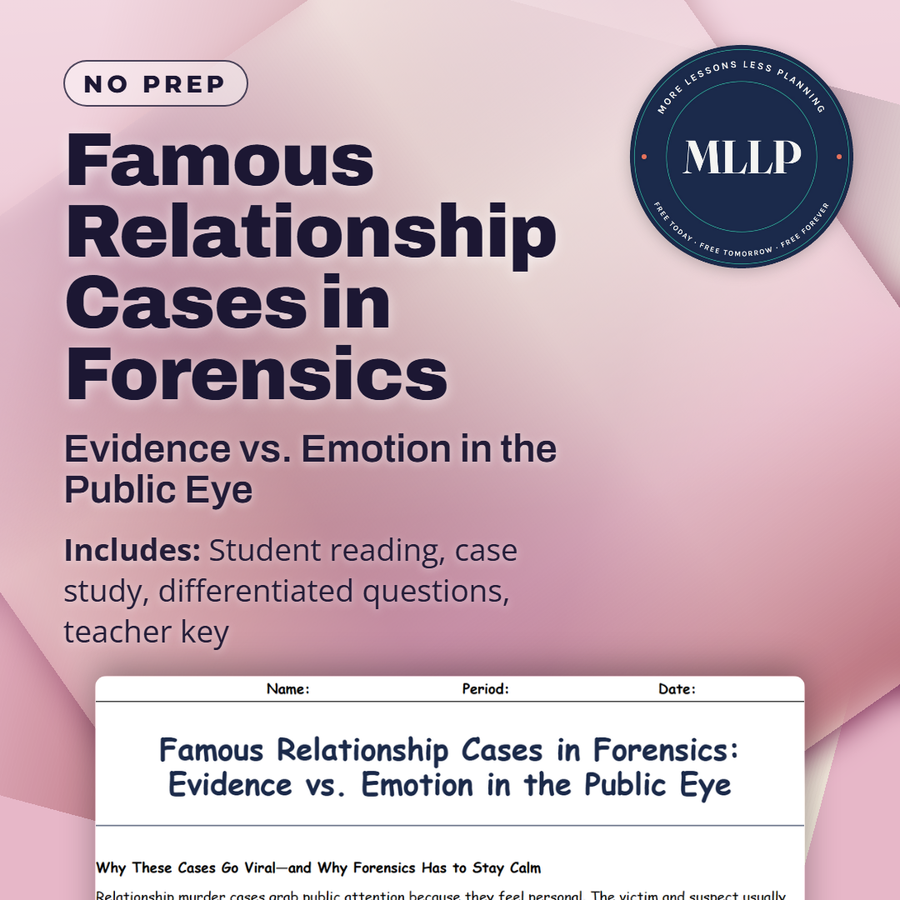
Famous Relationship Cases in Forensics: Evidence vs. Emotion in the Public Eye
Quality reviewed September 2026
Facts verified September 9, 2026
- Subject
- Science
- Grades
- Grades 9-12
- Length
- 10-page student worksheet
- Time
- About one 50-minute class period
- Great for
- Sub plans and independent work
- Includes
- Reading passage, comprehension questions + full answer key
- Format
- Print-and-go PDF
What students do
- Explain why public narratives about couple cases can create confirmation bias
- Analyze how timeline evidence constrains what alibis are possible
- Interpret DNA and trace evidence in shared-living contexts
- Compare digital evidence across multiple famous cases
What it covers
- Timeline construction from independent sources
- DNA and trace evidence in relationship investigations
- Chain of custody and procedural reliability
Start reading this worksheet
Why These Cases Go Viral (and Why Forensics Has to Stay Calm)
Relationship murder cases grab public attention because they feel personal. The victim and suspect usually shared a home, a history, and private conflicts that the public tries to explain with simple labels like “jealous,” “obsessed,” or “toxic.” But forensic science can’t solve a case with vibes. Investigators have to separate emotion from proof and focus on what can be documented: timelines, digital trails, DNA, trace evidence, and medically supported findings from an autopsy. This matters even more when a case becomes famous because a public narrative forms quickly. People pick a side early, and that can create confirmation bias. They start noticing only the facts that fit the story they already believe. Valentine’s Day is a perfect teaching moment for this because media often sells the idea that intensity equals love. In real life, intensity can also be a warning sign, especially when it includes control, threats, stalking, or isolation. Many famous couple cases include patterns of escalating conflict, but forensics doesn’t “prove” feelings. It proves actions. It answers practical questions: Who was where? When? What contact occurred? Does the scene match the statement? Are there independent records that confirm or contradict the story? Another reason these cases are tricky is that couples share spaces. If a person lived in the same home, their DNA may be “expected” in some areas, so investigators need stronger context than just “DNA exists.” That’s why high-profile cases often rely on multiple evidence types stacked together: a timeline, digital records, physical evidence, and inconsistent statements. When those pieces line up, a case becomes clearer. When evidence is mishandled or poorly documented, doubt grows, and sometimes that doubt is enough to change an outcome. In famous cases, the evidence must be strong and the procedures must be clean.
The Evidence Toolkit in Couple Homicides: What Investigators Look For
In relationship cases, investigators usually build the case around five major categories. First is the timeline, because time destroys lies. A timeline uses receipts, surveillance cameras, doorbell videos, phone records, texts, app activity, GPS/location history (when available), and witness observations. The best timelines are built from independent sources, not just one person’s memory. Second is digital evidence: call logs, message patterns, device movements, deleted content, and account activity. Digital evidence is powerful because it’s time-stamped and often created automatically. Third is biological evidence, including DNA. DNA can link a person to a location or object, but it must be interpreted carefully in shared environments. Investigators pay attention to where DNA is found and whether it suggests struggle, transfer, or unusual placement. Fourth is trace evidence: fibers, hair, soil, glass, or tiny transferred materials that can connect a person to a scene, vehicle, or outdoor location. Trace evidence is often underestimated by the public, but it matters because it can show contact and movement even when someone tries to clean up. Fifth is medical evidence: the autopsy and injury documentation. Autopsy findings can support or contradict claims like “it was an accident,” “I wasn’t there,” or “it happened differently.” Even though time-of-death estimates are ranges, those ranges can still eliminate alibis. Finally, there’s the courtroom layer: chain of custody and documentation. In famous cases, defense teams examine procedures closely. If evidence handling looks sloppy, jurors may doubt results, even when the science is strong. Forensics is science, but court is also trust.
Case Spotlight: O.J. Simpson: DNA, Procedure, and Public Pressure
The O.J. Simpson case is one of the most famous relationship-related murder trials in U.S. history, and it’s still discussed in forensic classrooms because it shows how evidence and procedure can collide. Prosecutors presented DNA and blood-related evidence to connect the suspect, the victims, and key locations. From a forensic perspective, students should understand two lessons. First, DNA evidence can be extremely powerful when it connects multiple places and objects in a way that supports a timeline. Second, the persuasive power of evidence depends heavily on collection, storage, and documentation. In this case, the defense challenged how evidence was handled and raised questions about contamination and reliability. Whether students view the verdict as correct or not, the forensic takeaway is clear: high-profile cases magnify every weakness in procedure. Chain of custody and scene documentation are not “boring paperwork.” They’re what make lab results believable to a jury. Another important classroom point is that relationship history can influence investigation focus, but it is not proof. A jury is not supposed to convict someone because a relationship was troubled; the state must connect the suspect to the crime through evidence. The public often remembers dramatic moments such as media coverage, courtroom clashes, and the cultural impact, but forensic science students should practice filtering the noise. Ask: What is the evidence? What does it show? How was it collected? Are there independent sources that confirm the same conclusion? This case is a reminder that in famous relationship murders, the court evaluates more than the science. It also evaluates whether the science was handled in a way that deserves trust.
Like what you read? The full reading, the case study, and every question set are in the free download below, along with the answer key.
Why this matters
Prosecutors in the O.J. Simpson trial had DNA evidence tying a suspect to the scene, and it still was not enough. The defense went after how that evidence was collected and stored, and the doubt they raised about procedure shaped the whole trial. That single case teaches students that a strong lab result and a believable one are not the same thing.
In my classroom, this is the assumption that needs correcting first: that a good test result settles a case on its own. Juries do not trust science, they trust the people who handled it, which is why chain of custody paperwork exists. Once procedure counts as part of the proof, every other case my students study afterward gets read differently.
From one teacher to another
The O.J. Simpson case shows why procedure matters as much as science. Prosecutors had DNA evidence, but the defense challenged how it was collected and stored, and that doubt shaped the whole trial. In my classroom, I use this case to teach that forensics doesn't impress juries just because the lab results are strong. Jurors trust results only when they trust the people handling evidence. That's why chain of custody documentation is not boring paperwork. It's what makes lab findings believable in court.
What you get
Download
Where should I send the next one?
Everything here is free and it stays that way. Leave your email and I'll send you the new lessons as they go up. You can unsubscribe from any one of them.
Related resources
Animal Courtship Biology: Sexual Selection in the Wild
Forensic Science and Domestic Violence
Forensic Science: Online Romance Scams
Government and Relationships: How Laws Have Shaped “Love” in U.S. History
Love Hormones: Oxytocin, Dopamine, and the Brain
Psychology Meets Hollywood: Romance Movies vs. Real Relationship Science
Every lesson on this site is free to download and use. If one of them saved you a prep period, you can chip in a few bucks toward my three kids' daycare fund. That's genuinely where tips go.