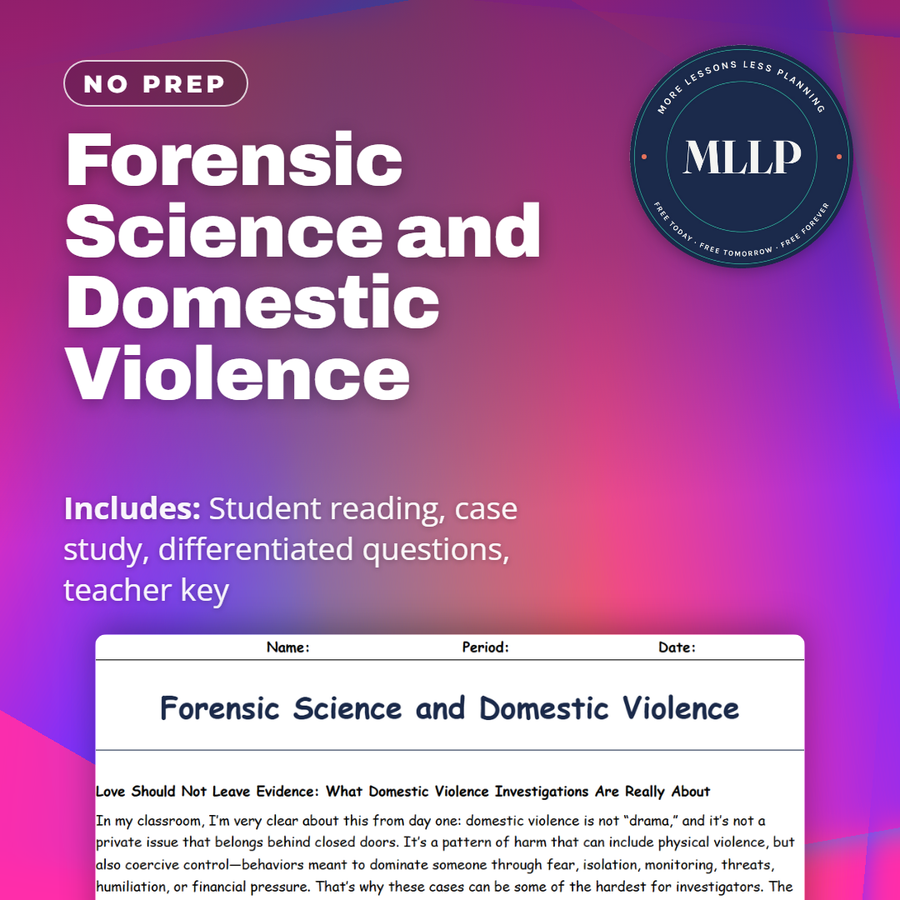
Forensic Science and Domestic Violence
Quality reviewed September 2026
Facts verified September 9, 2026
- Subject
- Science
- Grades
- Grades 9-12
- Length
- 9-page student worksheet
- Time
- About one 50-minute class period
- Great for
- Sub plans and independent work
- Includes
- Reading passage, comprehension questions + full answer key
- Format
- Print-and-go PDF
What students do
- Define coercive control and distinguish it from occasional conflict
- Interpret scene documentation and injury patterns as evidence
- Trace digital timelines to reveal patterns of surveillance and pressure
- Evaluate how trauma-informed interviewing protects evidence quality
What it covers
- Coercive control as a pattern of domination
- Documentation of scenes, injuries, and transfer evidence
- Digital evidence of control and timeline building
Start reading this worksheet
Love Should Not Leave Evidence: What Domestic Violence Investigations Are Really About
In my classroom, I’m very clear about this from day one: domestic violence is not “drama,” and it’s not a private issue that belongs behind closed doors. It’s a pattern of harm that can include physical violence, but also coercive control: behaviors meant to dominate someone through fear, isolation, monitoring, threats, humiliation, or financial pressure. That’s why these cases can be some of the hardest for investigators. The victim may be afraid to talk. The suspect may look calm and convincing. Friends and family may disagree about what they “think” happened. And because people in relationships share space, evidence can be easy to misinterpret unless investigators work carefully. Valentine’s Day is a surprisingly important context for this unit. Holidays can raise expectations and pressure: “Prove you love me,” “Don’t embarrass me,” “If you leave me, you’ll regret it.” Those lines can be warning signs, especially when they come with control: demanding passwords, tracking location, constant calls, or isolating a partner from friends. Forensic science doesn’t solve feelings. It solves cases by testing claims against facts: Does the scene match the story? Does the timeline make sense? Do injuries align with what someone said occurred? Are there independent records, such as cameras, texts, or receipts, that confirm or contradict statements? Domestic violence investigations are not built on one dramatic clue. They’re built like a sturdy bridge: documentation, injury evidence, digital timelines, trace transfer, and careful chain of custody. When those parts are handled correctly, evidence can speak even when someone is too scared to.
The First Hour: Safety, Documentation, and Why Details Matter Later
When a domestic violence call comes in, the first priority is immediate safety and medical care. Officers separate people, check for injuries, and secure the scene. The second priority is documentation, because what is documented early is often what holds up later. Injuries can change quickly, scenes can be cleaned, and stories can shift. That’s why investigators photograph visible injuries, torn clothing, disturbed rooms, broken items, and damaged phones. A phone matters because controlling a partner’s communication is a common part of coercive control. If a phone is smashed, hidden, or taken, that’s not just “property damage.” It can be evidence of isolation and intimidation. Investigators also gather statements, but in forensics we teach students this key rule: statements are starting points, not final truth. In DV cases, trauma can affect memory and order of events. Fear can affect what someone is willing to say. That means investigators should use trauma-informed interviewing: calm tone, clear questions, no blaming language, and patience. This does not mean “believe everything instantly.” It means collect information in a way that is ethical and more likely to produce accurate details. Domestic violence scenes often look “ordinary” at first glance: a home, a bedroom, a hallway. That’s exactly why scene photos, notes, and time stamps matter. If later a suspect claims, “Nothing was broken,” photos can prove otherwise. If someone says, “They left at midnight,” the timeline can test it. The earlier the documentation, the harder it is for anyone to rewrite what happened.
Evidence That Doesn’t Get Emotional: Transfer, Injuries, and What the Lab Can Actually Prove
Students are often surprised to learn that in domestic violence cases, DNA can be less dramatic than TV makes it seem. If two people live together, touch DNA or hair may be expected on common surfaces. So investigators focus on context: where evidence is found, whether it suggests struggle, and whether it appears in an unusual location. For example, transfer under fingernails, unusual clothing damage, or fresh biological material in a place that doesn’t match the story can become meaningful. Trace evidence matters because it follows contact. Fibers can transfer during a struggle. Soil can link shoes to a location. A broken object can leave tiny fragments that show movement. Even small details can support or challenge a claim, like whether a shirt was pulled, whether a necklace clasp broke, or whether a doorframe shows fresh damage. Injury evidence is also a major piece of the puzzle. That can include photographs, medical notes, and in some cases documentation by forensic nurses trained to record injuries carefully. Investigators look for consistency: Do the injuries match the explanation? Does the pattern match the claimed mechanism? (For example, “I fell” stories may not match bruising location or other scene details.) In court, this becomes about probability and consistency, not certainty from one clue. A strong DV case is built when multiple categories, such as scene, injuries, timeline, and digital records, tell the same story.
Like what you read? The full reading, the case study, and every question set are in the free download below, along with the answer key.
Why this matters
"Prove you love me" and "if you leave, you will regret it" can sound like ordinary relationship pressure alone, but this reading teaches students to hear them differently once they show up alongside monitoring, threats, or isolation. That combination separates coercive control from occasional conflict, and one has a name and a pattern while the other does not.
The reading centers on documentation: photos taken early, timelines built from calls and texts, injury records, scene notes. That paperwork exists because a person describing what happened is not always believed, but a timeline where the photos, texts, and injuries line up is harder to dismiss.
From one teacher to another
Domestic violence investigations are evidence-driven the same way any case is, but the stakes feel different. In a Valentine workshop, I explain that holidays can pressure people, "Prove you love me" or "If you leave, you'll regret it", and those lines can be warning signs when paired with monitoring, threats, or isolation. The worksheet focuses on how forensics builds a bridge of documentation: photos taken early, timelines from calls and texts, injury records, scene notes. When those parts align, evidence speaks even when someone is too afraid.
What you get
Download
Where should I send the next one?
Everything here is free and it stays that way. Leave your email and I'll send you the new lessons as they go up. You can unsubscribe from any one of them.
Related resources

Animal Courtship Biology: Sexual Selection in the Wild
Famous Relationship Cases in Forensics: Evidence vs. Emotion in the Public Eye

Forensic Science: Online Romance Scams

Government and Relationships: How Laws Have Shaped “Love” in U.S. History

Love Hormones: Oxytocin, Dopamine, and the Brain

Psychology Meets Hollywood: Romance Movies vs. Real Relationship Science
Every lesson on this site is free to download and use. If one of them saved you a prep period, you can chip in a few bucks toward my three kids' daycare fund. That's genuinely where tips go.