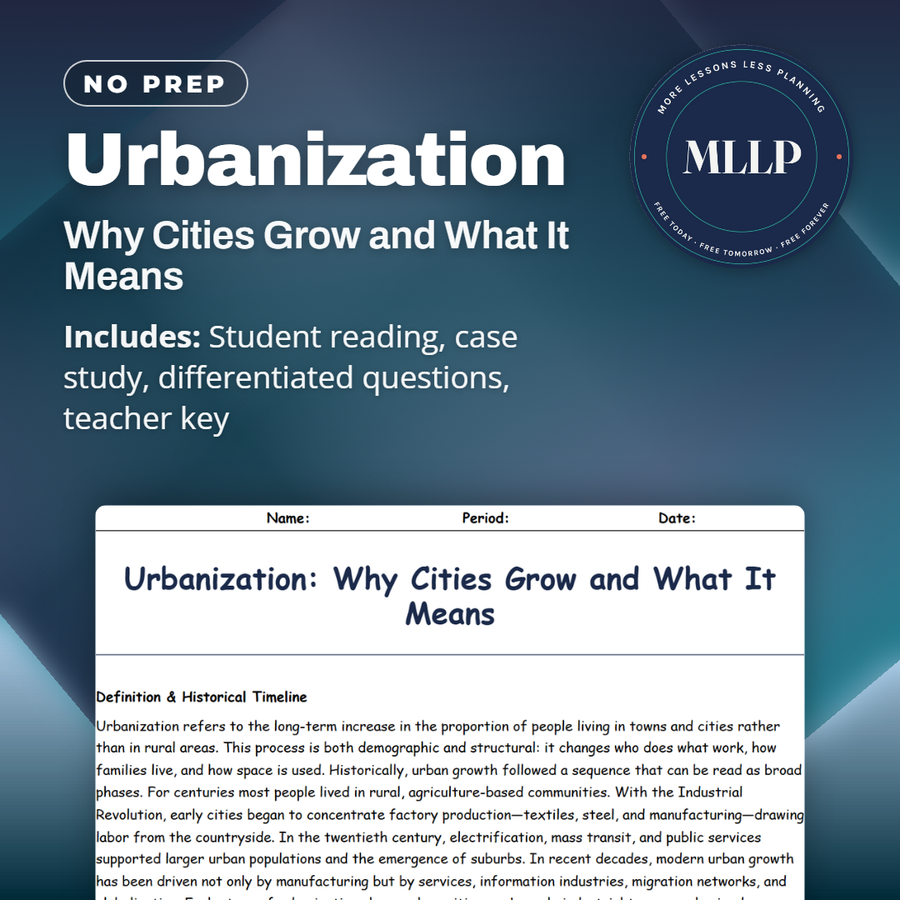
Urbanization: Why Cities Grow and What It Means
Quality reviewed September 2026
Facts verified September 14, 2026
- Subject
- Social Studies
- Grades
- Grades 9-12
- Length
- 8-page student worksheet
- Time
- About one 50-minute class period
- Great for
- Sub plans and independent work
- Includes
- Reading passage, comprehension questions + full answer key
- Format
- Print-and-go PDF
What students do
- Match terms like push factor, pull factor, informal settlement, mechanization, and remittances to their correct definitions
- Fill in the blank sentences on urbanization, pull factors, and informal settlements
- Answer multiple choice questions on common push factors for migration and what causes informal settlements to form
- Write short answers on how mechanized agriculture drives migration and how remittances affect rural households
What it covers
- The historical phases of urbanization, from early industrial factory towns to modern service and information economies
- Push and pull factors behind rural-to-urban migration, including mechanization, wages, and migrant networks
- A case study on a farming region where mechanized harvesters and new city jobs combined to drive a wave of migration
Start reading this worksheet
Definition & Historical Timeline
Urbanization refers to the long-term increase in the proportion of people living in towns and cities rather than in rural areas. This process is both demographic and structural: it changes who does what work, how families live, and how space is used. Historically, urban growth followed a sequence that can be read as broad phases. For centuries most people lived in rural, agriculture-based communities. With the Industrial Revolution, early cities began to concentrate factory production—textiles, steel, and manufacturing—drawing labor from the countryside. In the twentieth century, electrification, mass transit, and public services supported larger urban populations and the emergence of suburbs. In recent decades, modern urban growth has been driven not only by manufacturing but by services, information industries, migration networks, and globalization. Each stage of urbanization changes how cities work: early industrial towns emphasized proximity to factories; twentieth-century cities invested in mass transit and utilities; twenty-first-century urban systems emphasize regional networks, digital connectivity, and new patterns of commuting and suburbanization. Understanding these phases helps students see urbanization as a long-term transformation of economies, institutions, and everyday life.
Push & Pull Factors
Movements from rural areas to cities are shaped by push factors and pull factors that change over time and across places. Push factors are conditions that push people away from their homes: declining farm incomes, land fragmentation, drought or crop failure, limited access to education and health, or the mechanization of agriculture that reduces local labor needs. For example, a single large combine harvester can replace many seasonal workers; that mechanization makes it harder for young people to remain in farming households. Pull factors attract people to cities: perceived higher wages, a diversity of job types (manufacturing, services, trade), better schools and medical facilities, cultural and social attractions, and established migrant networks that ease the transition. The role of social networks cannot be overstated: once a relative or friend secures steady work in a city and sends back remittances or practical advice, migration becomes less risky and more likely to continue. At the same time, cities can create their own pull factors through economic growth strategies, industrial policy, or targeted investments (new factories, special economic zones, or university expansion) that promise jobs and training. Both push and pull interact: mechanization and land limits at home plus greater opportunity and social ties in the city make migration a rational choice for many households.
Like what you read? The full reading, the case study, and every question set are in the free download below, along with the answer key.
Why this matters
Push and pull rarely arrive as separate forces, they show up together in one family's decision to leave a farm. This farming town lost field labor to mechanized harvesters at the same time a nearby city added factory jobs, and migration followed both pressures at once.
My students usually expect the story to end well once the family reaches the city, so I make them sit with what actually changed: real income gains alongside crowded clinics and patchy water service. Remittances sent back to the family that stayed behind complicate the picture, since the move helps two households, not just one.
From one teacher to another
This one works well at the start of an urbanization unit because it lays out the push and pull factors clearly before asking students to apply them. The case study follows a farming family's town through mechanization and a factory boom in a nearby city, and it doesn't sugarcoat the result: crowded clinics, patchy water service, and informal housing alongside real income gains. It pairs well with a lesson on population growth or migration.
What you get
Download
Where should I send the next one?
Everything here is free and it stays that way. Leave your email and I'll send you the new lessons as they go up. You can unsubscribe from any one of them.
Related resources
City Transport & Infrastructure: Moving Millions Efficiently

Gentrification & Housing: Winners, Losers, and Choices
Megacities vs Global Cities: Powerhouses of Today
Smart Growth & Urban Planning: Designing Better Cities
Suburbanization & Sprawl: Causes, Costs, Consequences
Sustainable Cities: Green Solutions & Urban Resilience
Every lesson on this site is free to download and use. If one of them saved you a prep period, you can chip in a few bucks toward my three kids' daycare fund. That's genuinely where tips go.