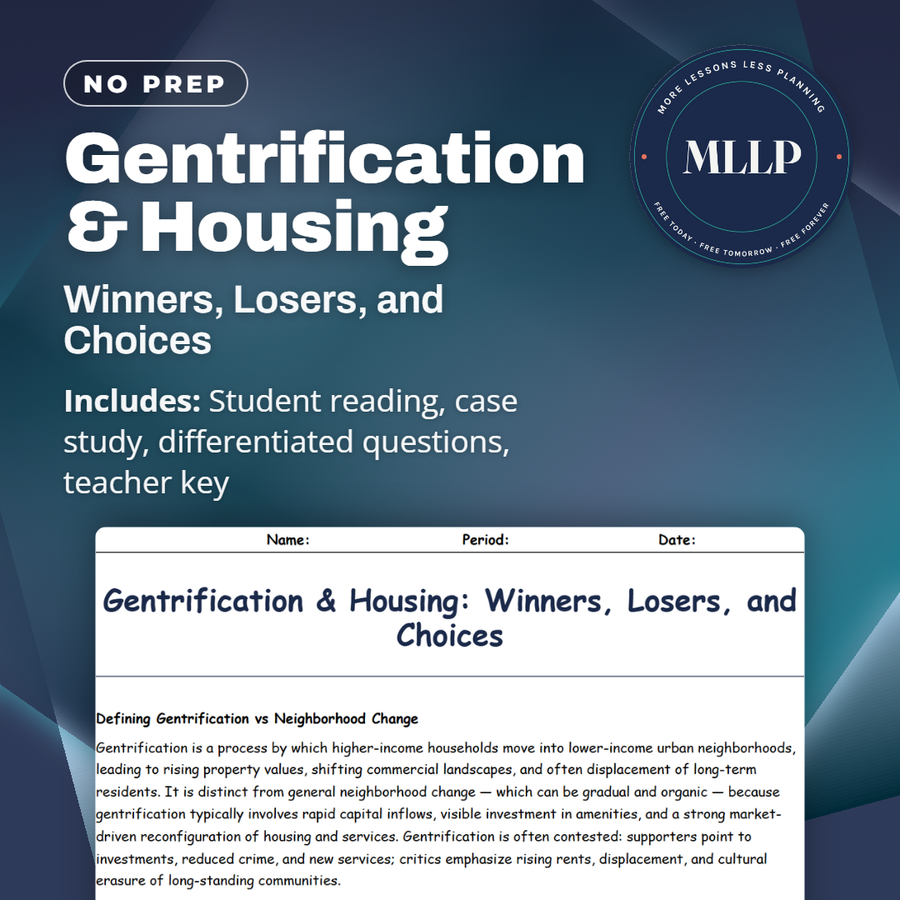
Gentrification & Housing: Winners, Losers, and Choices
Quality reviewed September 2026
Facts verified September 14, 2026
- Subject
- Social Studies
- Grades
- Grades 9-12
- Length
- 6-page student worksheet
- Time
- About one 50-minute class period
- Great for
- Sub plans and independent work
- Includes
- Reading passage, comprehension questions + full answer key
- Format
- Print-and-go PDF
What students do
- Match terms like displacement, inclusionary zoning, and community land trust to their correct definitions
- Fill in the blank sentences on rent stabilization, community land trusts, and neighborhood displacement
- Answer multiple choice questions on how gentrification typically begins and what rising rents cause
- Write short answers on the trade-offs of rent control and how a community land trust protects affordability
What it covers
- The process by which investment, new amenities, and rising rents can lead to resident displacement
- Policy tools like rent control, inclusionary zoning, and community land trusts used to address gentrification's effects
- A case study on a neighborhood where a new rail line triggered rapid change and the city's response with affordable housing rules
Start reading this worksheet
Defining Gentrification vs Neighborhood Change
Gentrification is a process by which higher-income households move into lower-income urban neighborhoods, leading to rising property values, shifting commercial landscapes, and often displacement of long-term residents. It is distinct from general neighborhood change (which can be gradual and organic) because gentrification typically involves rapid capital inflows, visible investment in amenities, and a strong market-driven reconfiguration of housing and services. Gentrification is often contested: supporters point to investments, reduced crime, and new services; critics emphasize rising rents, displacement, and cultural erasure of long-standing communities.
The Typical Process: Investment → Amenities → Rents → Displacement
Gentrification tends to follow a recognizable sequence. First, investment arrives: developers renovate housing, small investors buy properties, or public projects improve infrastructure. Second, new amenities (cafés, galleries, boutique stores) appear, making the area more attractive to wealthier residents. Third, demand increases and rents and home prices rise. Fourth, long-term, lower-income residents may experience displacement: forced relocation due to unaffordable housing costs or indirect pressures (loss of local services, increased property taxes). Displacement can be physical (eviction, inability to pay rent) or economic/cultural (longtime residents feel priced out of local life even if they remain). The degree of displacement depends on local housing markets, tenant protections, and available affordable housing.
Like what you read? The full reading, the case study, and every question set are in the free download below, along with the answer key.
Why this matters
A new rail line sets off rising rents, new amenities, and eventually eviction notices in the neighborhood this reading follows. That chain of cause and effect explains gentrification better than the word alone, since it shows a change meant to help pricing out the people already living there.
Students tend to treat rent control as an obvious fix until they weigh its trade-offs against a community land trust. I have them compare the two so they have to ask who actually benefits from each policy, instead of assuming one tool solves displacement alone.
From one teacher to another
This one fits a unit on urban geography because it doesn't shy away from the tension between investment and displacement. The case study follows a neighborhood through the whole sequence, from a new rail line to rising rents to eviction notices, so students see cause and effect play out. The short answer questions push kids to weigh the trade-offs of rent control instead of simply picking a side.
What you get
Download
Where should I send the next one?
Everything here is free and it stays that way. Leave your email and I'll send you the new lessons as they go up. You can unsubscribe from any one of them.
Related resources
City Transport & Infrastructure: Moving Millions Efficiently
Megacities vs Global Cities: Powerhouses of Today
Smart Growth & Urban Planning: Designing Better Cities
Suburbanization & Sprawl: Causes, Costs, Consequences
Sustainable Cities: Green Solutions & Urban Resilience
Urban Challenges: Pollution, Crime, and Inequality
Every lesson on this site is free to download and use. If one of them saved you a prep period, you can chip in a few bucks toward my three kids' daycare fund. That's genuinely where tips go.