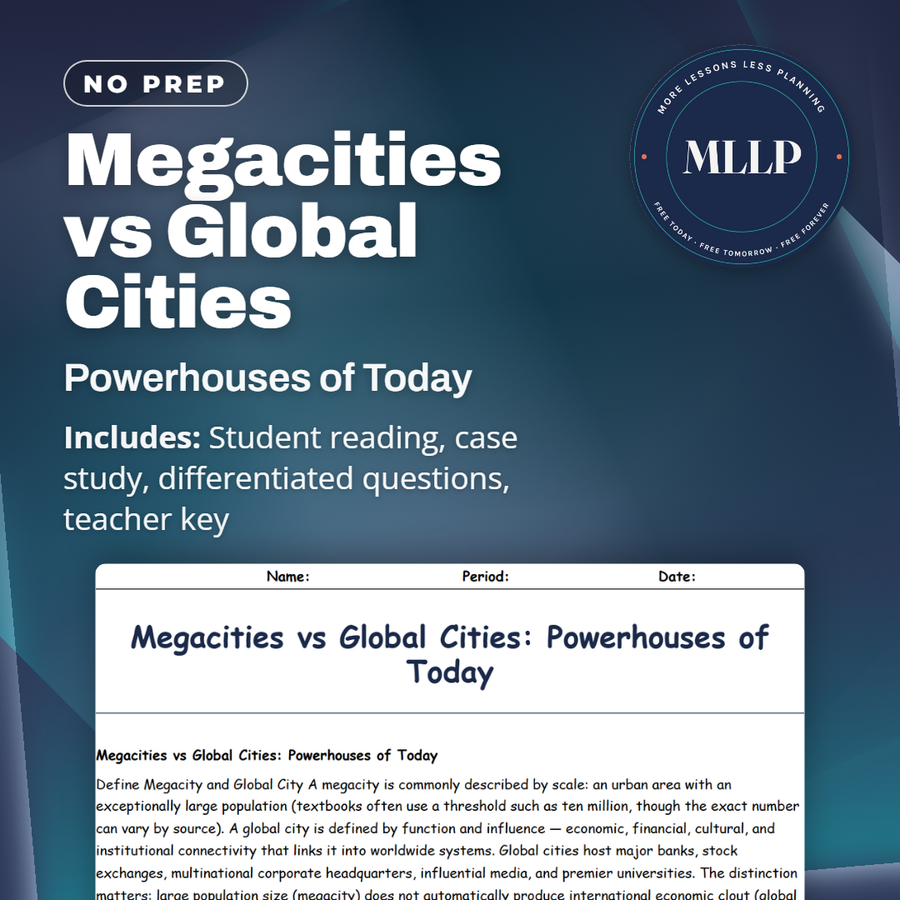
Megacities vs Global Cities: Powerhouses of Today
Quality reviewed September 2026
Facts verified September 14, 2026
- Subject
- Social Studies
- Grades
- Grades 9-12
- Length
- 6-page student worksheet
- Time
- About one 50-minute class period
- Great for
- Sub plans and independent work
- Includes
- Reading passage, comprehension questions + full answer key
- Format
- Print-and-go PDF
What students do
- Match terms like primate city, megaregion, and diaspora community to their correct definitions
- Fill in the blank sentences on global cities, megaregions, and primate cities
- Answer multiple choice questions on what defines a megacity versus a global city
- Write short answers on why a smaller city can carry more global influence than a larger one
What it covers
- The difference between a megacity, defined by population scale, and a global city, defined by economic and cultural influence
- Related concepts like primate cities, megaregions, and transnational networks
- A case study comparing two cities, one built around sheer population growth and the other around global financial and institutional influence
Start reading this worksheet
Megacities vs Global Cities: Powerhouses of Today
Define Megacity and Global City A megacity is commonly described by scale: an urban area with an exceptionally large population (textbooks often use a threshold such as ten million, though the exact number can vary by source). A global city is defined by function and influence: economic, financial, cultural, and institutional connectivity that links it into worldwide systems. Global cities host major banks, stock exchanges, multinational corporate headquarters, influential media, and premier universities. The distinction matters: large population size (megacity) does not automatically produce international economic clout (global city), and some global cities are not the largest in population terms. These differences influence policy priorities, planning strategies, and social outcomes.
Characteristics of Each: Scale vs Role
Megacities display the logistics of sheer scale: mass transportation needs, housing markets stretching across hundreds of neighborhoods, and huge daily flows of people and goods. Global cities act as command points in a global economy: decision-making centers where finance, law, creative industries, and international diplomacy concentrate. Important related concepts: primate city (a city that dominates its national urban system by population or politics), megaregion (linked metropolitan areas forming cohesive economic zones), and transnational network (flows of capital, people, information connecting cities across borders). Identifying whether an urban center is a megacity, a global city, or both is not just academic. It determines whether local policy should emphasize mass housing and services or international regulation, talent retention, and global connectivity.
Like what you read? The full reading, the case study, and every question set are in the free download below, along with the answer key.
Why this matters
Population size and global influence sound like the same thing until the case study lines up two cities: one straining under population growth, the other running global finance with far fewer people. A city a student has never heard of can matter more than one with a bigger skyline.
Students treat megacity and global city as synonyms, so I have them argue from the comparison instead of a gut feeling. Defending a smaller, more influential city is the moment primate city and megaregion stop being extra vocabulary.
From one teacher to another
I like pairing this one with a unit on world cities because it gets students past the assumption that bigger automatically means more powerful. The case study contrasts two cities directly, one straining under population growth and one running global finance and diplomacy with a much smaller population, so students have to argue from evidence instead of a hunch. It works well right after a lesson on urban hierarchies.
What you get
Download
Where should I send the next one?
Everything here is free and it stays that way. Leave your email and I'll send you the new lessons as they go up. You can unsubscribe from any one of them.
Related resources
City Transport & Infrastructure: Moving Millions Efficiently
Gentrification & Housing: Winners, Losers, and Choices
Smart Growth & Urban Planning: Designing Better Cities
Suburbanization & Sprawl: Causes, Costs, Consequences
Sustainable Cities: Green Solutions & Urban Resilience
Urban Challenges: Pollution, Crime, and Inequality
Every lesson on this site is free to download and use. If one of them saved you a prep period, you can chip in a few bucks toward my three kids' daycare fund. That's genuinely where tips go.