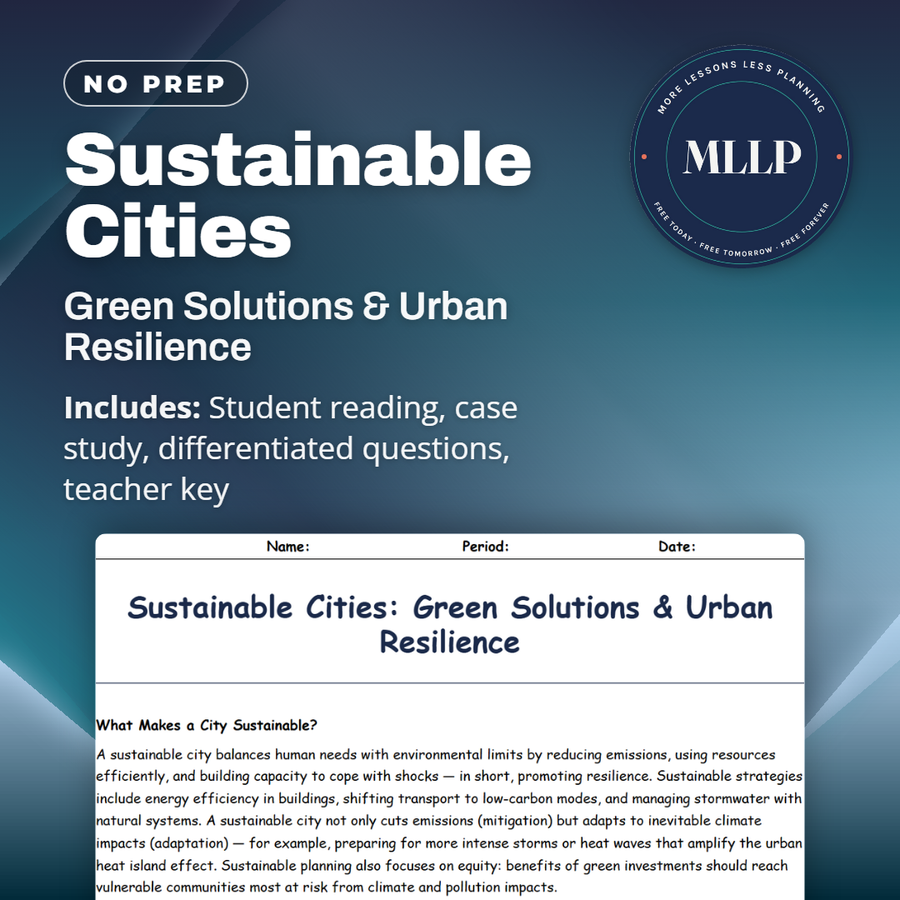
Sustainable Cities: Green Solutions & Urban Resilience
Quality reviewed September 2026
Facts verified September 14, 2026
- Subject
- Social Studies
- Grades
- Grades 9-12
- Length
- 6-page student worksheet
- Time
- About one 50-minute class period
- Great for
- Sub plans and independent work
- Includes
- Reading passage, comprehension questions + full answer key
- Format
- Print-and-go PDF
What students do
- Match terms like resilience, green infrastructure, urban heat island, mitigation, and adaptation to their correct definitions
- Fill in the blank sentences on green infrastructure, green bonds, and mitigation
- Answer multiple choice questions on what reduces both heat and stormwater runoff and how green bonds work
- Write short answers on why green infrastructure needs maintenance funding and how to avoid green gentrification
What it covers
- What makes a city sustainable, balancing emissions reduction, resource efficiency, and resilience to shocks
- Proven strategies like green roofs, reliable transit, blue-green systems, and energy-efficiency retrofits
- A case study on a city that paired a resilience plan of solar incentives and green corridors with affordable-housing protections
Start reading this worksheet
What Makes a City Sustainable?
A sustainable city balances human needs with environmental limits by reducing emissions, using resources efficiently, and building capacity to cope with shocks: in short, promoting resilience. Sustainable strategies include energy efficiency in buildings, shifting transport to low-carbon modes, and managing stormwater with natural systems. A sustainable city not only cuts emissions (mitigation) but adapts to inevitable climate impacts (adaptation), for example, preparing for more intense storms or heat waves that amplify the urban heat island effect. Sustainable planning also focuses on equity: benefits of green investments should reach vulnerable communities most at risk from climate and pollution impacts.
Proven Strategies: Green Roofs, Transit, and Blue-Green Systems
Cities use many proven strategies. Green roofs reduce building temperatures, extend roof life, and manage stormwater. Investing in frequent, reliable public transit and safe active-transport networks reduces private-car dependence and emissions. Blue-green systems (integrating waterways, wetlands, and parks) hold stormwater, improve biodiversity, and provide recreation. Energy-efficiency retrofits lower consumption in older building stocks. Renewable energy deployment (solar, district heating where feasible) reduces local pollution and improves long-term resilience. Combining these strategies produces co-benefits: better health, lower energy bills, and enhanced urban amenity.
Like what you read? The full reading, the case study, and every question set are in the free download below, along with the answer key.
Why this matters
Skip the affordable-housing protections and a green roof that cools a neighborhood during a heat wave can price out the people it was built to help. This reading will not let students celebrate solar incentives and green corridors without asking who pays, since the case study city built its resilience plan and housing protections together.
I use the term green gentrification because it is the one my students have never heard, even though they can describe the pattern once I name it: a neighborhood improves and residents can no longer afford to stay. Mitigation only works, in this reading, when paired with protecting the people already living there.
From one teacher to another
I like this one because it doesn't treat sustainability and equity as separate topics. The case study follows a city through heat waves and flooding, then shows how it paired green infrastructure with an affordable-housing fund so long-term residents weren't priced out by the very improvements meant to help them. It fits well in a unit on climate adaptation or urban planning, and the short answer questions get at real budget trade-offs.
What you get
Download
Where should I send the next one?
Everything here is free and it stays that way. Leave your email and I'll send you the new lessons as they go up. You can unsubscribe from any one of them.
Related resources
City Transport & Infrastructure: Moving Millions Efficiently
Gentrification & Housing: Winners, Losers, and Choices
Megacities vs Global Cities: Powerhouses of Today
Smart Growth & Urban Planning: Designing Better Cities
Suburbanization & Sprawl: Causes, Costs, Consequences
Urban Challenges: Pollution, Crime, and Inequality
Every lesson on this site is free to download and use. If one of them saved you a prep period, you can chip in a few bucks toward my three kids' daycare fund. That's genuinely where tips go.