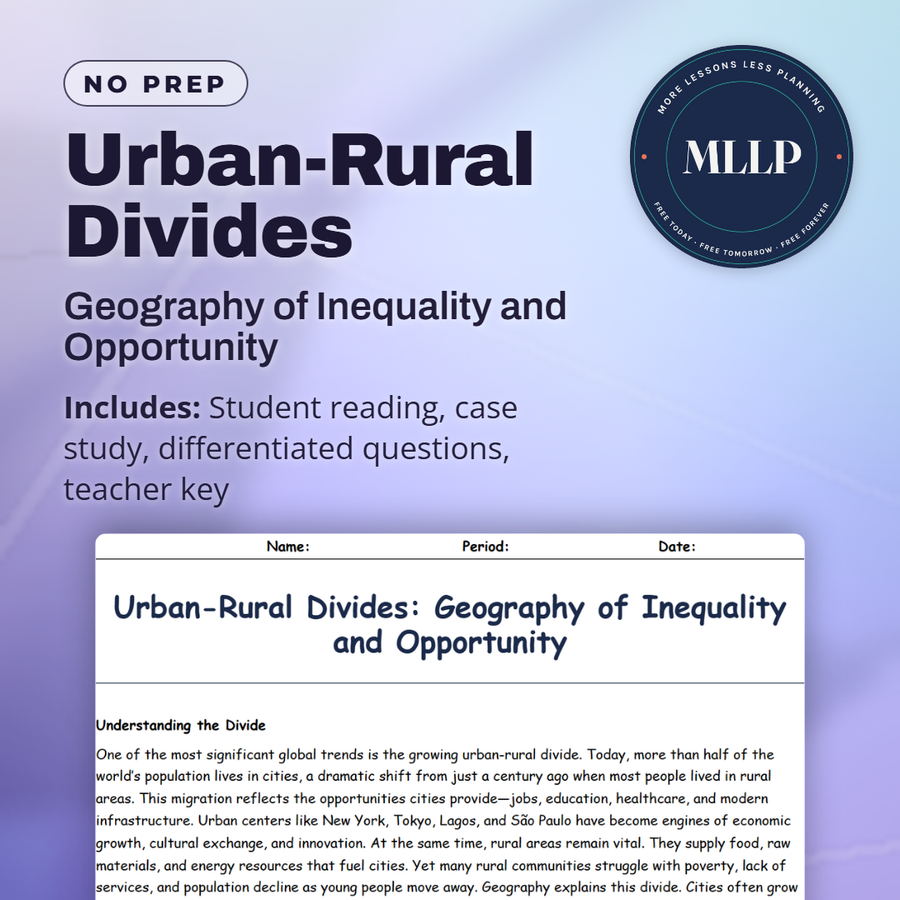
Urban-Rural Divides: Geography of Inequality and Opportunity
Quality reviewed September 2026
Facts verified September 14, 2026
- Subject
- Social Studies
- Grades
- Grades 9-12
- Length
- 7-page student worksheet
- Time
- About one 50-minute class period
- Great for
- Sub plans and independent work
- Includes
- Reading passage, comprehension questions + full answer key
- Format
- Print-and-go PDF
What students do
- Match regions like Africa, Asia, and China to the urban or rural challenges they face
- Fill in the blank sentences on China's hukou system, rural-to-urban migration, and what rural communities supply to cities
- Answer multiple choice questions on why cities historically formed near trade routes, a major problem facing rural areas, and what China's hukou system restricted
- Write short answers on why megacities face slums and pollution, how the urban-rural divide shapes politics, and what strategies could bridge the gap
What it covers
- Why more than half the world now lives in cities, and how geography like rivers and trade routes explains where urban centers grew
- The different challenges facing cities and rural areas, from megacity overcrowding to rural depopulation and lost services
- A case study on China's urban-rural divide, including the hukou system and recent rural revitalization efforts
Start reading this worksheet
Understanding the Divide
One of the most significant global trends is the growing urban-rural divide. Today, more than half of the world’s population lives in cities, a dramatic shift from just a century ago when most people lived in rural areas. This migration reflects the opportunities cities provide—jobs, education, healthcare, and modern infrastructure. Urban centers like New York, Tokyo, Lagos, and São Paulo have become engines of economic growth, cultural exchange, and innovation. At the same time, rural areas remain vital. They supply food, raw materials, and energy resources that fuel cities. Yet many rural communities struggle with poverty, lack of services, and population decline as young people move away. Geography explains this divide. Cities often grow where rivers, ports, or crossroads give them strategic advantages. Rural areas may be far from trade networks, making it harder to attract investment. The gap between these regions creates economic, social, and political challenges for countries around the world.
Urbanization and Its Challenges
Rapid urbanization brings both progress and problems. In wealthier nations, cities offer high standards of living, advanced healthcare, and cultural opportunities. However, even in developed countries, inequality persists, with wealthy neighborhoods standing in stark contrast to areas facing poverty and unemployment. In developing nations, urban growth often outpaces planning. Megacities like Dhaka, Lagos, and Mumbai struggle with overcrowding, traffic, air pollution, and inadequate housing. Informal settlements, often called slums, emerge when people migrate faster than infrastructure can expand. These neighborhoods lack clean water, electricity, and sanitation, leading to serious health risks. At the same time, cities in developing regions can also drive progress by concentrating talent and industry. Rural areas face different challenges. Limited schools, hospitals, and transportation make it difficult to retain young people. Agricultural communities are especially vulnerable to climate change, as droughts, floods, and shifting growing seasons affect crops. The rural-to-urban migration trend is likely to continue, raising questions about how to create balance and opportunity for both regions.
Global Inequality and the Divide
This kind of urban-rural divide appears worldwide, not just in one country. In the United States, cities like New York and San Francisco thrive as economic hubs, while rural communities in the Midwest and Appalachia face depopulation and job losses. In Africa, rapid urban growth has created megacities alongside rural areas that still lack electricity or safe water. In Latin America, rural Indigenous communities often experience poverty and marginalization compared to urban elites. The divide also influences politics. Rural populations may feel neglected by governments that prioritize urban development, fueling resentment and political polarization. At the same time, cities dominate national economies and global trade, making it hard to ignore their needs. Geography reveals that the challenge of balancing urban and rural development is both local and global.
Like what you read? The full reading, the case study, and every question set are in the free download below, along with the answer key.
Why this matters
More than half the world now lives in a city, and this reading asks why that split runs so unevenly. Rivers and trade routes explain where the first urban centers took hold, but the divide today is also administrative, shaped by policies like China's hukou system as much as by geography.
What surprises students is that rural areas lose out too, not just in income but in the services cities take for granted. I like pairing the megacity side, overcrowding and pollution, with the rural side, depopulation and vanishing services, so the class sees both halves of one system instead of picking a winner.
From one teacher to another
This reading gets at a divide that shows up everywhere from the U.S. to China, comparing the problems cities face with the problems rural areas face side by side. The key info table breaks down urban and rural challenges by region, which works well for a compare-and-contrast discussion. The China case study on the hukou system shows students how policy, not only geography, can widen this gap. This pairs well with a unit on urbanization or human geography.
What you get
Download
Where should I send the next one?
Everything here is free and it stays that way. Leave your email and I'll send you the new lessons as they go up. You can unsubscribe from any one of them.
Related resources
Changing Political Boundaries: Shaping the World Map
Climate Change Impacts and Adaptation: Facing a Warming World
Disease and Global Health: Geography of Epidemics and Recovery
Globalization and Interdependence: How the World is Connected
International Cooperation and Sustainability: Working Together for a Better Future
Migration Crises: Movement in a Changing World
Every lesson on this site is free to download and use. If one of them saved you a prep period, you can chip in a few bucks toward my three kids' daycare fund. That's genuinely where tips go.