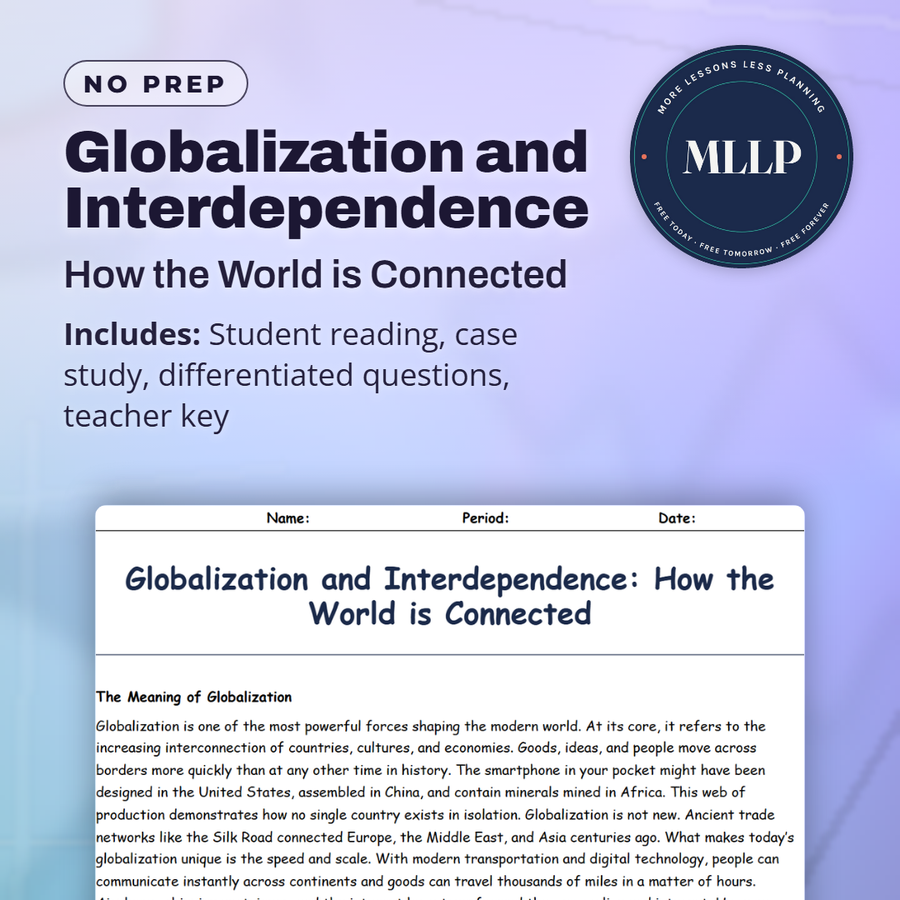
Globalization and Interdependence: How the World is Connected
Quality reviewed September 2026
Facts verified September 14, 2026
- Subject
- Social Studies
- Grades
- Grades 9-12
- Length
- 8-page student worksheet
- Time
- About one 50-minute class period
- Great for
- Sub plans and independent work
- Includes
- Reading passage, comprehension questions + full answer key
- Format
- Print-and-go PDF
What students do
- Match terms like the Silk Road, global supply chains, and cultural homogenization to their correct definitions
- Fill in the blank sentences on the Silk Road, the 2008 financial crisis, and disrupted supply chains during COVID-19
- Answer multiple choice questions on what globalization means, which crisis exposed the risks of interconnected economies, and what counts as cultural diffusion
- Write short answers on how technology has accelerated globalization, the benefits and drawbacks of cultural diffusion, and why interdependence creates both opportunity and risk
What it covers
- What globalization means and how it connects economies, cultures, and politics across borders, from the ancient Silk Road to modern supply chains
- The economic web of interdependence, showing how products like the iPhone and coffee travel through multiple countries before reaching a shelf
- A case study on the 2008 global financial crisis and how one country's mortgage collapse spread instability worldwide
Start reading this worksheet
The Meaning of Globalization
Globalization is one of the most powerful forces shaping the modern world. At its core, it refers to the increasing interconnection of countries, cultures, and economies. Goods, ideas, and people move across borders more quickly than at any other time in history. The smartphone in your pocket might have been designed in the United States, assembled in China, and contain minerals mined in Africa. This web of production demonstrates how no single country exists in isolation. Globalization is not new. Ancient trade networks like the Silk Road connected Europe, the Middle East, and Asia centuries ago. What makes today’s globalization unique is the speed and scale. With modern transportation and digital technology, people can communicate instantly across continents and goods can travel thousands of miles in a matter of hours. Airplanes, shipping containers, and the internet have transformed the way we live and interact. However, globalization is not just about economics. It also impacts culture, politics, and the environment. Cultural products like Hollywood films, K-pop music, and global sports like soccer spread ideas and lifestyles across borders. Politically, globalization creates opportunities for cooperation but also sparks tensions over sovereignty and control. Environmental issues such as climate change show how local actions can have global consequences, requiring worldwide solutions.
The Economic Web of Interdependence
One of the most visible effects of globalization is the global economy. Countries now depend on each other for resources, goods, and services. For example, oil extracted in the Middle East fuels cars in Europe, while coffee grown in Colombia ends up in cafés in New York or Paris. This interdependence creates prosperity, allowing nations to specialize in what they produce best and trade for what they lack. Yet, economic globalization also creates challenges. Factories may close in one country as jobs move overseas where labor is cheaper. Farmers may struggle when global markets drive down prices for their crops. The 2008 financial crisis showed how interconnected economies can quickly spread instability around the world. What begins as a banking problem in the United States can ripple across Europe, Asia, and Africa in a matter of weeks. Global supply chains, where production is spread across multiple countries, highlight both the strengths and weaknesses of interdependence. During the COVID-19 pandemic, disruptions in manufacturing in one country affected the availability of products worldwide. From medical equipment to electronic devices, shortages revealed how fragile the system can be. This table shows how products are rarely “local” anymore. They are the result of global cooperation and competition, making interdependence an unavoidable reality of the modern age.
Cultural Exchange and Identity
Globalization has also transformed culture. Cultural diffusion spreads language, religion, food, music, and fashion across borders. For instance, American fast food restaurants can be found in nearly every major city in the world, while yoga—originating in India—has become a global practice. These exchanges enrich societies, giving people access to new ideas and traditions. However, globalization also raises questions of cultural identity. Critics argue that Western culture, especially from the United States, dominates global media, creating a kind of cultural homogenization where local traditions are overshadowed. At the same time, local cultures resist and adapt global influences in unique ways. A hamburger in Japan may include teriyaki sauce, while hip-hop music in Africa incorporates local languages and rhythms. Globalization also spreads social movements. Ideas about democracy, human rights, or environmental justice can travel rapidly across borders through social media. Hashtags and online campaigns unite activists from different countries around common causes. This blending of local and global values is reshaping how people view themselves and their communities.
Like what you read? The full reading, the case study, and every question set are in the free download below, along with the answer key.
Why this matters
How many countries does it take to get a cup of coffee onto a shelf? This reading traces that question, plus two other everyday products, through the countries that supply, assemble, and sell them, so interdependence becomes something students can follow step by step.
I use the 2008 financial crisis to make this concrete: one country's mortgage collapse spread instability worldwide, proof interdependence cuts both ways. Connecting that to COVID-19's disrupted supply chains matters too, since most students lived through empty shelves without ever learning why one disruption reached so far.
From one teacher to another
This one gets at how tangled the modern economy really is, tracing a product like an iPhone or a cup of coffee through multiple countries before it reaches a customer. The key info table breaks down exactly which countries supply materials, assembly, and markets for three everyday products. The 2008 financial crisis case study shows students what happens when that interdependence turns into vulnerability. This pairs well with a unit on economic geography or globalization.
What you get
Download
Where should I send the next one?
Everything here is free and it stays that way. Leave your email and I'll send you the new lessons as they go up. You can unsubscribe from any one of them.
Related resources
Changing Political Boundaries: Shaping the World Map
Climate Change Impacts and Adaptation: Facing a Warming World
Disease and Global Health: Geography of Epidemics and Recovery
International Cooperation and Sustainability: Working Together for a Better Future
Migration Crises: Movement in a Changing World
Resource Scarcity and Conflict: Struggles Over Earth’s Essentials
Every lesson on this site is free to download and use. If one of them saved you a prep period, you can chip in a few bucks toward my three kids' daycare fund. That's genuinely where tips go.