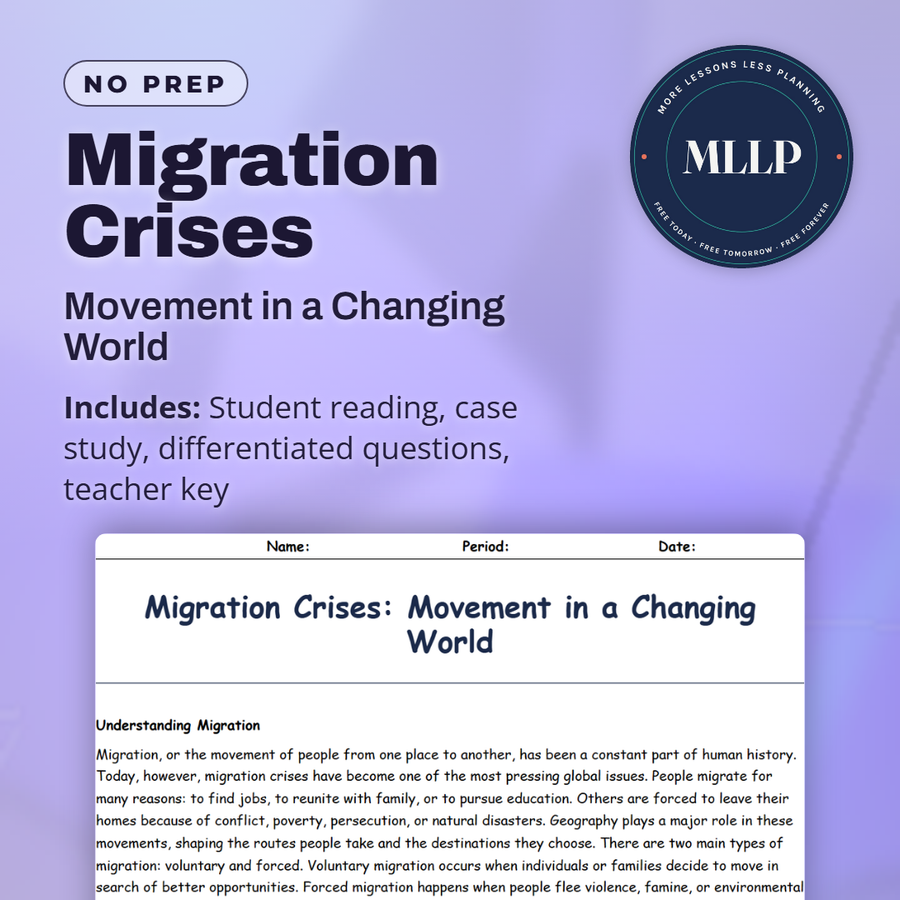
Migration Crises: Movement in a Changing World
Quality reviewed September 2026
Facts verified September 14, 2026
- Subject
- Social Studies
- Grades
- Grades 9-12
- Length
- 7-page student worksheet
- Time
- About one 50-minute class period
- Great for
- Sub plans and independent work
- Includes
- Reading passage, comprehension questions + full answer key
- Format
- Print-and-go PDF
What students do
- Match terms like push factor, pull factor, and climate refugee to their correct definitions
- Fill in the blank sentences on the projected number of climate refugees by 2050, the Syrian civil war, and human trafficking
- Answer multiple choice questions on what counts as a push factor, which region has seen millions displaced by war, and what role UNHCR plays
- Write short answers on how push and pull factors combine to create crises, why migration challenges host nations, and what strategies could reduce future migration crises
What it covers
- The difference between voluntary and forced migration, and the push and pull factors like war, poverty, and job opportunities that drive people to move
- How climate change is becoming a major push factor, with the UN projecting over 200 million climate refugees by 2050
- A case study on the Syrian refugee crisis and how it strained host countries like Lebanon while reshaping millions of lives
Start reading this worksheet
Understanding Migration
Migration, or the movement of people from one place to another, has been a constant part of human history. Today, however, migration crises have become one of the most pressing global issues. People migrate for many reasons: to find jobs, to reunite with family, or to pursue education. Others are forced to leave their homes because of conflict, poverty, persecution, or natural disasters. Geography plays a major role in these movements, shaping the routes people take and the destinations they choose. There are two main types of migration: voluntary and forced. Voluntary migration occurs when individuals or families decide to move in search of better opportunities. Forced migration happens when people flee violence, famine, or environmental collapse. In many cases, migration crises arise when large numbers of people move at once, overwhelming the resources of receiving countries. For example, millions of people from Central America have moved northward toward the United States due to poverty, violence, and environmental problems like drought. In Africa, conflicts in Sudan and the Democratic Republic of the Congo have displaced millions, creating refugee populations that cross into neighboring countries. In Europe, wars in the Middle East—particularly in Syria—have led to waves of migrants seeking safety. Each crisis creates new political, social, and humanitarian challenges for both migrants and host nations.
Causes of Migration Crises
Migration is often driven by a combination of push and pull factors. Push factors are conditions that drive people away from their homes, such as war, unemployment, or environmental disasters. Pull factors attract people to new areas, such as job opportunities, safety, or better living conditions. Climate change has become a powerful push factor. Rising seas, desertification, and natural disasters make some regions unlivable. The United Nations predicts that by 2050, there could be over 200 million climate refugees worldwide. Economic inequality also fuels migration. Workers in poorer countries may seek better opportunities in wealthier nations, creating labor shortages in one place and pressures on social services in another. Political instability and conflict remain major drivers. Civil wars in Syria, Yemen, and South Sudan have forced millions to flee. Refugee camps often provide temporary shelter, but conditions can be harsh and long-term solutions difficult to achieve. Meanwhile, human trafficking and exploitation worsen the plight of many migrants. Understanding these root causes is essential for creating policies that balance national security with humanitarian responsibility.
Like what you read? The full reading, the case study, and every question set are in the free download below, along with the answer key.
Why this matters
The UN projects more than 200 million people could become climate refugees by 2050, a push factor that barely existed in the vocabulary a generation ago. The Syrian refugee crisis shows what displacement does to host countries, since Lebanon carried a weight far beyond its size.
Migration reads as one undifferentiated crisis in the news, so sorting causes into push and pull factors gives students a framework instead of a feeling. I ask them to place the 200 million projection into that framework themselves.
From one teacher to another
This reading breaks migration down into push and pull factors before asking students to apply that framework to a real crisis. The key info table sorts five causes of migration into push or pull with a specific example for each, which makes for an easy warm-up discussion. The Syrian refugee crisis case study shows both the human cost and the strain on host countries like Lebanon. This pairs well with a unit on population geography or current global issues.
What you get
Download
Where should I send the next one?
Everything here is free and it stays that way. Leave your email and I'll send you the new lessons as they go up. You can unsubscribe from any one of them.
Related resources

Changing Political Boundaries: Shaping the World Map
Climate Change Impacts and Adaptation: Facing a Warming World
Disease and Global Health: Geography of Epidemics and Recovery
Globalization and Interdependence: How the World is Connected
International Cooperation and Sustainability: Working Together for a Better Future
Resource Scarcity and Conflict: Struggles Over Earth’s Essentials
Every lesson on this site is free to download and use. If one of them saved you a prep period, you can chip in a few bucks toward my three kids' daycare fund. That's genuinely where tips go.