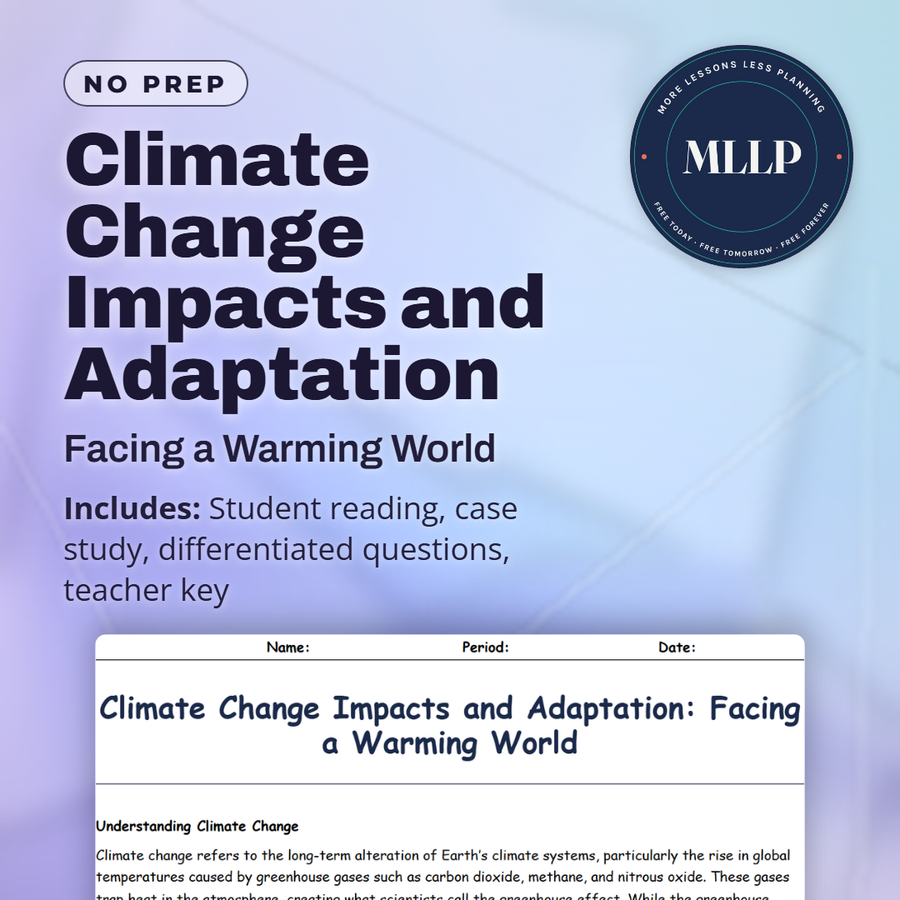
Climate Change Impacts and Adaptation: Facing a Warming World
Quality reviewed September 2026
Facts verified September 14, 2026
- Subject
- Social Studies
- Grades
- Grades 9-12
- Length
- 7-page student worksheet
- Time
- About one 50-minute class period
- Great for
- Sub plans and independent work
- Includes
- Reading passage, comprehension questions + full answer key
- Format
- Print-and-go PDF
What students do
- Match terms like the greenhouse effect, the Paris Agreement, and sea-level rise to their correct definitions
- Fill in the blank sentences on the Paris Agreement, the greenhouse effect, and ocean acidification's threat to coral reefs
- Answer multiple choice questions on the gases behind climate change, which nation is most at risk from rising seas, and what counts as climate adaptation
- Write short answers on climate change's threat to food security, why adaptation is harder for poorer nations, and what role wealthy countries should play
What it covers
- How greenhouse gases trap heat and drive rising temperatures, more intense heatwaves, and melting ice sheets
- The uneven effects of climate change on people and places, from sunny-day flooding in coastal cities to disrupted growing seasons in sub-Saharan Africa
- A case study on the Maldives, a low-lying island nation exploring sea walls and floating infrastructure to adapt to rising seas
Start reading this worksheet
Understanding Climate Change
Climate change refers to the long-term alteration of Earth’s climate systems, particularly the rise in global temperatures caused by greenhouse gases such as carbon dioxide, methane, and nitrous oxide. These gases trap heat in the atmosphere, creating what scientists call the greenhouse effect. While the greenhouse effect is a natural process that makes Earth livable, human activity has greatly intensified it over the past two centuries. The burning of fossil fuels for electricity, transportation, and industry releases massive amounts of carbon dioxide into the air. Deforestation, especially in tropical rainforests, further increases the problem by reducing the number of trees that absorb carbon. As a result, Earth’s average surface temperature has risen more than 1°C since the late 19th century. While this may seem small, it has far-reaching consequences for ecosystems, weather patterns, and human societies. The impacts of climate change are not uniform. Some regions experience more frequent droughts, while others face stronger storms. Polar regions are warming faster than anywhere else, leading to the melting of ice sheets and glaciers. Sea levels are rising, threatening coastal cities and small island nations. For students of geography, climate change is not just an environmental issue—it is a global challenge that reshapes the relationship between people and the planet.
The Effects on People and Places
Climate change affects both natural systems and human societies. Extreme weather events such as hurricanes, wildfires, and heatwaves are becoming more intense and frequent. The 2021 heat dome in western North America caused record-breaking temperatures, leading to hundreds of deaths. In contrast, South Asia has faced devastating floods that displace millions. These events highlight how vulnerability depends on location, resources, and preparedness. Rising seas threaten densely populated coastal areas. Cities like Miami, Bangkok, and Dhaka already experience flooding during high tides, a phenomenon sometimes called “sunny-day flooding.” Small island nations like the Maldives and Tuvalu face an existential threat, as much of their land may disappear beneath the waves. Meanwhile, agricultural regions are disrupted as rainfall patterns shift. Farmers in sub-Saharan Africa, for example, face unpredictable growing seasons, which can worsen food insecurity. Climate change also amplifies social and political challenges. Resource scarcity caused by droughts can trigger conflicts, as seen in parts of the Middle East and Africa. Migration may increase as people flee areas made uninhabitable by rising seas or extreme heat. Public health is another concern, with warmer temperatures expanding the reach of diseases like malaria and dengue fever. In this way, climate change is not only an environmental crisis but also a human crisis.
Adapting to a Changing Climate
While reducing emissions is crucial, adaptation is equally important. Adaptation refers to strategies that help societies adjust to the effects of climate change. For coastal cities, this might mean constructing sea walls, restoring mangroves, or elevating buildings. Farmers are experimenting with drought-resistant crops and new irrigation methods. In some regions, governments are relocating communities away from high-risk areas. Adaptation also involves improving infrastructure. Better drainage systems reduce flooding in cities, while early warning systems save lives during storms. Public health measures can control the spread of climate-sensitive diseases. Education and community planning prepare citizens to respond effectively when disasters strike. However, adaptation has limits. Some ecosystems, like coral reefs, cannot survive rising temperatures and ocean acidification, no matter what humans do. Poorer countries face financial and technological barriers, making it difficult to adapt without international support. The Paris Agreement, signed in 2015, recognizes this challenge and calls for wealthier nations to help fund adaptation projects in vulnerable regions.
Like what you read? The full reading, the case study, and every question set are in the free download below, along with the answer key.
Why this matters
Sunny-day flooding, water in the streets with no storm in sight, already happens in some coastal cities, while a warming climate disrupts growing seasons across sub-Saharan Africa. Those two effects come from the same greenhouse gases, but they land on completely different people, which is the gap this reading asks students to hold onto.
Sea walls and floating infrastructure are the two choices the Maldives is actually weighing. I assign this case study after the Paris Agreement section so students see international climate policy from the ground level of a country actually living with the deadline.
From one teacher to another
This reading walks students through what actually causes climate change and why the effects land so unevenly around the world. The key info table connects specific impacts like rising seas and heatwaves to the regions hit hardest, which makes for good discussion before the case study. I like that the Maldives case study grounds adaptation in a real place instead of staying abstract. This pairs well with a unit on human-environment interaction or global issues.
What you get
Download
Where should I send the next one?
Everything here is free and it stays that way. Leave your email and I'll send you the new lessons as they go up. You can unsubscribe from any one of them.
Related resources
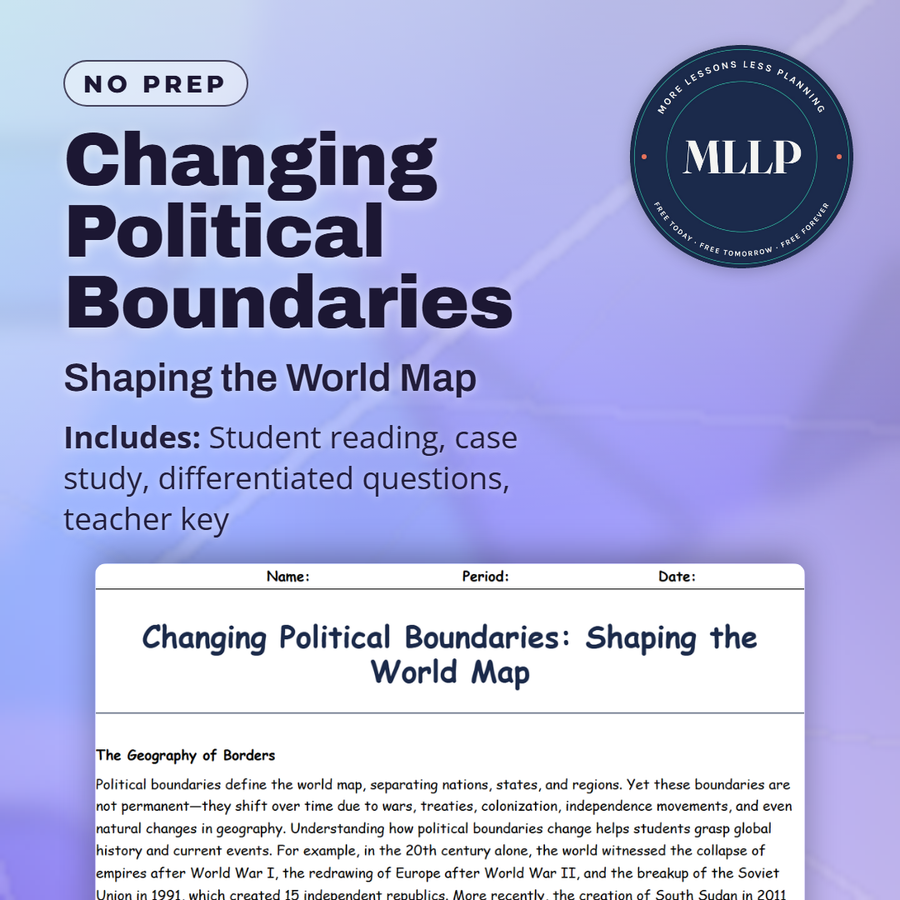
Changing Political Boundaries: Shaping the World Map
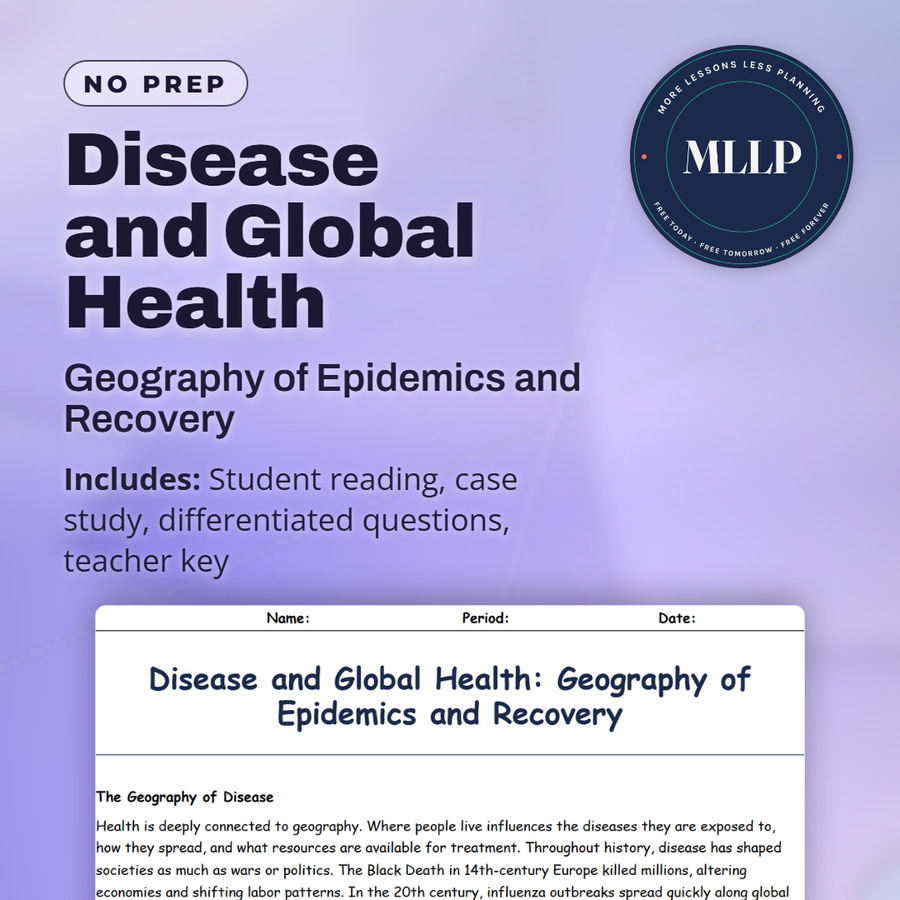
Disease and Global Health: Geography of Epidemics and Recovery
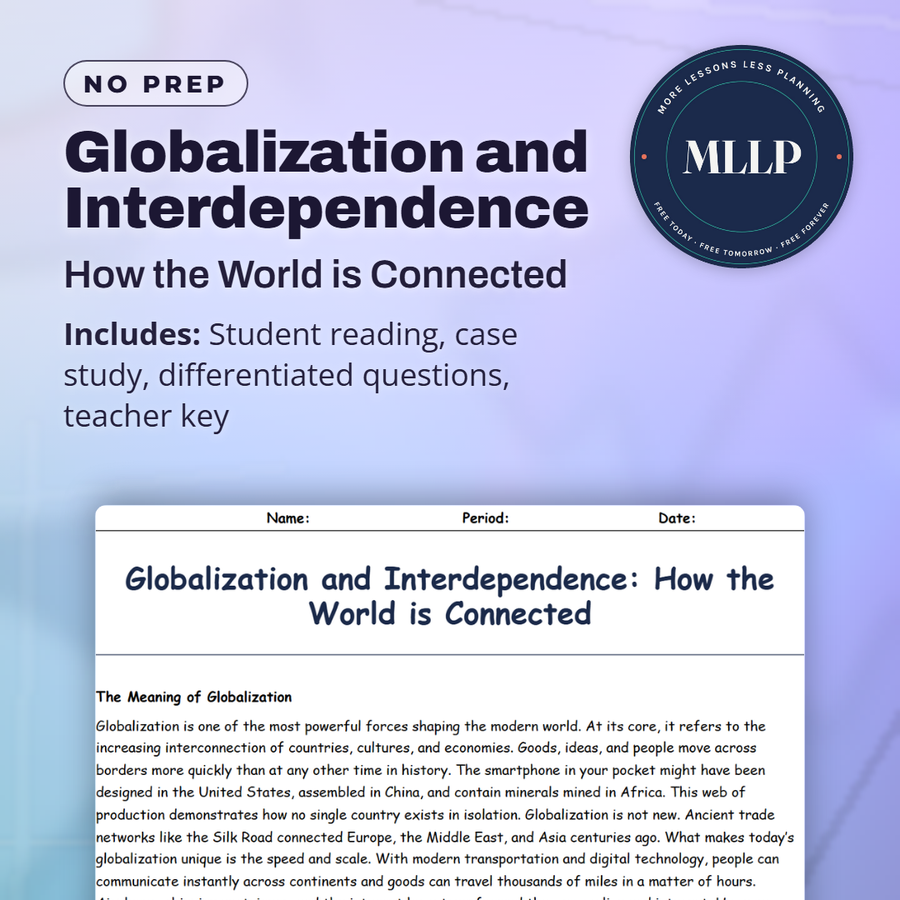
Globalization and Interdependence: How the World is Connected
International Cooperation and Sustainability: Working Together for a Better Future
Migration Crises: Movement in a Changing World
Resource Scarcity and Conflict: Struggles Over Earth’s Essentials
Every lesson on this site is free to download and use. If one of them saved you a prep period, you can chip in a few bucks toward my three kids' daycare fund. That's genuinely where tips go.