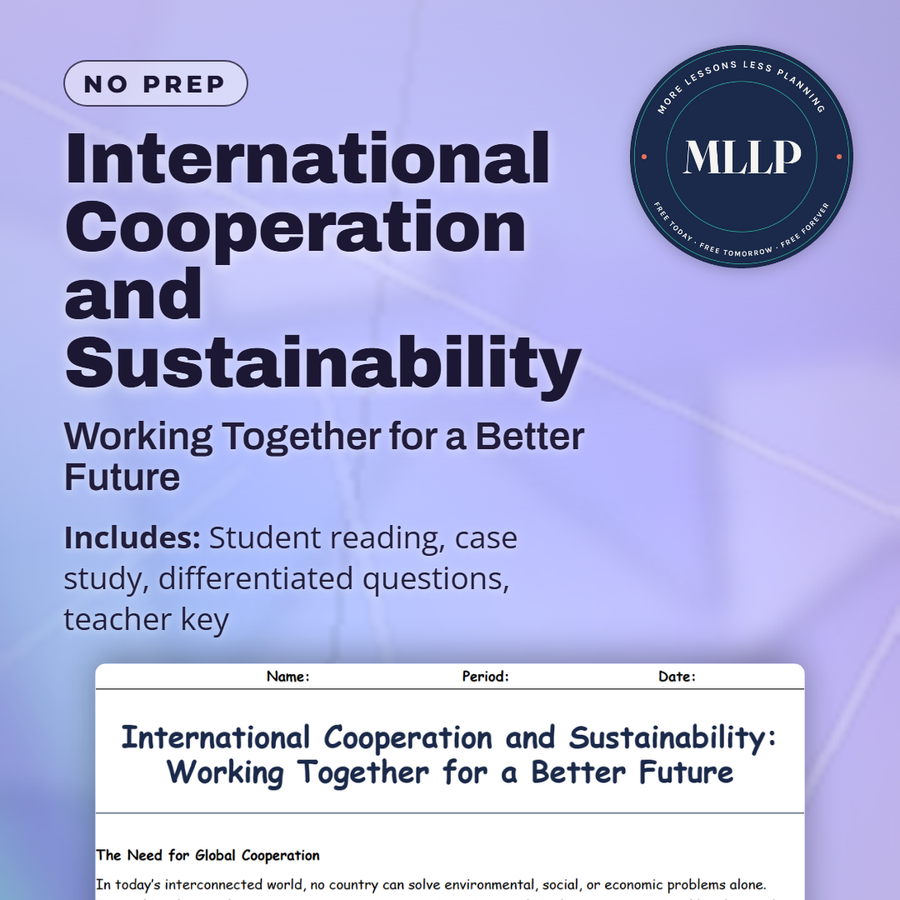
International Cooperation and Sustainability: Working Together for a Better Future
Quality reviewed September 2026
Facts verified September 14, 2026
- Subject
- Social Studies
- Grades
- Grades 9-12
- Length
- 7-page student worksheet
- Time
- About one 50-minute class period
- Great for
- Sub plans and independent work
- Includes
- Reading passage, comprehension questions + full answer key
- Format
- Print-and-go PDF
What students do
- Match terms like the Paris Agreement, the Montreal Protocol, and the UN's Sustainable Development Goals to their correct definitions
- Fill in the blank sentences on the Sustainable Development Goals, sea-level rise threatening island nations, and the Montreal Protocol
- Answer multiple choice questions on the central goal of the Paris Agreement, which treaty fixed the ozone layer, and what the UN's Sustainable Development Goals aim to achieve
- Write short answers on why sustainability is both a local and global responsibility, how youth movements and technology drive cooperation, and what lessons the Montreal Protocol offers today
What it covers
- Why global problems like climate change and resource scarcity require international cooperation through organizations like the UN, WHO, and WTO
- The UN's 17 Sustainable Development Goals and how the Montreal Protocol shows collective action can succeed
- A case study on the Paris Agreement, where nearly 200 countries pledged to limit global warming and support vulnerable nations
Start reading this worksheet
The Need for Global Cooperation
In an interconnected world today, no country can solve environmental, social, or economic problems alone. Issues like climate change, resource scarcity, migration crises, and pandemics cross national borders and require international cooperation. Organizations such as the United Nations (UN), the World Health Organization (WHO), and the World Trade Organization (WTO) bring countries together to create agreements, set goals, and share resources. One of the best-known examples of cooperation is the Paris Agreement, a global treaty signed in 2015 where nearly 200 countries pledged to reduce greenhouse gas emissions to limit global warming. While some countries struggle to meet their targets, the agreement represents a historic moment of global unity. Similarly, the Montreal Protocol of 1987 successfully phased out substances that damaged the ozone layer, showing that collective action can work. Yet cooperation is not always easy. Political rivalries, economic competition, and disagreements about responsibility often create obstacles. Wealthier countries may push for ambitious goals, while poorer nations emphasize the need for financial support to achieve those goals. Geography plays an important role in these debates, as countries most vulnerable to disasters (such as small island nations threatened by rising seas) often have the least resources to adapt.
Sustainability and Shared Goals
The concept of sustainability is central to global cooperation. Sustainability means meeting the needs of the present without compromising the ability of future generations to meet theirs. The UN has outlined 17 Sustainable Development Goals (SDGs), covering areas like clean energy, quality education, poverty reduction, and environmental protection. These goals encourage governments, businesses, and individuals to work together to build a fairer and more resilient world. For example, Goal 7 seeks to ensure affordable and clean energy for all. In many developing nations, access to electricity is limited, and cooperation between governments, NGOs, and private companies helps expand renewable energy sources like solar and wind. Another, Goal 13, addresses climate action, pushing countries to reduce emissions and prepare for climate impacts. These goals are ambitious, but they highlight how sustainability is both a local and a global responsibility.
Barriers and Opportunities in Global Cooperation
International cooperation often faces barriers such as political conflict, lack of funding, and unequal power between nations. Some countries hesitate to give up sovereignty or fear that cooperation may hurt their economies. Others may prioritize short-term growth over long-term sustainability. Despite these obstacles, opportunities are growing. Global organizations, youth movements, and scientific networks are building momentum for change. Movements like Fridays for Future, led by young people, show how citizens can pressure governments to act. Advances in technology also allow countries to share knowledge more easily, from satellite data on deforestation to medical breakthroughs in fighting disease. The future of cooperation will depend on trust, accountability, and a willingness to share both the burdens and benefits of sustainability. Geography shows us that what happens in one part of the world, such as deforestation in the Amazon or pollution in the oceans, affects everyone. Working together is not just an option but a necessity.
Like what you read? The full reading, the case study, and every question set are in the free download below, along with the answer key.
Why this matters
Nearly two hundred countries signed the Paris Agreement, promising to limit warming and support island nations already losing land to rising seas. The Montreal Protocol shows that kind of promise can hold: it is the rare treaty that actually closed the hole in the ozone layer.
I use this when students assume global politics is just gridlock. Comparing a treaty that worked against one still being tested gives them a real standard to judge cooperation by, not just a headline to shrug at.
From one teacher to another
This reading shows students that global problems need global solutions, using real agreements instead of abstract ideas. The key info table lines up the Montreal Protocol, Paris Agreement, and UN Sustainable Development Goals with their actual purposes and outcomes. The Paris Agreement case study gets into the messy part too, showing which countries struggled to meet their commitments. This pairs well with a unit on global issues or environmental geography.
What you get
Download
Where should I send the next one?
Everything here is free and it stays that way. Leave your email and I'll send you the new lessons as they go up. You can unsubscribe from any one of them.
Related resources
Changing Political Boundaries: Shaping the World Map
Climate Change Impacts and Adaptation: Facing a Warming World
Disease and Global Health: Geography of Epidemics and Recovery
Globalization and Interdependence: How the World is Connected
Migration Crises: Movement in a Changing World
Resource Scarcity and Conflict: Struggles Over Earth’s Essentials
Every lesson on this site is free to download and use. If one of them saved you a prep period, you can chip in a few bucks toward my three kids' daycare fund. That's genuinely where tips go.