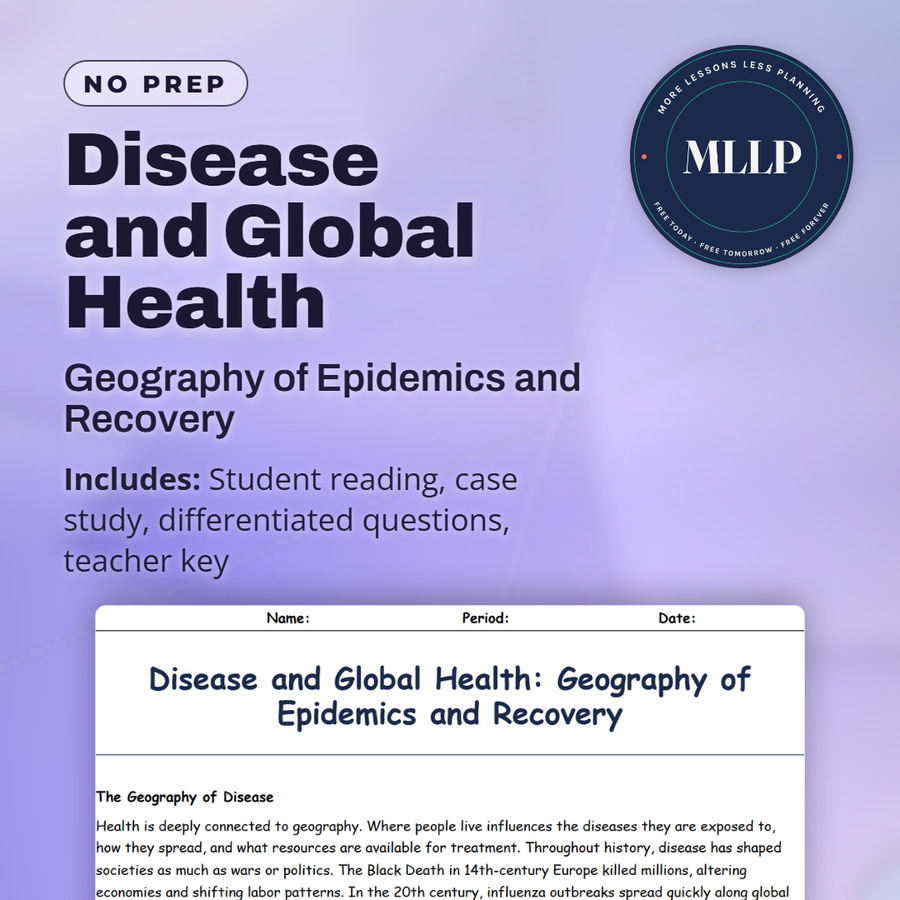
Disease and Global Health: Geography of Epidemics and Recovery
Quality reviewed September 2026
Facts verified September 14, 2026
- Subject
- Social Studies
- Grades
- Grades 9-12
- Length
- 7-page student worksheet
- Time
- About one 50-minute class period
- Great for
- Sub plans and independent work
- Includes
- Reading passage, comprehension questions + full answer key
- Format
- Print-and-go PDF
What students do
- Match terms like Malaria, COVID-19, and Tuberculosis to what makes each one spread or persist
- Fill in the blank sentences on the eradication of smallpox, the vaccine divide, and what endemic disease means
- Answer multiple choice questions on which disease is endemic to tropical Africa and Asia, who led the effort to eradicate smallpox, and what COVID-19 vaccine distribution revealed
- Write short answers on how population density and travel spread disease, why preventable diseases persist in poorer regions, and how COVID-19 reshaped daily life
What it covers
- How geography shapes the spread of disease, from malaria's ties to warm climates to COVID-19 moving along global travel networks
- Global health inequality, comparing diseases like malaria and tuberculosis in poorer regions to lifestyle diseases like diabetes in wealthy nations
- A case study on the COVID-19 pandemic, tracing how airports and dense cities shaped its spread and how vaccine access split along wealth lines
Start reading this worksheet
The Geography of Disease
Health is deeply connected to geography. Where people live influences the diseases they are exposed to, how they spread, and what resources are available for treatment. Throughout history, disease has shaped societies as much as wars or politics. The Black Death in 14th-century Europe killed millions, altering economies and shifting labor patterns. In the 20th century, influenza outbreaks spread quickly along global trade and travel networks, showing how geography and mobility combine to create risk. Today, diseases move even faster. Air travel means a virus can cross continents in hours. The 2014 Ebola outbreak in West Africa revealed how diseases can overwhelm weak health systems, while the COVID-19 pandemic demonstrated the interconnectedness of the modern world. Geography explains not only how diseases spread but also why certain regions are more vulnerable. Climate, population density, poverty, and access to clean water all influence health outcomes. Some diseases are endemic, meaning they remain in a region permanently. Malaria, for example, persists in tropical areas of Africa and Asia because of warm climates and mosquito habitats. Other diseases are epidemics (local outbreaks) or pandemics (global outbreaks), such as HIV/AIDS or COVID-19. Understanding the geography of disease helps explain how environment, human movement, and inequality shape global health challenges.
Global Health Inequality
Not all regions experience disease the same way. Access to healthcare, sanitation, and nutrition varies widely. Wealthier nations often have advanced hospitals and vaccines, while poorer regions struggle with shortages of doctors, medicine, and clean water. This creates what the World Health Organization calls “health inequities.” For example, Africa carries a heavy burden of diseases like malaria, tuberculosis, and HIV/AIDS. Many of these illnesses are preventable or treatable but persist because of poverty, limited infrastructure, and political instability. In contrast, wealthier countries face “lifestyle diseases” such as diabetes, heart disease, and cancer, often linked to diet and sedentary lifestyles. Geography plays a role: urban areas may expose people to air pollution, while rural areas might lack healthcare facilities. Global health also highlights the importance of international cooperation. Organizations like the WHO, Doctors Without Borders, and UNICEF provide vaccines, aid, and health education. Global initiatives such as the eradication of smallpox in 1980 show that cooperation can work. However, unequal vaccine access during the COVID-19 pandemic revealed ongoing disparities. The question of who receives treatment first often reflects global power structures more than medical need.
Like what you read? The full reading, the case study, and every question set are in the free download below, along with the answer key.
Why this matters
Malaria and diabetes rarely come up in the same conversation, but this reading puts them side by side: where you live still predicts what might make you sick. Malaria persists in warm climates with the right conditions for its spread, while diabetes shows up as a wealthy-nation problem instead.
The COVID-19 case study is the section I lean on hardest, since students lived through it but rarely connected airports, dense cities, and how fast the virus moved through both. The vaccine divide splitting along wealth lines adds a harder lesson: geography shapes who recovers first, not just who gets sick.
From one teacher to another
This reading connects disease straight to geography, showing why malaria persists in some regions while diabetes shows up as a wealthy-nation problem. The key info table lines up five diseases with the regions hit hardest and the geographic reasons why. The COVID-19 case study is the centerpiece, tracing how airports, dense cities, and the vaccine divide shaped who got hit hardest and who recovered first. This pairs well with a unit on global health or human geography.
What you get
Download
Where should I send the next one?
Everything here is free and it stays that way. Leave your email and I'll send you the new lessons as they go up. You can unsubscribe from any one of them.
Related resources
Changing Political Boundaries: Shaping the World Map
Climate Change Impacts and Adaptation: Facing a Warming World
Globalization and Interdependence: How the World is Connected
International Cooperation and Sustainability: Working Together for a Better Future
Migration Crises: Movement in a Changing World
Resource Scarcity and Conflict: Struggles Over Earth’s Essentials
Every lesson on this site is free to download and use. If one of them saved you a prep period, you can chip in a few bucks toward my three kids' daycare fund. That's genuinely where tips go.