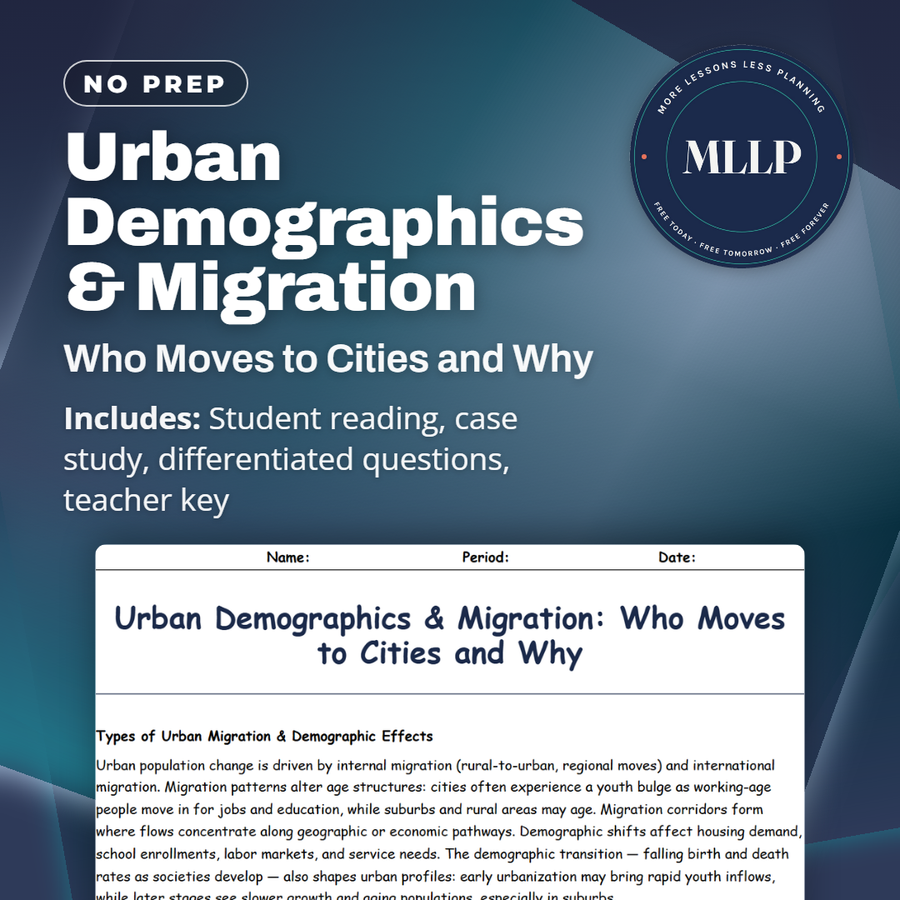
Urban Demographics & Migration: Who Moves to Cities and Why
Quality reviewed September 2026
Facts verified September 14, 2026
- Subject
- Social Studies
- Grades
- Grades 9-12
- Length
- 6-page student worksheet
- Time
- About one 50-minute class period
- Great for
- Sub plans and independent work
- Includes
- Reading passage, comprehension questions + full answer key
- Format
- Print-and-go PDF
What students do
- Match terms like push/pull, migration corridor, dependency ratio, and diaspora networks to their correct definitions
- Fill in the blank sentences on youth bulge, the demographic transition, and migration corridors
- Answer multiple choice questions on labeling push and pull factors and what a falling dependency ratio means
- Write short answers on turning informal jobs into formal ones and why migrants choose informal settlements
What it covers
- How internal and international migration reshape a city's age structure and labor market
- Concepts like dependency ratio, youth bulge, migration corridors, and diaspora networks
- A case study on a coastal city where a new logistics hub and IT jobs drew migrants and strained housing and schools
Start reading this worksheet
Types of Urban Migration & Demographic Effects
Urban population change is driven by internal migration (rural-to-urban, regional moves) and international migration. Migration patterns alter age structures: cities often experience a youth bulge as working-age people move in for jobs and education, while suburbs and rural areas may age. Migration corridors form where flows concentrate along geographic or economic pathways. Demographic shifts affect housing demand, school enrollments, labor markets, and service needs. The demographic transition, falling birth and death rates as societies develop, also shapes urban profiles: early urbanization may bring rapid youth inflows, while later stages see slower growth and aging populations, especially in suburbs.
Labor Markets, Services, and Dependency Ratios
Migrants typically move for work opportunities; urban labor markets expand in services, construction, and informal sectors. Cities can benefit from a lower dependency ratio (more working-age people per dependent), supporting economic growth if jobs are available. But if urban labor markets cannot absorb migrants, unemployment and underemployment rise. Service demand (health, education, housing, transit) increases rapidly with population inflows and requires planning. Migration can also create transnational linkages: diaspora networks facilitate trade, remittances, and skills flows, shaping urban economies beyond the local level.
Like what you read? The full reading, the case study, and every question set are in the free download below, along with the answer key.
Why this matters
A new logistics hub and a wave of IT jobs can pull workers into a coastal city faster than it can build housing or open schools for them. Migrants moved in for work here, informal settlements grew around the city's edges, and remittances flowed back to the rural families they had left behind. Push and pull factors explain why people leave, but dependency ratio and youth bulge explain what a city looks like once they arrive.
Migration gets treated as a single event, someone leaves one place and arrives in another, end of story. Following remittances back to rural families while informal settlements form around a booming coastal city shows migration as an ongoing relationship instead of a one-way trip.
From one teacher to another
I like this one for a population unit because it moves past the textbook definition of push and pull factors into what actually happens once people arrive. The case study tracks a coastal city as jobs draw in young workers, informal settlements grow, and remittances flow back to rural families, so students see migration as a two-way relationship rather than a one-time event. It pairs well with a unit on urbanization or population growth.
What you get
Download
Where should I send the next one?
Everything here is free and it stays that way. Leave your email and I'll send you the new lessons as they go up. You can unsubscribe from any one of them.
Related resources
City Transport & Infrastructure: Moving Millions Efficiently

Gentrification & Housing: Winners, Losers, and Choices
Megacities vs Global Cities: Powerhouses of Today
Smart Growth & Urban Planning: Designing Better Cities
Suburbanization & Sprawl: Causes, Costs, Consequences
Sustainable Cities: Green Solutions & Urban Resilience
Every lesson on this site is free to download and use. If one of them saved you a prep period, you can chip in a few bucks toward my three kids' daycare fund. That's genuinely where tips go.