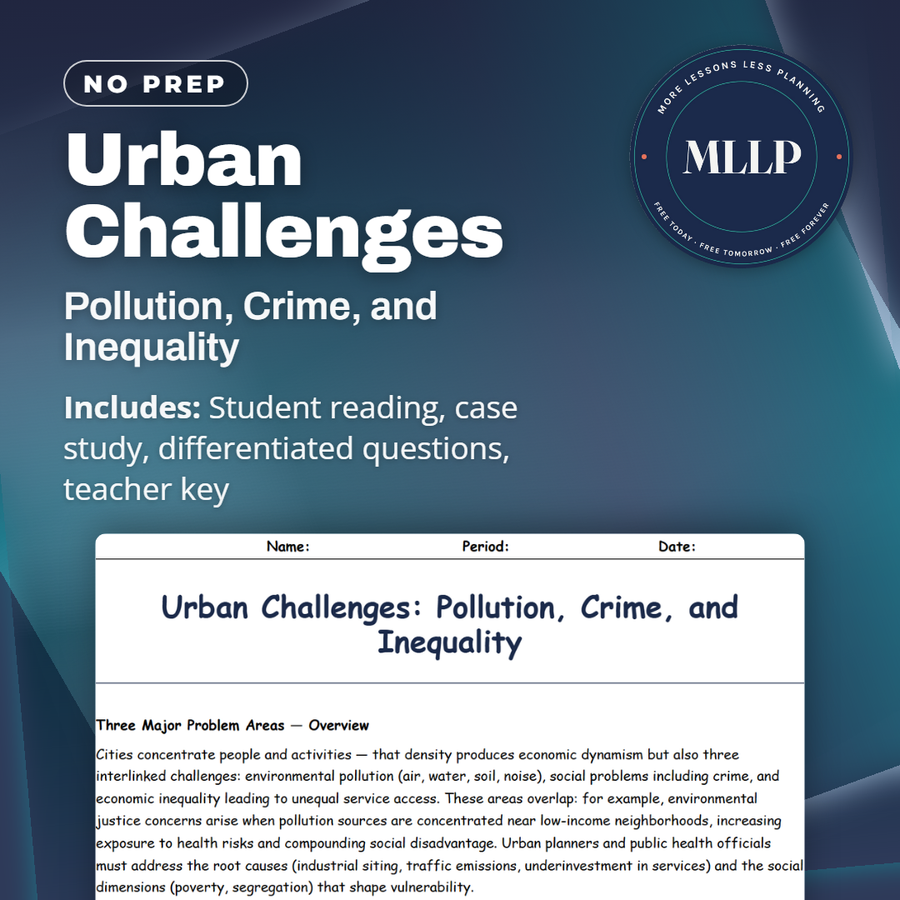
Urban Challenges: Pollution, Crime, and Inequality
Quality reviewed September 2026
Facts verified September 14, 2026
- Subject
- Social Studies
- Grades
- Grades 9-12
- Length
- 7-page student worksheet
- Time
- About one 50-minute class period
- Great for
- Sub plans and independent work
- Includes
- Reading passage, comprehension questions + full answer key
- Format
- Print-and-go PDF
What students do
- Match terms like environmental justice, exposure, segregation, and crime prevention to their correct definitions
- Fill in the blank sentences on green infrastructure, environmental justice, and community policing
- Answer multiple choice questions on what environmental justice concerns focus on and how job training links to environmental improvement
- Write short answers on why infrastructure upgrades need targeted financing and how segregation contributes to unequal health outcomes
What it covers
- How pollution, crime, and inequality overlap and reinforce each other in cities
- Environmental issues like air and water pollution, the urban heat island effect, and their health consequences
- A case study on a neighborhood near a highway that responded to pollution and unemployment with green jobs and community policing
Start reading this worksheet
Three Major Problem Areas: Overview
Cities concentrate people and activities. That density produces economic dynamism but also three interlinked challenges: environmental pollution (air, water, soil, noise), social problems including crime, and economic inequality leading to unequal service access. These areas overlap: for example, environmental justice concerns arise when pollution sources are concentrated near low-income neighborhoods, increasing exposure to health risks and compounding social disadvantage. Urban planners and public health officials must address the root causes (industrial siting, traffic emissions, underinvestment in services) and the social dimensions (poverty, segregation) that shape vulnerability.
Environmental Issues: Air, Water, Noise, and Urban Health
Major urban environmental problems include poor air quality from vehicle emissions and industrial sources, contaminated waterways from stormwater and sewage overflow, and noise pollution from traffic and industry. The urban health consequences are severe: respiratory illnesses, higher rates of cardiovascular disease, and developmental harm in children exposed to pollutants. The urban heat island effect, where built surfaces raise local temperatures, exacerbates heat stress, particularly in neighborhoods with less tree cover. Addressing environmental problems requires regulatory approaches (emissions standards, wastewater treatment), infrastructure investments (separate storm and sanitary sewers, green infrastructure), and planning that reduces polluting activities near homes and schools.
Social Problems: Crime, Segregation, and Service Gaps
Crime is shaped by social and spatial factors: concentrated poverty, lack of opportunity, weak social cohesion, and places with poor lighting or inactive streets at night. Crime prevention strategies include community policing, environmental design that enhances visibility and activity, youth programs, and targeted social services. Spatial segregation (income and racial segregation) concentrates disadvantage and limits access to quality schooling, jobs, and healthcare, reinforcing inequality. Public policies that integrate affordable housing, equitable transit, and targeted job creation can reduce segregation’s impacts.
Like what you read? The full reading, the case study, and every question set are in the free download below, along with the answer key.
Why this matters
Asthma rates, sewage backups, and unemployment rarely show up in a neighborhood in isolation, they tend to arrive together. One community in this reading deals with all three at once, living near a highway that brought pollution and job loss with it, before the city responded with green jobs and community policing instead of addressing each problem separately.
I pair pollution, crime, and inequality in one reading on purpose, since studying them as three separate units misses how they actually show up in a neighborhood. Once students trace how green infrastructure and job training became part of the same response, they start asking why environmental and economic policy get treated as separate conversations.
From one teacher to another
I like this one because it refuses to treat pollution, crime, and inequality as three separate units, which is closer to how these issues actually show up in a neighborhood. The case study follows one community as it deals with asthma rates, sewage backups, and youth unemployment all at once, then traces the city's integrated response. It works well paired with a unit on environmental justice or urban policy.
What you get
Download
Where should I send the next one?
Everything here is free and it stays that way. Leave your email and I'll send you the new lessons as they go up. You can unsubscribe from any one of them.
Related resources
City Transport & Infrastructure: Moving Millions Efficiently
Gentrification & Housing: Winners, Losers, and Choices
Megacities vs Global Cities: Powerhouses of Today
Smart Growth & Urban Planning: Designing Better Cities
Suburbanization & Sprawl: Causes, Costs, Consequences
Sustainable Cities: Green Solutions & Urban Resilience
Every lesson on this site is free to download and use. If one of them saved you a prep period, you can chip in a few bucks toward my three kids' daycare fund. That's genuinely where tips go.