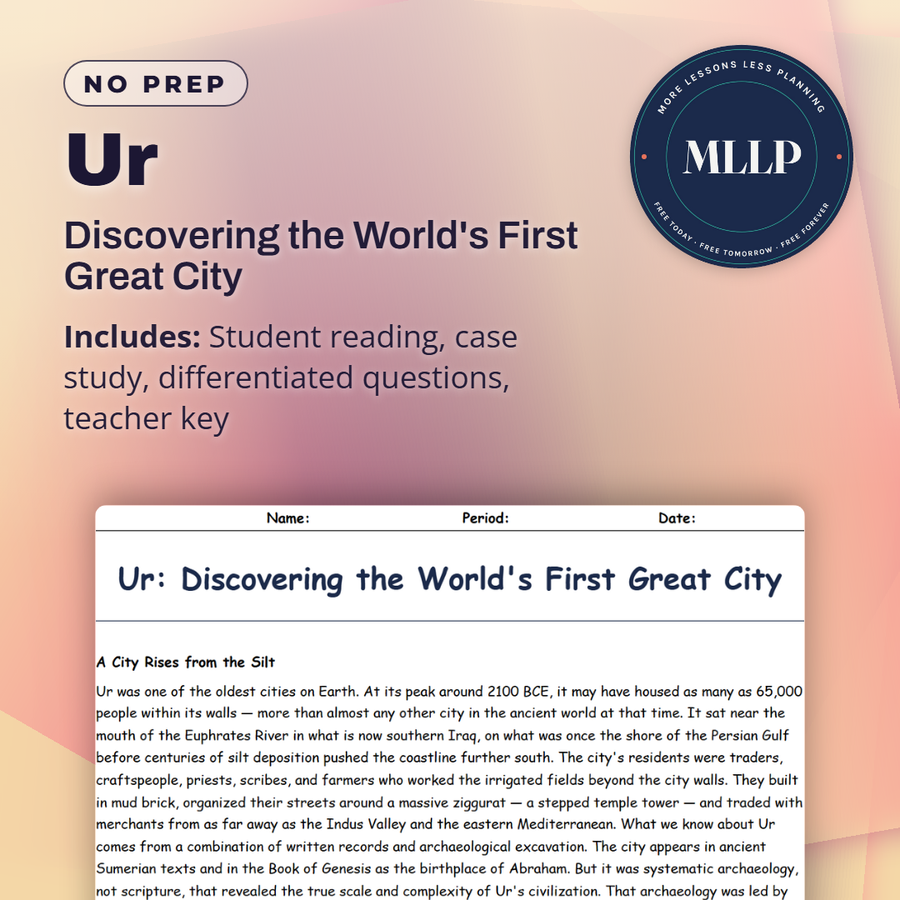
Ur: Discovering the World's First Great City
Quality reviewed September 2026
Facts verified September 21, 2026
- Subject
- Social Studies
- Grades
- Grades 9-12
- Length
- 8-page student worksheet
- Time
- About one 50-minute class period
- Great for
- Sub plans and independent work
- Includes
- Reading passage, comprehension questions + full answer key
- Format
- Print-and-go PDF
What students do
- The Great Death Pit's 74 attendants get weighed against newer evidence suggesting not every death there was fully voluntary
- Explain what the Standard of Ur's two mosaic panels reveal about Sumerian war and daily life
- Ninsun's final morning in the case study gets connected to how archaeologists interpret ritual practices from a different culture and era
- Sort the Ziggurat, the Standard of Ur, and the Royal Tombs by what each one reveals about Sumerian society
What it covers
- Leonard Woolley's 1920s discovery of the Royal Tombs and the Great Death Pit at Ur
- What the Standard of Ur's war and feast panels show about Sumerian life
- Daily life in Ur's mud-brick houses, beyond the wealth of the royal tombs
Start reading this worksheet
A City Rises from the Silt
Ur was one of the oldest cities on Earth. At its peak around 2100 BCE, it may have housed as many as 65,000 people within its walls, more than almost any other city in the ancient world at that time. It sat near the mouth of the Euphrates River in what is now southern Iraq, on what was once the shore of the Persian Gulf before centuries of silt deposition pushed the coastline further south. The city's residents were traders, craftspeople, priests, scribes, and farmers who worked the irrigated fields beyond the city walls. They built in mud brick, organized their streets around a massive ziggurat (a stepped temple tower), and traded with merchants from as far away as the Indus Valley and the eastern Mediterranean. What we know about Ur comes from a combination of written records and archaeological excavation. The city appears in ancient Sumerian texts and in the Book of Genesis as the birthplace of Abraham. But it was systematic archaeology, not scripture, that revealed the true scale and complexity of Ur's civilization. That archaeology was led by one man: Leonard Woolley.
Leonard Woolley and the Royal Cemetery
Leonard Woolley was a British archaeologist who excavated Ur between 1922 and 1934 as a joint project of the British Museum and the University of Pennsylvania. He was meticulous, creative, and possessed of a dramatic flair that made his discoveries front-page news. Working in the scorching heat of southern Iraq, Woolley and his team uncovered something no archaeologist had ever seen before: a royal cemetery containing more than 2,000 graves, including sixteen that Woolley labeled the 'Royal Tombs.' What set the Royal Tombs apart was not just the wealth they contained (and there was extraordinary wealth, including gold helmets, lyres inlaid with lapis lazuli and shell, and jewelry of stunning craftsmanship) but the human cost. The royal burials were accompanied by dozens of attendants. In the Great Death Pit, Woolley found 74 bodies: 68 women and 6 men, lying in neat rows as if they had lain down to sleep. Many were still wearing their court finery, their gold and silver headdresses and beaded necklaces in place. Near each body was a small cup, likely used to drink a lethal liquid as part of a ritual. Woolley's theory was that these attendants had willingly accompanied their ruler to the afterlife, drinking poison as part of a ceremony. More recent analysis has complicated this picture: some skulls show evidence of being struck before burial, suggesting that not all deaths were entirely voluntary. Whatever the exact mechanism, the Royal Tombs reveal a society capable of organizing mass ritual death in service of royal power.
The Standard of Ur: A Window Into Sumerian Life
Among the most famous objects recovered from the Royal Tombs is the Standard of Ur, a hollow wooden box roughly the size of a hardback book, covered on both sides with mosaics made of shell, lapis lazuli, and red limestone. The object's function is debated: Woolley believed it was carried on a pole like a standard in battle, but it may have been a musical instrument's soundbox or a decorative piece. What is certain is what it shows. One side depicts war: soldiers in helmets march in formation, chariots roll over fallen enemies, and prisoners are paraded before a seated king who towers above them in scale, indicating his importance. The other side shows peace: a banquet scene in which the king and nobles recline with cups of beer while musicians play and servants bring food. Animals are led to the feast. In just two wooden panels, the Standard of Ur captures the two faces of Sumerian civilization: violence and celebration, conquest and abundance. The Standard is now in the British Museum in London, far from the soil of Iraq where it was created. Its location has become a point of tension between British curators, who argue they provide superior conservation, and Iraqi scholars, who argue that Iraq's cultural heritage belongs in Iraq. This argument, echoed across many of the world's great museums, remains unresolved.
Like what you read? The full reading, the case study, and every question set are in the free download below, along with the answer key.
Why this matters
Ur's Royal Tombs get most of the attention because of their gold and their scale, but the reading's case study spends its time somewhere quieter, inside the final morning of Ninsun, a young attendant who is thinking about her mother's onion field and the irrigation channels back home right before the ceremony begins. That choice matters because it is easy to read about mass burial from four thousand years away and only see the spectacle. The reading asks students to hold both the scale of Sumerian royal power and the ordinary, specific life of one person caught inside it. Archaeology recovers gold headdresses and lyres, but reading it well also means noticing the servant who is thinking about onions.
From one teacher to another
Leonard Woolley excavated Ur between 1922 and 1934 and found something no archaeologist had ever documented before: a royal cemetery where kings and queens were buried alongside dozens of attendants who appear to have died as part of the burial ceremony itself. The reading walks through the Great Death Pit, where 74 bodies were found still wearing their court finery, and the Standard of Ur, a mosaic box that shows scenes of war on one face and a royal feast on the other. Students also see the city beyond the tombs: mud-brick houses with courtyards and basic plumbing, cuneiform tablets recording ordinary business and school lessons, and the Great Ziggurat that Ur-Nammu built around 2100 BCE. A case study imagines the final morning of Ninsun, a young court attendant, from the inside, without deciding for the reader whether what she did was willing or not.
What you get
Download
Where should I send the next one?
Everything here is free and it stays that way. Leave your email and I'll send you the new lessons as they go up. You can unsubscribe from any one of them.
Related resources
Babylon and the Hanging Gardens: Myth or Reality?
Cuneiform: The World's First Writing System
Gobekli Tepe: The Temple That Rewrote History
Hammurabi's Code: Justice Carved in Stone
Looting and Loss: The Destruction of Iraq's Heritage
Mesopotamia and the Fertile Crescent: Where Civilization Began
Every lesson on this site is free to download and use. If one of them saved you a prep period, you can chip in a few bucks toward my three kids' daycare fund. That's genuinely where tips go.