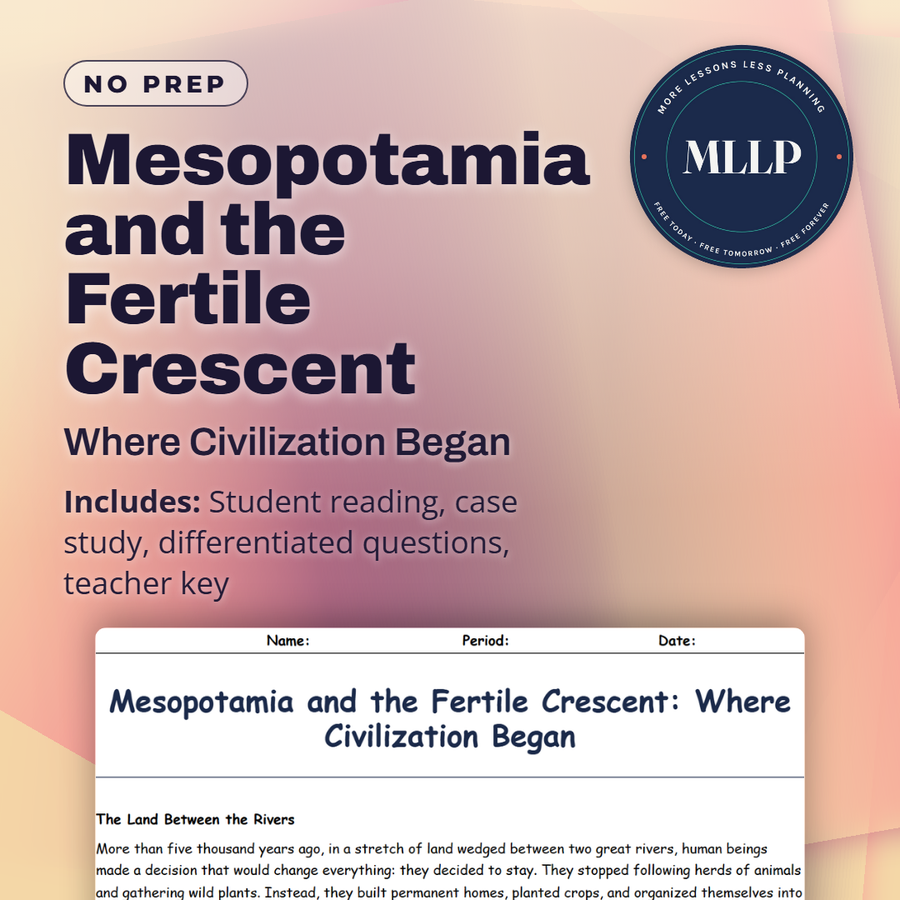
Mesopotamia and the Fertile Crescent: Where Civilization Began
Quality reviewed September 2026
Facts verified September 21, 2026
- Subject
- Social Studies
- Grades
- Grades 9-12
- Length
- 8-page student worksheet
- Time
- About one 50-minute class period
- Great for
- Sub plans and independent work
- Includes
- Reading passage, comprehension questions + full answer key
- Format
- Print-and-go PDF
What students do
- The sequence from Sumer to Akkad to Babylon to Assyria gets laid out with what each civilization is remembered for
- Explain why Sumerian irrigation and agricultural surplus made writing, trade, and government possible in the first place
- Dr. Hassan's decision to backfill an unexpected wall instead of digging it gets used to test what responsible excavation actually requires
- Match cuneiform, city-state, and irrigation to the roles they played in early Mesopotamian civilization
What it covers
- The rise and fall of Sumer, Akkad, Babylon, and Assyria in Mesopotamian history
- Why the flooding of the Tigris and Euphrates made large-scale farming possible
- Modern threats to Mesopotamian sites, from colonial-era digs to ISIS's destruction of Nimrud
Start reading this worksheet
The Land Between the Rivers
More than five thousand years ago, in a stretch of land wedged between two great rivers, human beings made a decision that would change everything: they decided to stay. They stopped following herds of animals and gathering wild plants. Instead, they built permanent homes, planted crops, and organized themselves into something new: cities. This was Mesopotamia, a Greek word meaning 'land between the rivers,' and those rivers were the Tigris and the Euphrates. The region today corresponds roughly to modern Iraq, with portions extending into Syria, Turkey, and Kuwait. But ancient Mesopotamia was not defined by national borders. It was defined by its geography: a flat, sun-baked plain crossed by two powerful rivers that flooded unpredictably each spring, depositing rich silt across the fields. That silt made farming possible in a landscape that would otherwise be too dry and infertile to support large populations.
The Fertile Crescent: A Geography of Civilization
Historians and archaeologists use the term 'Fertile Crescent' to describe a larger arc-shaped zone of productive land stretching from the Persian Gulf through modern Iraq and Syria, up through Lebanon, and down into Israel and Egypt. This crescent shape traces the areas where early agriculture first took hold, where wild ancestors of wheat and barley grew naturally, and where the first domesticated animals (goats, sheep, pigs, and cattle) began living alongside humans. Mesopotamia sits at the heart of this crescent. The southern portion, called Sumer, was particularly significant because it lay at the confluence of the Tigris and Euphrates before they emptied into the Persian Gulf. Sumerian farmers developed sophisticated irrigation systems to channel river water into their fields, allowing them to grow crops year-round. This agricultural surplus (producing more food than a family needed to survive) made everything else possible: specialization of labor, trade, taxation, writing, and government.
Sumer, Akkad, Babylon, and Assyria: Empires in Sequence
Mesopotamian history unfolds as a series of civilizations rising, expanding, and being absorbed or replaced by the next. The Sumerians built the world's first cities around 4000 BCE in the south: Ur, Uruk, Nippur, and Lagash, each one a self-governing city-state with its own ruler, gods, and army. The Sumerians invented cuneiform writing, the sexagesimal number system (base 60, which is why we still divide hours into 60 minutes and circles into 360 degrees), and the first written law codes. Around 2334 BCE, a ruler named Sargon of Akkad conquered the Sumerian city-states and created the world's first empire, uniting Mesopotamia under a single government. The Akkadian Empire did not last long. It collapsed around 2154 BCE, but it established a template that later empires would follow. The Third Dynasty of Ur briefly revived Sumerian dominance before the Babylonians rose to power under their greatest king, Hammurabi, around 1792 BCE. Hammurabi is remembered for the law code carved on a tall black stone stele, one of the best-preserved ancient legal documents in the world. After Babylon came the Assyrians, who built a terrifying war machine capable of besieging fortified cities and moving entire conquered populations from one end of the empire to the other. The Assyrian capital of Nineveh held the library of Ashurbanipal, a vast collection of clay tablets containing literature, science, and prophecy from across the ancient world. When Nineveh fell to a coalition of Babylonians and Medes in 612 BCE, its library burned, but its clay tablets survived underground, preserved by the very fire that destroyed the building above them.
Like what you read? The full reading, the case study, and every question set are in the free download below, along with the answer key.
Why this matters
Mesopotamia is where the reading's own case study archaeologist, Dr. Hassan, has to make a decision most students never have to think about: whether to keep digging without enough time or resources, or protect what she found and walk away. That choice matters because the region covered in this reading has already lost so much, from nineteenth century digs that shipped artifacts to European museums without recording where they came from, to the 2003 Iraq Museum looting, to ISIS's demolition of Nimrud. Every decision an archaeologist makes about a single wall echoes those larger losses. Students reading about the world's first cities are also reading about how fragile the record of those cities still is today.
From one teacher to another
Two rivers carried enough silt every spring to make farming possible on a plain that would otherwise have been too dry to support the first cities, and that flood cycle is where this reading starts. Students move from the geography of the Fertile Crescent through the sequence of empires that rose on it, Sumer's city-states, Sargon of Akkad's first empire, Hammurabi's Babylon, and the Assyrians, ending with the library at Nineveh that survived the fire that destroyed it. The reading also names the costs of studying this region directly: colonial-era digs that stripped artifacts from context, the 2003 Iraq Museum looting, and ISIS's destruction of Nimrud between 2014 and 2017. A case study follows an archaeologist who has to backfill and walk away from a wall her team just found, because protecting it mattered more than digging it before she had the resources to do it properly.
What you get
Download
Where should I send the next one?
Everything here is free and it stays that way. Leave your email and I'll send you the new lessons as they go up. You can unsubscribe from any one of them.
Related resources
Babylon and the Hanging Gardens: Myth or Reality?

Cuneiform: The World's First Writing System
Gobekli Tepe: The Temple That Rewrote History
Hammurabi's Code: Justice Carved in Stone
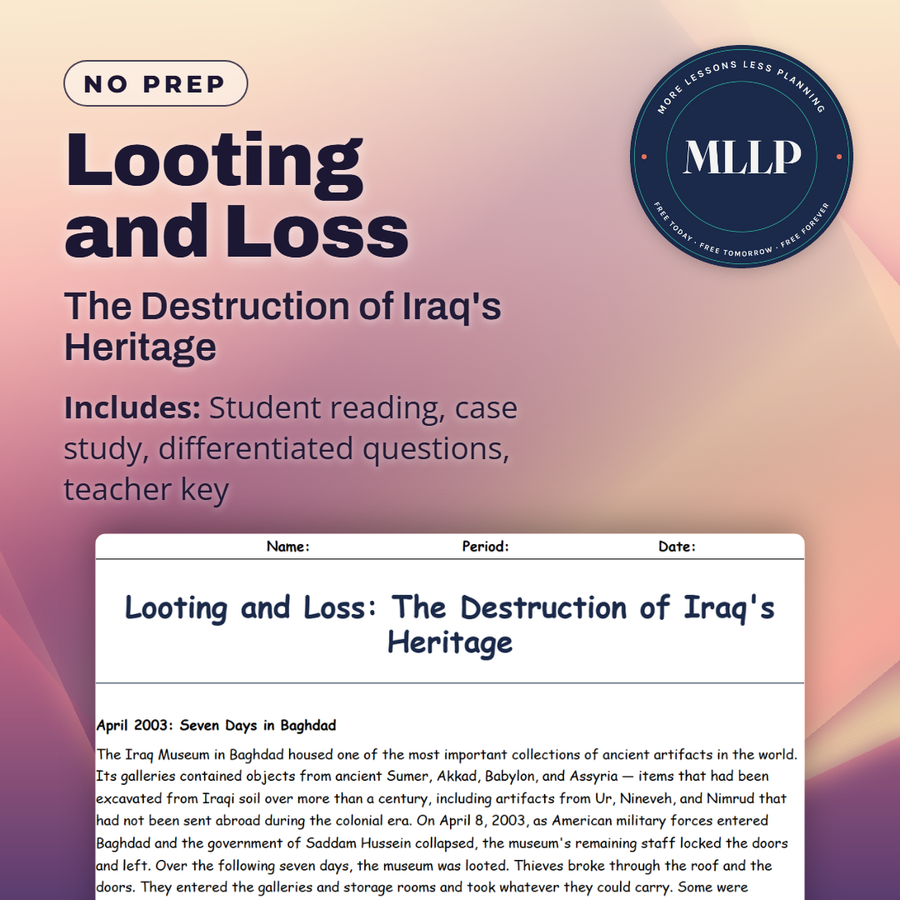
Looting and Loss: The Destruction of Iraq's Heritage
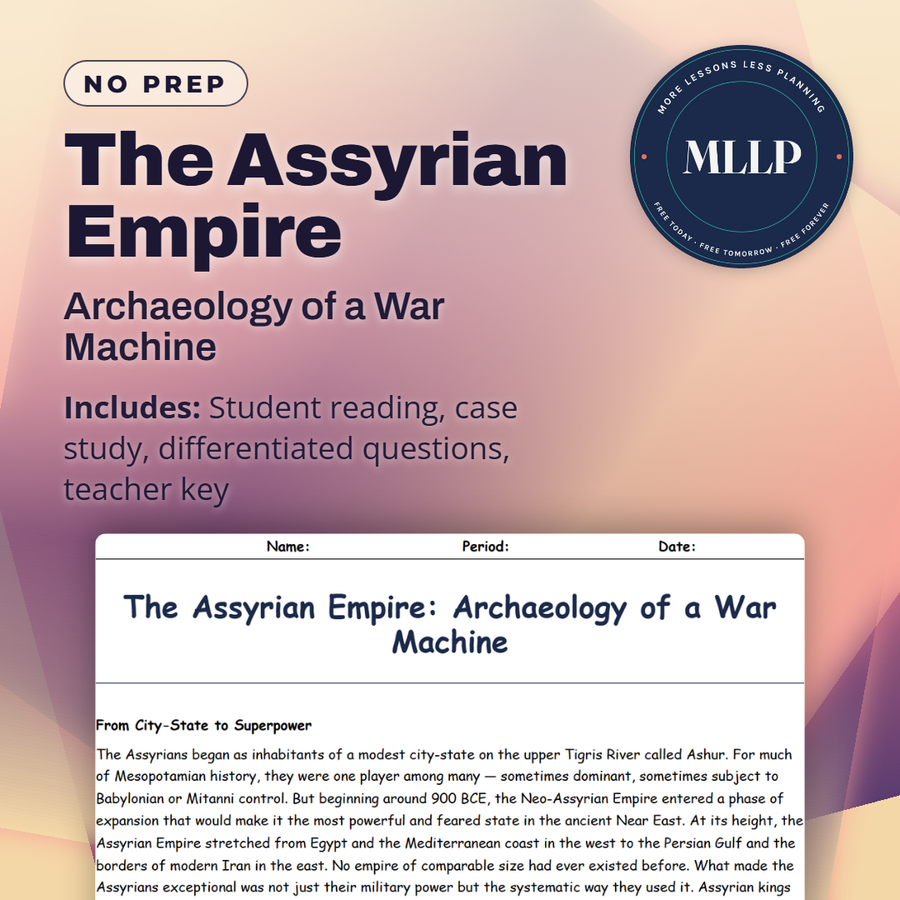
The Assyrian Empire: Archaeology of a War Machine
Every lesson on this site is free to download and use. If one of them saved you a prep period, you can chip in a few bucks toward my three kids' daycare fund. That's genuinely where tips go.