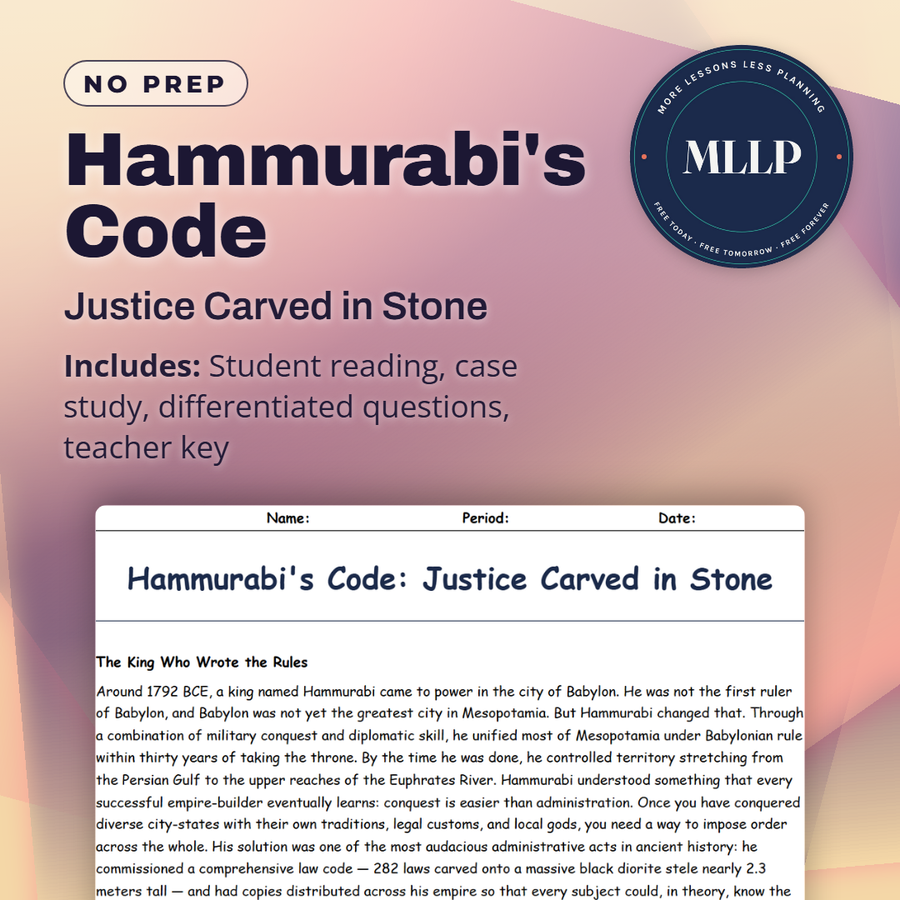
Hammurabi's Code: Justice Carved in Stone
Quality reviewed September 2026
Facts verified September 21, 2026
- Subject
- Social Studies
- Grades
- Grades 9-12
- Length
- 8-page student worksheet
- Time
- About one 50-minute class period
- Great for
- Sub plans and independent work
- Includes
- Reading passage, comprehension questions + full answer key
- Format
- Print-and-go PDF
What students do
- The three legal classes in Hammurabi's Code, awilum, mushkenum, and wardum, get matched to how differently each one was punished for the same crime
- Fill in details from the stele's own image of Hammurabi receiving the law from the sun god Shamash
- Naram the merchant's court case gets used to test whether legal equality on paper matched how power actually worked in Babylon
- Explain why Hammurabi displayed his laws in public stone instead of keeping them as internal palace records
What it covers
- How Hammurabi's 282 laws applied differently depending on a person's social class
- The stele's journey from Babylon to Susa as war plunder to the Louvre in Paris
- What the sun god Shamash's image at the top of the stele was meant to communicate
Start reading this worksheet
The King Who Wrote the Rules
Around 1792 BCE, a king named Hammurabi came to power in the city of Babylon. He was not the first ruler of Babylon, and Babylon was not yet the greatest city in Mesopotamia. But Hammurabi changed that. Through a combination of military conquest and diplomatic skill, he unified most of Mesopotamia under Babylonian rule within thirty years of taking the throne. By the time he was done, he controlled territory stretching from the Persian Gulf to the upper reaches of the Euphrates River. Hammurabi understood something that every successful empire-builder eventually learns: conquest is easier than administration. Once you have conquered diverse city-states with their own traditions, legal customs, and local gods, you need a way to impose order across the whole. His solution was one of the most audacious administrative acts in ancient history: he commissioned a comprehensive law code (282 laws carved onto a massive black diorite stele nearly 2.3 meters tall) and had copies distributed across his empire so that every subject could, in theory, know the law.
Eye for an Eye: How the Code Actually Worked
The phrase 'an eye for an eye, a tooth for a tooth' comes from Hammurabi's Code, and it is often cited as an example of brutal ancient justice. In context, it was actually a principle of proportionality: the punishment should fit the crime, and the victim's injury should be matched rather than exceeded. In a world where powerful nobles could previously demand whatever punishment they wanted for offenses against them, this represented a form of protection. If a noble put out a commoner's eye, the noble could not just pay a small fine: he would lose his own eye. The code covers an enormous range of situations: construction liability (if a builder's house collapses and kills the owner, the builder is put to death), trade regulations (exact rules for interest rates on loans), family law (rules for marriage, divorce, and inheritance), and professional standards (fees that doctors, barbers, and boatmen could charge). There are laws protecting women from arbitrary abandonment, laws governing the rights of slaves, and laws about what happens when a soldier is captured by the enemy and someone else takes his field and his wife.
Class Justice: Not Everyone Is Equal Before the Law
The Code of Hammurabi is not a document of equality. It explicitly divides society into three classes: free persons (awilum), dependent persons or commoners (mushkenum), and slaves (wardum). The punishments for crimes differ dramatically depending on the class of the victim and the class of the perpetrator. If a free person destroys the eye of another free person, they lose their own eye. If a free person destroys the eye of a commoner, they pay sixty silver shekels as a fine. If a free person destroys the eye of a slave, they pay half the slave's purchase price to the slave's owner. This makes the Code simultaneously more sophisticated than its reputation and more troubling than its admirers often acknowledge. It is a legal system, yes, but it is a legal system explicitly designed to reinforce social hierarchy rather than challenge it. The very act of writing down the law creates a kind of legitimacy for the system it encodes. By carving these rules in stone and displaying them publicly, Hammurabi was not just announcing what the rules were; he was claiming divine sanction for a social order in which inequality was built into the law itself.
Like what you read? The full reading, the case study, and every question set are in the free download below, along with the answer key.
Why this matters
Hammurabi's Code is not a museum curiosity about ancient cruelty, it is one of the earliest surviving arguments that a ruler's power should be written down where everyone can see it. The reading's own case study shows the gap between that ideal and reality: Naram wins his case on the law's own terms, and still leaves the courtroom nervous about what an angry palace administrator might do to him outside it. That gap between what a law says and how power actually behaves outside a courtroom has not closed in 3,800 years, and students who read closely will notice the Code protected people unevenly by design, not by accident.
From one teacher to another
Hammurabi carved 282 laws onto a 2.3 meter black diorite stele and had copies sent across the Babylonian empire so that, in theory, every subject could know the rules he was governed by. The reading breaks down what "an eye for an eye" actually meant in context, a principle of proportional punishment rather than random cruelty, then complicates that picture by showing how the Code split society into three legal classes with very different penalties depending on who hurt whom. Students follow the stele's own journey too, carried off as war plunder to Susa by an Elamite king, buried under debris for centuries, and finally dug up by a French expedition in 1901 before it went to the Louvre, where it sits today. A case study puts a free merchant and a palace administrator in front of a judge to see how the law actually played out for people who were not kings.
What you get
Download
Where should I send the next one?
Everything here is free and it stays that way. Leave your email and I'll send you the new lessons as they go up. You can unsubscribe from any one of them.
Related resources
Babylon and the Hanging Gardens: Myth or Reality?
Cuneiform: The World's First Writing System
Gobekli Tepe: The Temple That Rewrote History
Looting and Loss: The Destruction of Iraq's Heritage
Mesopotamia and the Fertile Crescent: Where Civilization Began
The Assyrian Empire: Archaeology of a War Machine
Every lesson on this site is free to download and use. If one of them saved you a prep period, you can chip in a few bucks toward my three kids' daycare fund. That's genuinely where tips go.