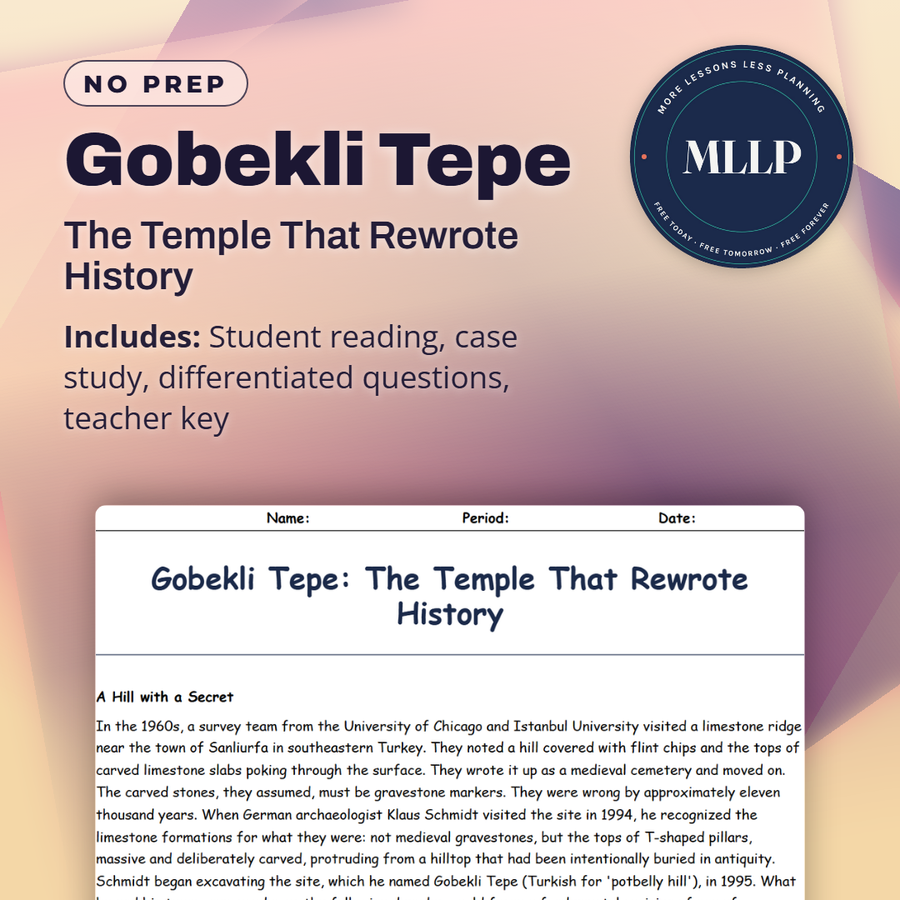
Gobekli Tepe: The Temple That Rewrote History
Quality reviewed September 2026
Facts verified September 21, 2026
- Subject
- Social Studies
- Grades
- Grades 9-12
- Length
- 8-page student worksheet
- Time
- About one 50-minute class period
- Great for
- Sub plans and independent work
- Includes
- Reading passage, comprehension questions + full answer key
- Format
- Print-and-go PDF
What students do
- T-shaped pillars carved with foxes, boars, and vultures get connected to what they might have meant to the people who raised them
- Explain why Gobekli Tepe forces a rethink of the old farming-first, temple-second model of prehistory
- The site's deliberate burial around 8000 BCE gets weighed against the reasons a community would bury what it spent generations building
- Trace Professor Marchetti's realization that a textbook she taught for seventeen years had the sequence backward
What it covers
- Why hunter gatherers, not farmers, built the world's oldest known monumental site
- Klaus Schmidt's excavation and the animal carvings found on Gobekli Tepe's pillars
- The possibility that ritual gathering drove farming's invention rather than the other way around
Start reading this worksheet
A Hill with a Secret
In the 1960s, a survey team from the University of Chicago and Istanbul University visited a limestone ridge near the town of Sanliurfa in southeastern Turkey. They noted a hill covered with flint chips and the tops of carved limestone slabs poking through the surface. They wrote it up as a medieval cemetery and moved on. The carved stones, they assumed, must be gravestone markers. They were wrong by approximately eleven thousand years. When German archaeologist Klaus Schmidt visited the site in 1994, he recognized the limestone formations for what they were: not medieval gravestones, but the tops of T-shaped pillars, massive and deliberately carved, protruding from a hilltop that had been intentionally buried in antiquity. Schmidt began excavating the site, which he named Gobekli Tepe (Turkish for 'potbelly hill'), in 1995. What he and his team uncovered over the following decades would force a fundamental revision of one of archaeology's most confident assumptions.
The World's Oldest Temple: Before Farming, Before Cities
Gobekli Tepe dates to approximately 9600 BCE, making it more than 6,000 years older than Stonehenge and more than 7,000 years older than the Egyptian pyramids. It is the oldest known large-scale stone monument complex in the world. Its builders were not farmers. They were hunter-gatherers: mobile groups of people who followed animal herds and gathered wild plants, with no permanent settlements and, as archaeologists had always assumed, no capacity for the organized collective labor required to build something like this. The site consists of multiple circular enclosures, each containing a pair of massive T-shaped limestone pillars at the center (some standing 5.5 meters tall and weighing up to 20 tons), surrounded by rings of smaller pillars. The surfaces of the pillars are carved with images of animals: foxes, boars, cranes, aurochs (wild cattle), spiders, vultures, and abstract symbols. Some pillars appear to be stylized human figures, with arms carved in low relief along the sides and belts indicated around the 'waist' of the T-shape. These figures may have represented gods, ancestors, or spirits. Whatever they represented, they were clearly significant enough to justify an enormous investment of collective labor.
The Problem With Everything We Thought We Knew
For decades, the standard model of human prehistory went roughly like this: first, humans developed agriculture and settled into permanent communities. Then, freed from the constant effort of finding food, they had surplus time and resources that made possible larger-scale social organization, specialization, and eventually monumental architecture. Temples and cities, in other words, came after farming: they were products of it. Gobekli Tepe blew this model up. Here was monumental architecture (complex, coordinated, requiring sustained collective effort over centuries) built by people who had not yet developed agriculture. The site was in active use from approximately 9600 BCE to 8000 BCE, and the evidence suggests that thousands of people may have gathered there, requiring someone to feed them. Bones of wild animals found at the site, such as aurochs, gazelle, and red deer, suggest massive communal feasting on a scale that required organized hunting across a wide area. The provocative implication is that the causal relationship may have run in the opposite direction from what archaeologists assumed. Maybe agriculture did not make temples possible. Maybe temples, or whatever Gobekli Tepe was, made agriculture necessary. If large numbers of people regularly gathered at a ritual site, they would need a reliable local food supply. That pressure might have driven the early domestication of plants and animals in exactly the region where the world's first agriculture is known to have appeared. The site is in southeastern Turkey, at the northern edge of the Fertile Crescent, where wild wheat and barley grew in abundance.
Like what you read? The full reading, the case study, and every question set are in the free download below, along with the answer key.
Why this matters
Gobekli Tepe is a reminder that even settled facts in a textbook can be wrong, and that the people who write textbooks know it. Professor Marchetti in the case study had taught the same tidy sequence, farming first and then temples, for seventeen years before a single site in Turkey made her rewrite her lecture from scratch. That is not a failure of teaching, it is what happens when evidence changes. Students who are used to thinking of history as a fixed set of facts to memorize benefit from seeing a working archaeologist admit she had the order wrong and then walk into class ready to figure it out with her students instead of pretending she always knew.
From one teacher to another
Hunter gatherers built Gobekli Tepe roughly 11,000 years ago, thousands of years before anyone in the region had planted a crop or settled into a permanent village. The reading follows German archaeologist Klaus Schmidt's recognition in 1994 that the carved limestone slabs a 1960s survey team wrote off as medieval gravestones were actually the tops of massive T-shaped pillars, some standing 5.5 meters tall and weighing up to 20 tons. Students work through why this site upends the standard order everyone used to teach, agriculture first, then villages, then monuments, because Gobekli Tepe's builders had no farms at all. A case study follows a university professor who has to rewrite seventeen years of lecture notes after reading Schmidt's report over a single weekend.
What you get
Download
Where should I send the next one?
Everything here is free and it stays that way. Leave your email and I'll send you the new lessons as they go up. You can unsubscribe from any one of them.
Related resources

Babylon and the Hanging Gardens: Myth or Reality?

Cuneiform: The World's First Writing System

Hammurabi's Code: Justice Carved in Stone

Looting and Loss: The Destruction of Iraq's Heritage
Mesopotamia and the Fertile Crescent: Where Civilization Began
The Assyrian Empire: Archaeology of a War Machine
Every lesson on this site is free to download and use. If one of them saved you a prep period, you can chip in a few bucks toward my three kids' daycare fund. That's genuinely where tips go.