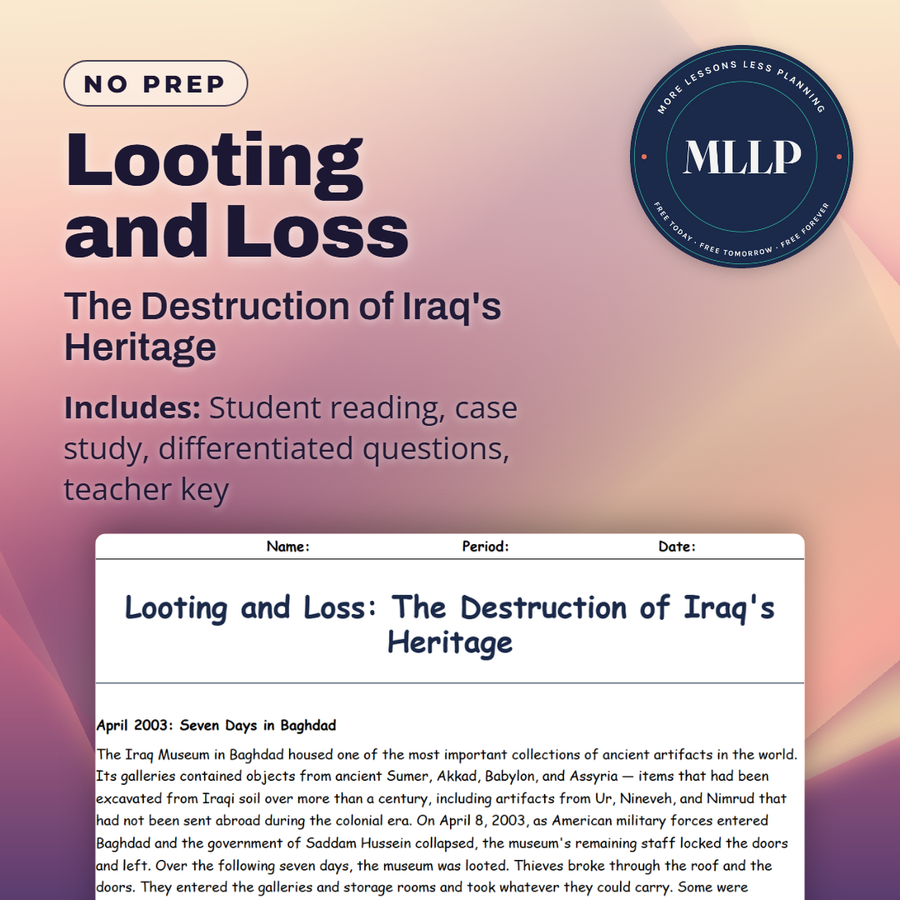
Looting and Loss: The Destruction of Iraq's Heritage
Quality reviewed September 2026
Facts verified September 21, 2026
- Subject
- Social Studies
- Grades
- Grades 9-12
- Length
- 9-page student worksheet
- Time
- About one 50-minute class period
- Great for
- Sub plans and independent work
- Includes
- Reading passage, comprehension questions + full answer key
- Format
- Print-and-go PDF
What students do
- The Sacred Vase of Warka's damaged return in June 2003 gets compared with how much harder site artifacts are to recover
- Sort through why the 1954 Hague Convention did not protect the Iraq Museum in 2003
- Mohsen's handwritten list of missing objects gets connected to why even incomplete documentation still matters to investigators
- Answer questions about who bears responsibility for the looting, considering the military, collectors, auction houses, and the collapsed Iraqi government
What it covers
- How 15,000 objects were stolen from the Iraq Museum in seven days in April 2003
- The difference between recovering catalogued museum pieces and looted, undocumented site artifacts
- ISIS's 2014 to 2017 destruction of Nimrud and the Mosul Museum
Start reading this worksheet
April 2003: Seven Days in Baghdad
The Iraq Museum in Baghdad housed one of the most important collections of ancient artifacts in the world. Its galleries contained objects from ancient Sumer, Akkad, Babylon, and Assyria (items that had been excavated from Iraqi soil over more than a century, including artifacts from Ur, Nineveh, and Nimrud that had not been sent abroad during the colonial era). On April 8, 2003, as American military forces entered Baghdad and the government of Saddam Hussein collapsed, the museum's remaining staff locked the doors and left. Over the following seven days, the museum was looted. Thieves broke through the roof and the doors. They entered the galleries and storage rooms and took whatever they could carry. Some were opportunists seizing a moment of chaos; some were professional artifact thieves with shopping lists: specific items ordered in advance by collectors who knew exactly what they wanted and were willing to pay for it. Approximately 15,000 objects were stolen. Among them were the Sacred Vase of Warka, a 5,000-year-old alabaster vessel, and the Mask of Warka, one of the oldest naturalistic depictions of a human face in the history of art, dating to around 3100 BCE.
Who Was Responsible, and Who Could Have Prevented It
The looting of the Iraq Museum became an international scandal almost immediately. American military commanders were criticized for failing to protect the museum when troops were available nearby. The criticism was partially unfair (the chaos of the invasion made comprehensive site protection impossible) and partially legitimate: cultural heritage sites have been protected under the 1954 Hague Convention for the Protection of Cultural Property in the Event of Armed Conflict, which the United States had not ratified at the time. American archaeologists, scholars, and heritage professionals had warned the Department of Defense before the invasion that the Iraq Museum and key archaeological sites across the country would be vulnerable if civil order broke down. A list of sites requiring protection was provided to military planners. It was not acted upon. The consequences extended far beyond the museum: across Iraq, thousands of archaeological sites were looted in the months and years following the invasion as central government authority collapsed. Satellite imagery showed the distinctive pockmarks of illegal digging at hundreds of sites throughout the country.
The Antiquities Black Market
The objects stolen from the Iraq Museum and from sites across Iraq did not disappear. They entered the global black market for antiquities, a network of dealers, auction houses, private collectors, and middlemen that moves cultural objects from conflict zones and poor countries to wealthy buyers in Europe, North America, and Asia. This market is not entirely illegal: many transactions involve objects with questionable provenance that are sold as 'unprovenanced' (having no documented history) through legitimate auction houses that are willing to accept sellers' assurances that objects were legally acquired. The scale of the market is difficult to estimate, but law enforcement agencies and UNESCO have tracked thousands of Iraqi objects appearing on the international market since 2003. Many bear the distinctive style of specific sites, such as Sumerian artifacts from the southern marshes and Assyrian reliefs from the north, but without documentation connecting them to specific excavations, proving their illegal origin is difficult. Some governments have enacted stricter import controls on unprovenanced antiquities. But the fundamental driver of the market, collectors willing to pay large sums for ancient objects without asking too many questions about where they came from, has not been eliminated.
Like what you read? The full reading, the case study, and every question set are in the free download below, along with the answer key.
Why this matters
Looting is not a problem confined to a single week in 2003. The reading shows a black market that is still active today, moving unprovenanced objects toward buyers willing to pay without asking where something came from, and a legal framework, the 1954 Hague Convention, that the United States had not even ratified when the Iraq Museum was looted. Mohsen's decision to write down what was missing using a borrowed pen and a catalogue's blank margins shows that protecting the past sometimes comes down to one person doing what little they can with what they have. Students should walk away understanding that an object without a documented origin loses its ability to tell historians anything, even if the object itself survives.
From one teacher to another
American forces entered Baghdad on April 8, 2003, and over the next seven days looters broke into the Iraq Museum and carried off roughly 15,000 objects, including the 5,000 year old Mask of Warka. The reading traces where those objects went next, into an international antiquities market that keeps moving looted artifacts toward collectors who ask few questions about where a piece actually came from. Students also see the harder problem: objects stolen straight from unexcavated sites were never catalogued in the first place, so there is no record to match them against even if they resurface. A case study follows Mohsen al-Rashidi, a museum guard who stayed behind after his colleagues fled and wrote down what he remembered was missing using a pen and the margins of a catalogue he found on the floor.
What you get
Download
Where should I send the next one?
Everything here is free and it stays that way. Leave your email and I'll send you the new lessons as they go up. You can unsubscribe from any one of them.
Related resources
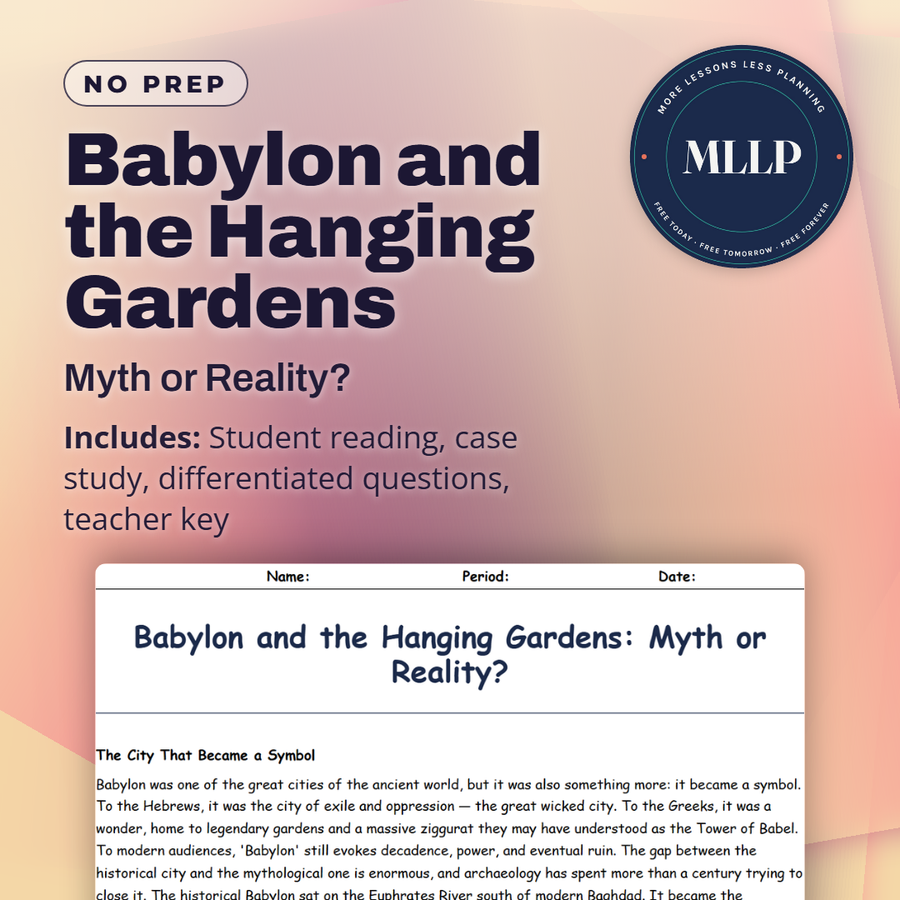
Babylon and the Hanging Gardens: Myth or Reality?
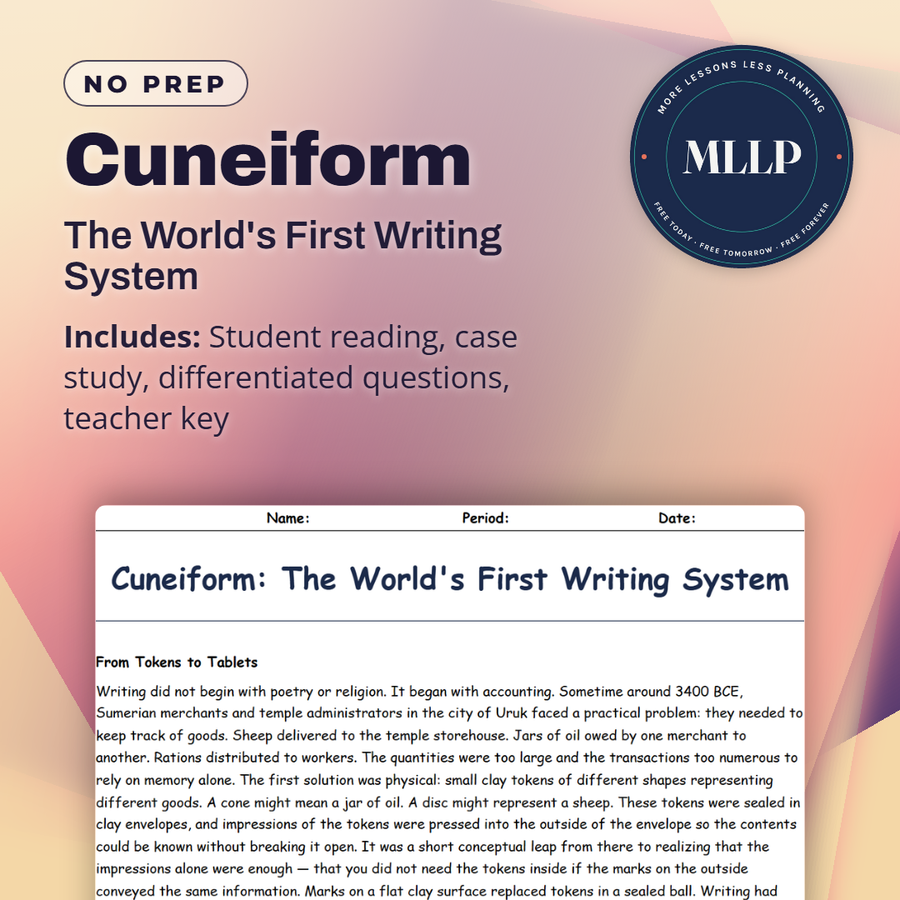
Cuneiform: The World's First Writing System
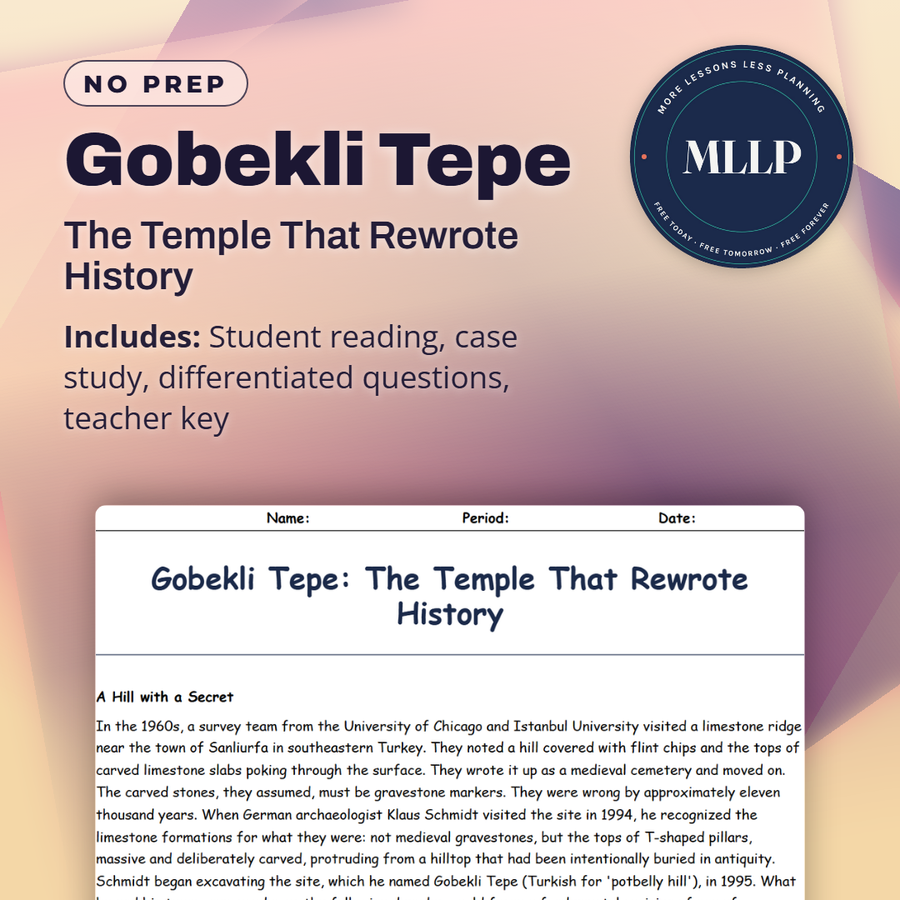
Gobekli Tepe: The Temple That Rewrote History
Hammurabi's Code: Justice Carved in Stone
Mesopotamia and the Fertile Crescent: Where Civilization Began
The Assyrian Empire: Archaeology of a War Machine
Every lesson on this site is free to download and use. If one of them saved you a prep period, you can chip in a few bucks toward my three kids' daycare fund. That's genuinely where tips go.