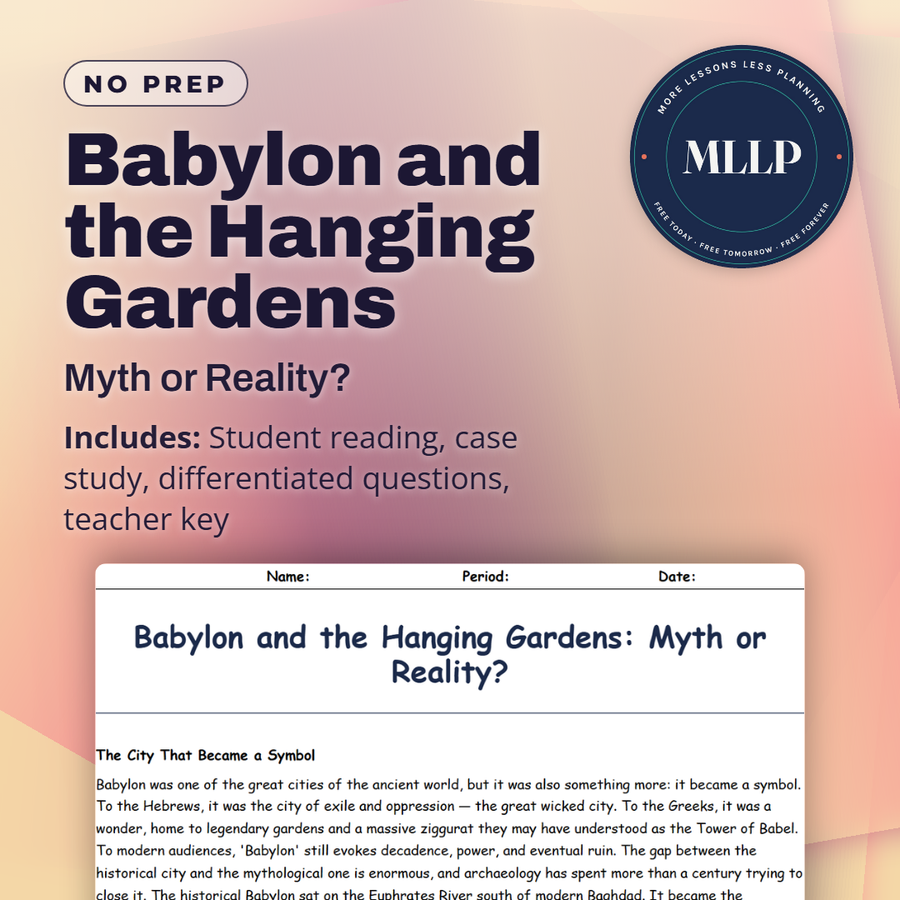
Babylon and the Hanging Gardens: Myth or Reality?
Quality reviewed September 2026
Facts verified September 21, 2026
- Subject
- Social Studies
- Grades
- Grades 9-12
- Length
- 8-page student worksheet
- Time
- About one 50-minute class period
- Great for
- Sub plans and independent work
- Includes
- Reading passage, comprehension questions + full answer key
- Format
- Print-and-go PDF
What students do
- The Ishtar Gate's glazed dragons and bulls get matched against the reasons no Hanging Gardens ruins have ever turned up at Babylon
- Read Stephanie Dalley's case that the gardens actually stood in Nineveh, built by the Assyrian king Sennacherib
- Nebuchadnezzar's building program, from the Processional Way to the double city walls, gets sized up against what actually survives today
- Answer questions on whether the Ishtar Gate belongs in Berlin or Iraq, working from Tariq's case study
What it covers
- How Robert Koldewey's excavation rebuilt Babylon's Ishtar Gate piece by piece
- Why no physical evidence for the Hanging Gardens has ever been found at Babylon
- The unresolved dispute over whether Iraq should get the Ishtar Gate back from Berlin
Start reading this worksheet
The City That Became a Symbol
Babylon was one of the great cities of the ancient world, but it was also something more: it became a symbol. To the Hebrews, it was the city of exile and oppression, the great wicked city. To the Greeks, it was a wonder, home to legendary gardens and a massive ziggurat they may have understood as the Tower of Babel. To modern audiences, 'Babylon' still evokes decadence, power, and eventual ruin. The gap between the historical city and the mythological one is enormous, and archaeology has spent more than a century trying to close it. The historical Babylon sat on the Euphrates River south of modern Baghdad. It became the dominant city in Mesopotamia under Hammurabi in the eighteenth century BCE, was sacked by the Hittites around 1595 BCE, and experienced a complex middle period before rising again under the Neo-Babylonian Empire in the seventh and sixth centuries BCE. It was under the Neo-Babylonian king Nebuchadnezzar II, who reigned from 605 to 562 BCE, that Babylon reached its architectural peak. Its most famous claim, the Hanging Gardens, supposedly dates to his reign.
Nebuchadnezzar II: Builder of a World
Nebuchadnezzar II was one of the ancient world's great builders. Under his reign, Babylon was rebuilt on a scale that stunned ancient visitors. The city was surrounded by a double wall so massive that ancient sources claimed chariots could race side by side on top of it. The Processional Way (a magnificent boulevard paved with glazed blue and yellow bricks) ran from the city's main gate to the great temple of Marduk. Lining its walls were relief images of lions (symbols of Babylon), dragons, and bulls made from glazed brick in vivid blue, yellow, and white. At the end of the Processional Way stood the Ishtar Gate, one of the ancient world's most extraordinary architectural achievements. The gate was faced entirely with deep blue glazed bricks decorated with alternating rows of striding dragons and bulls, approximately 120 animal figures in total. The original gate stood nearly 14 meters high. German archaeologist Robert Koldewey excavated Babylon between 1899 and 1917 and found the Ishtar Gate in pieces, which were then reconstructed and reassembled in Berlin's Pergamon Museum. Visitors today can walk through a full-scale reconstruction of the gate in Berlin, though whether it should be in Berlin or in Iraq is a debate that has grown more pointed in recent decades.
The Hanging Gardens: Ancient Wonder, Missing Evidence
The Hanging Gardens of Babylon were one of the Seven Wonders of the Ancient World. Ancient writers described a massive terraced garden visible from afar, its irrigated trees and flowers cascading down stepped stone terraces like a mountain of greenery in the middle of a flat city. The gardens were said to have been built by Nebuchadnezzar II for his wife Amytis, who missed the green hills of her Median homeland. There is one significant problem: no archaeological evidence for the Hanging Gardens has been found at Babylon. Despite extensive German excavations and subsequent work by Iraqi archaeologists, no structure at the site matches the ancient descriptions. This has led some scholars to conclude that the gardens never existed: that they were a literary invention, perhaps a composite of real Babylonian architecture exaggerated by Greek travelers who had never visited the city themselves. But Stephanie Dalley, a British scholar, has proposed an alternative explanation: the Hanging Gardens were not in Babylon at all. They were in Nineveh, built by the Assyrian king Sennacherib, who explicitly described creating a spectacular garden with complex irrigation machinery. Dalley argues that the confusion arose because ancient writers sometimes used 'Babylon' loosely to refer to all of Mesopotamia, and that Sennacherib's own description of his gardens matches the ancient accounts more closely than anything found at Babylon. The debate remains open and active.
Like what you read? The full reading, the case study, and every question set are in the free download below, along with the answer key.
Why this matters
Babylon's Ishtar Gate sits in a museum in Berlin instead of in Iraq, and that fact is not a footnote in this reading, it is the actual argument. Tariq, the heritage lawyer in the case study, admits he was genuinely moved standing in front of the gate in Berlin, and still argues afterward that it belongs in the landscape where it was built. Students are going to run into this same argument about other objects for the rest of their lives, from the Elgin Marbles to museum collections that make the news every few years. Learning to hold both halves of Tariq's reaction, the real educational value of public access and the claim of the country an object came from, is a more useful skill than picking a side and stopping there.
From one teacher to another
Nebuchadnezzar II rebuilt Babylon on a scale that ancient visitors found hard to believe, from the double city walls to the glazed brick Ishtar Gate with its rows of dragons and bulls. The reading walks through what German archaeologist Robert Koldewey actually dug up between 1899 and 1917, then turns to the one thing nobody has ever found: any trace of the Hanging Gardens at the site itself. Students read Stephanie Dalley's argument that the gardens were really built by the Assyrian king Sennacherib at Nineveh, not by Nebuchadnezzar at all, and weigh that theory against the traditional account. A case study follows an Iraqi heritage lawyer through the Pergamon Museum in Berlin, standing in front of the reconstructed Ishtar Gate while he works out what he actually thinks about where it belongs.
What you get
Download
Where should I send the next one?
Everything here is free and it stays that way. Leave your email and I'll send you the new lessons as they go up. You can unsubscribe from any one of them.
Related resources

Cuneiform: The World's First Writing System

Gobekli Tepe: The Temple That Rewrote History
Hammurabi's Code: Justice Carved in Stone
Looting and Loss: The Destruction of Iraq's Heritage
Mesopotamia and the Fertile Crescent: Where Civilization Began
The Assyrian Empire: Archaeology of a War Machine
Every lesson on this site is free to download and use. If one of them saved you a prep period, you can chip in a few bucks toward my three kids' daycare fund. That's genuinely where tips go.