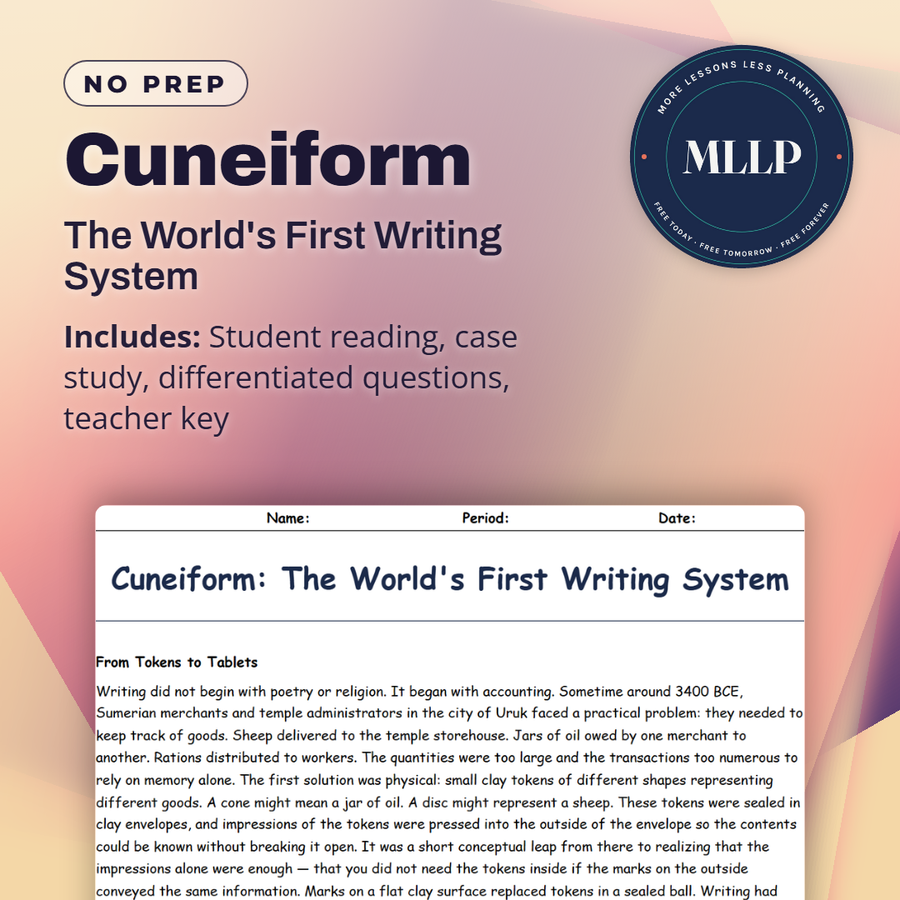
Cuneiform: The World's First Writing System
Quality reviewed September 2026
Facts verified September 21, 2026
- Subject
- Social Studies
- Grades
- Grades 9-12
- Length
- 8-page student worksheet
- Time
- About one 50-minute class period
- Great for
- Sub plans and independent work
- Includes
- Reading passage, comprehension questions + full answer key
- Format
- Print-and-go PDF
What students do
- The jump from clay tokens sealed in envelopes to marks pressed straight into flat tablets gets traced step by step
- Sort through why administrative tablets, the ancient world's spreadsheets, matter as much to archaeologists as the Epic of Gilgamesh
- Enheduanna's hymns and the Behistun Inscription's role in cracking the code both get pinned to their dates
- Explain what happened in George Smith's mind the moment he recognized a flood story on a 1,700 year old tablet
What it covers
- How Sumerian tokens for goods turned into the world's first writing system
- The difference between cuneiform's early pictographs and its later phonetic signs
- Henry Rawlinson's decipherment of cuneiform using the trilingual Behistun Inscription
Start reading this worksheet
From Tokens to Tablets
Writing did not begin with poetry or religion. It began with accounting. Sometime around 3400 BCE, Sumerian merchants and temple administrators in the city of Uruk faced a practical problem: they needed to keep track of goods. Sheep delivered to the temple storehouse. Jars of oil owed by one merchant to another. Rations distributed to workers. The quantities were too large and the transactions too numerous to rely on memory alone. The first solution was physical: small clay tokens of different shapes representing different goods. A cone might mean a jar of oil. A disc might represent a sheep. These tokens were sealed in clay envelopes, and impressions of the tokens were pressed into the outside of the envelope so the contents could be known without breaking it open. It was a short conceptual leap from there to realizing that the impressions alone were enough: that you did not need the tokens inside if the marks on the outside conveyed the same information. Marks on a flat clay surface replaced tokens in a sealed ball. Writing had been invented.
How Cuneiform Actually Worked
The earliest cuneiform signs were pictographic: a drawing of a head meant 'head,' a drawing of a foot meant 'foot' or 'to walk.' But pictures are slow to draw, and the rounded shapes of pictographs were difficult to press into clay efficiently. Over centuries, the signs were rotated and simplified into combinations of wedge-shaped marks, which is what 'cuneiform' means in Latin: wedge-shaped. A scribe pressed a cut reed stylus into a damp clay tablet at different angles to produce these wedges, building up complex signs from simple marks. By around 2600 BCE, cuneiform had evolved from a purely pictographic system into one that could represent sounds as well as objects. This was the phonetic breakthrough: a sign could stand for a syllable, not just a thing. This allowed scribes to write verbs, names, abstract concepts, and eventually entire texts of literature and law. The system was complex (there were hundreds of signs, and a fully trained scribe had to master all of them), but it was capable of expressing almost anything a human mind could think. Cuneiform was written on clay tablets that were then dried in the sun or fired in a kiln for permanent records. Tablets could be recycled by wetting them again before they dried, making clay an ideal writing medium: cheap, abundant, and reusable. The durability of fired clay is why we have so many Mesopotamian texts today. Tablets baked in the fires that destroyed ancient buildings survived where papyrus, wood, and cloth did not.
What Was Written: Mostly Receipts, Occasionally Genius
The vast majority of cuneiform tablets are administrative records, the ancient equivalent of spreadsheets. They record grain deliveries, cattle inventories, ration lists, land transactions, debt contracts, and court cases. For every tablet containing a hymn to a goddess or a line of epic poetry, there are thousands recording that a certain farmer delivered a certain number of sheep to a certain temple on a certain date. This is actually useful to archaeologists: the mundane records reveal the economic structures, labor systems, and daily rhythms of Mesopotamian life in extraordinary detail. But among the routine accounting, cuneiform scribes also preserved masterpieces. The Epic of Gilgamesh (the world's oldest surviving long-form narrative) was written in cuneiform on twelve tablets. Hymns to the goddess Inanna, written by the world's first named author (a priestess named Enheduanna, around 2300 BCE), survive in cuneiform. Mathematical texts show that Babylonian mathematicians understood what we now call the Pythagorean theorem more than a thousand years before Pythagoras. Medical texts describe symptoms and treatments. Astronomical records track the movements of planets with impressive precision.
Like what you read? The full reading, the case study, and every question set are in the free download below, along with the answer key.
Why this matters
Every text message and grocery list a student writes is a distant descendant of a system invented to track sheep and oil jars in Uruk. That is worth sitting with for a minute, because it means writing was not born out of poetry or scripture, it was born out of bookkeeping. The reading also shows what happens when a script goes silent: cuneiform was unreadable for 1,700 years until Henry Rawlinson risked his neck copying a cliff inscription in Persia. Somewhere out there right now, a dead file format or an unreadable storage medium is doing the same thing to today's records, and a future George Smith may have to find a way back in.
From one teacher to another
Sumerian merchants started writing for the most unglamorous reason imaginable: to keep count of sheep, oil jars, and grain owed between temple and trader. This reading traces cuneiform from clay tokens sealed inside envelope-shaped balls of clay to the wedge-shaped signs pressed with a cut reed stylus, and shows how a system built for receipts gained the phonetic range to record the Epic of Gilgamesh and the hymns of Enheduanna, the world's first named author. Students also meet the Behistun Inscription, the trilingual rock carving that let Henry Rawlinson decipher cuneiform in the 1830s and 1850s after it sat unread for more than 1,700 years. A case study follows George Smith, a self-taught engraver, at the exact moment in 1872 when he realizes the tablet in his hands describes a flood story older than the Book of Genesis.
What you get
Download
Where should I send the next one?
Everything here is free and it stays that way. Leave your email and I'll send you the new lessons as they go up. You can unsubscribe from any one of them.
Related resources

Babylon and the Hanging Gardens: Myth or Reality?
Gobekli Tepe: The Temple That Rewrote History
Hammurabi's Code: Justice Carved in Stone
Looting and Loss: The Destruction of Iraq's Heritage
Mesopotamia and the Fertile Crescent: Where Civilization Began
The Assyrian Empire: Archaeology of a War Machine
Every lesson on this site is free to download and use. If one of them saved you a prep period, you can chip in a few bucks toward my three kids' daycare fund. That's genuinely where tips go.